

The Real Cost to Build SaaS MVP: A Story Every Founder Needs to Hear
It was 3:47 AM when Michael finally closed his laptop and stared at the ceiling of his small San Francisco apartment. Six months ago, he’d quit his $180K engineering job at a tech giant to build what he called “the next big thing” in project management software. He had $85,000 saved up—what he thought was more than enough to build a SaaS MVP and get to market.
The developer he’d hired quoted him $35,000 for a “fully functional MVP.” It sounded perfect. Simple. Achievable.
Fast-forward six months: Michael had burned through $73,000, his MVP still couldn’t handle more than 50 concurrent users without crashing, and his developer had just informed him that they’d need “another $40,000 minimum” to fix the infrastructure issues and add the features his early beta testers were desperately asking for.
His savings? Almost gone. His dream? On life support.
The brutal truth? Michael fell victim to one of the most expensive mistakes in the startup world: underestimating the real cost to build SaaS MVP. And he’s far from alone.

If you’re reading this, there’s a good chance you’re where Michael was six months ago—excited about your SaaS idea, researching quotes, trying to figure out if you have enough runway to actually build something real. The question burning in your mind is probably the same one that kept Michael up at night: “What’s the actual cost to build SaaS MVP in 2026?”
Here’s what nobody tells you upfront: the cost to build SaaS MVP isn’t just about paying developers. It’s about infrastructure that scales, security that doesn’t get you hacked on day three, compliance that keeps you out of legal trouble, and the hidden expenses that only surface when you’re already knee-deep in development.
In this comprehensive guide, I’m going to break down the real cost to build SaaS MVP in 2026—not the sugar-coated version you’ll find in most agency sales pitches, but the actual numbers based on real projects, real failures, and real lessons learned the hard way. Whether you’re a non-technical founder, a developer planning your first SaaS, or a startup veteran looking for a reality check, you’ll walk away knowing exactly what to budget and how to avoid Michael’s $73,000 mistake.

Why the Cost to Build SaaS MVP Keeps Founders Up at Night
Before we dive into the numbers, let’s address the elephant in the room: why is pricing a SaaS MVP so damn confusing?
The problem is that “MVP” means different things to different people. To some founders, an MVP is a landing page with a waitlist. To others, it’s a fully functional multi-tenant application with authentication, payment processing, and real-time features. To developers, it’s somewhere in between—but that “somewhere” can mean the difference between $15,000 and $150,000.
The Three Categories of SaaS MVP Pricing in 2026
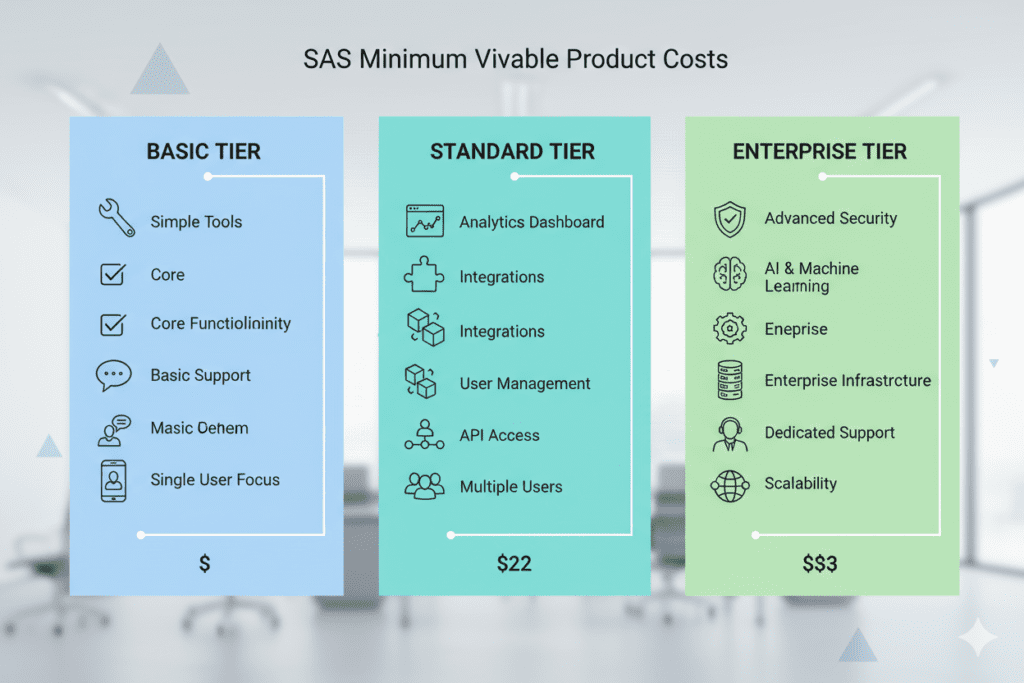
According to current market data and real-world projects in 2026, the cost to build SaaS MVP falls into three broad categories:
1. Basic SaaS MVP: $30,000 – $55,000 This is your lean validation machine. Think landing page, basic CRUD operations, simple user authentication, and minimal feature set. Perfect for testing if anyone actually wants what you’re building.
2. Standard SaaS MVP: $55,000 – $140,000 This is the sweet spot for most B2B SaaS products. You get multi-tenant architecture, dashboard functionality, third-party integrations, payment processing, and enough polish to actually charge customers.
3. AI-Powered or Enterprise SaaS MVP: $140,000 – $300,000+ If you’re building something that requires AI/ML features, complex compliance (HIPAA, SOC2), enterprise-grade security, or advanced automation, you’re playing in the big leagues. This is where the cost to build SaaS MVP starts looking more like building a full product.
But here’s the catch: these are just baseline numbers. The actual cost to build SaaS MVP for YOUR specific idea depends on about fifteen different variables, and most founders only consider three or four of them when they start budgeting.
The Real Cost Breakdown: Where Your Money Actually Goes
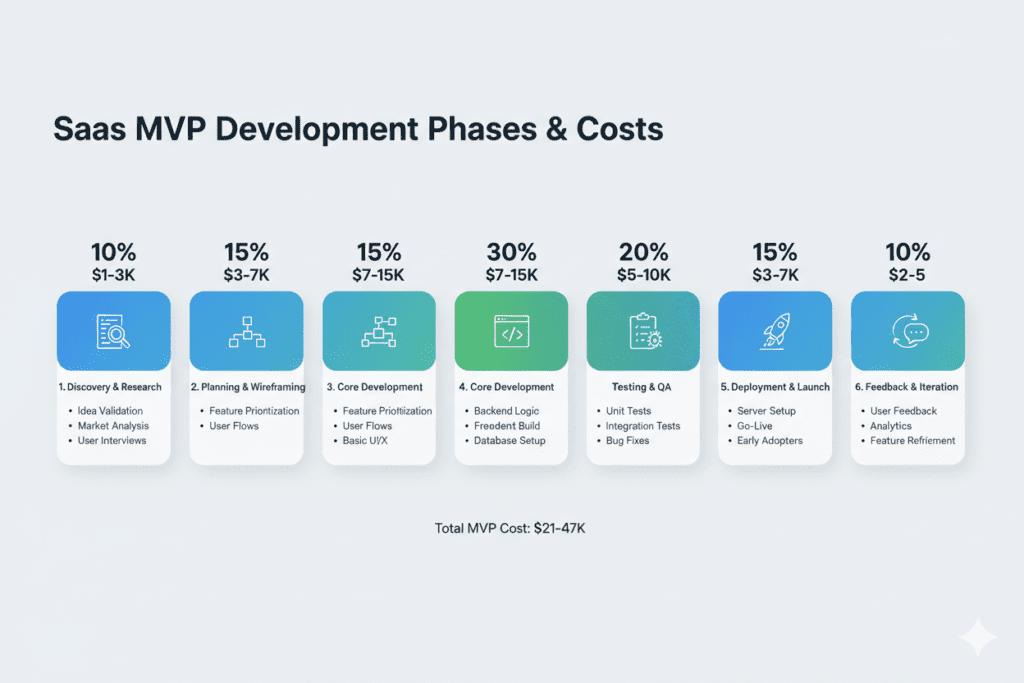
Let’s get specific. When you pay to build a SaaS MVP, you’re not just paying for “coding.” You’re investing in six distinct phases, each with its own price tag and its own potential for cost overruns.
Phase 1: Discovery & Planning ($5,000 – $15,000)
This is the phase most first-time founders try to skip—and it always comes back to haunt them.
What it includes:
- Market research and competitive analysis
- User persona development
- Feature prioritization (MoSCoW framework)
- Technical architecture planning
- Technology stack selection
- Risk assessment and compliance review
Real cost example: At BkAbhi, we’ve seen founders waste $40,000+ rebuilding their MVP because they skipped proper planning. One client came to us after burning $65,000 with another developer who built the wrong product—because nobody took the time to validate what users actually needed.
Percentage of total MVP budget: 10-15%
The discovery phase answers critical questions like: “Do we need real-time features?” “What’s our data model?” “How will we handle multi-tenancy?” Get these wrong, and you’re rebuilding from scratch six months in.
Phase 2: Design & UX ($8,000 – $25,000)
Here’s a controversial take: most SaaS MVPs are over-designed. You don’t need pixel-perfect animations and micro-interactions in version 0.1. But you absolutely need clean, intuitive UX that doesn’t make users rage-quit within five minutes.
What it includes:
- Wireframing and user flow mapping
- UI design for core screens
- Component library creation
- Responsive design specifications
- Basic brand identity (if needed)
Percentage of total MVP budget: 15-20%
The cost to build SaaS MVP can balloon quickly if you’re perfecting every button state and animation. Focus on clarity and usability first. Instagram’s original MVP was borderline ugly—but it worked flawlessly.
Phase 3: Core Development ($25,000 – $100,000)
This is where the rubber meets the road. Development costs represent 50-60% of your total cost to build SaaS MVP, and it’s also where estimates go sideways most often.
Frontend Development ($12,000 – $45,000):
- React, Vue.js, or Angular implementation
- Component development and state management
- API integration on the client side
- Responsive implementation across devices
Backend Development ($13,000 – $55,000):
- Database schema design and implementation
- RESTful or GraphQL API development
- Authentication and authorization systems
- Business logic implementation
- Third-party service integrations
- Multi-tenant architecture (if applicable)
The 2026 reality: Modern SaaS MVP development increasingly relies on serverless architecture and Backend-as-a-Service (BaaS) platforms. This can reduce initial costs by 25-40%, but introduces ongoing operational expenses that many founders forget to budget for.
Real example: A project management SaaS we worked on at BkAbhi initially estimated $55,000 for development. Four months in, the founder realized they needed real-time collaboration features (think Google Docs-style concurrent editing). That “small addition” added $18,000 to the bill and pushed the timeline back six weeks.
Phase 4: Testing & QA ($5,000 – $20,000)
Skipping proper QA is like skipping a parachute check before jumping out of a plane. Sure, you’ll save time and money upfront—but the landing is going to hurt.
What it includes:
- Functional testing across all features
- Cross-browser and device testing
- Security vulnerability assessment
- Performance and load testing
- User acceptance testing (UAT)
- Bug fixing and iteration
Percentage of total MVP budget: 10-15%
The cost to build SaaS MVP doesn’t end when the code compiles. One critical bug discovered by your first paying customer can cost you that customer, their referrals, and your reputation. Ask yourself: is saving $8,000 on QA worth losing a $50,000 annual contract?
Phase 5: Deployment & Infrastructure Setup ($3,000 – $12,000)
Getting your SaaS MVP live isn’t just hitting a “deploy” button (though modern tools make it feel that way). Proper infrastructure setup is critical for scale and security.
What it includes:
- Cloud infrastructure setup (AWS, Google Cloud, or Azure)
- Domain and SSL certificate configuration
- CDN setup for global performance
- Database deployment and backup configuration
- Monitoring and alerting systems
- CI/CD pipeline implementation
Percentage of total MVP budget: 5-10%
2026 factor: Most startups now use Platform-as-a-Service (PaaS) solutions like Vercel, Railway, or Render for their MVP. This reduces setup complexity but increases monthly operational costs. Budget $200-$800/month for infrastructure once you’re live.
Phase 6: Post-Launch Support & Iteration ($5,000 – $15,000 for first 3 months)
Here’s the part nobody tells you: launching your MVP is just the beginning. The real work—and real cost—starts when actual users touch your product.
What it includes:
- Bug fixes for issues users discover
- Performance optimization based on real usage
- Small feature tweaks and adjustments
- User onboarding improvements
- Analytics implementation and monitoring
Percentage of initial MVP budget: 15-20% of your original cost annually
Critical reality check: The most successful SaaS products allocate at least $15,000-$25,000 for the first three months post-launch. This is your “iteration runway”—the budget that lets you respond to user feedback and fix the gaps you didn’t know existed.
Michael’s mistake wasn’t just underestimating development costs. He spent 100% of his budget on building version 1.0 and had nothing left to fix the problems users discovered in week one.
The Hidden Costs Nobody Talks About (But Everyone Pays)
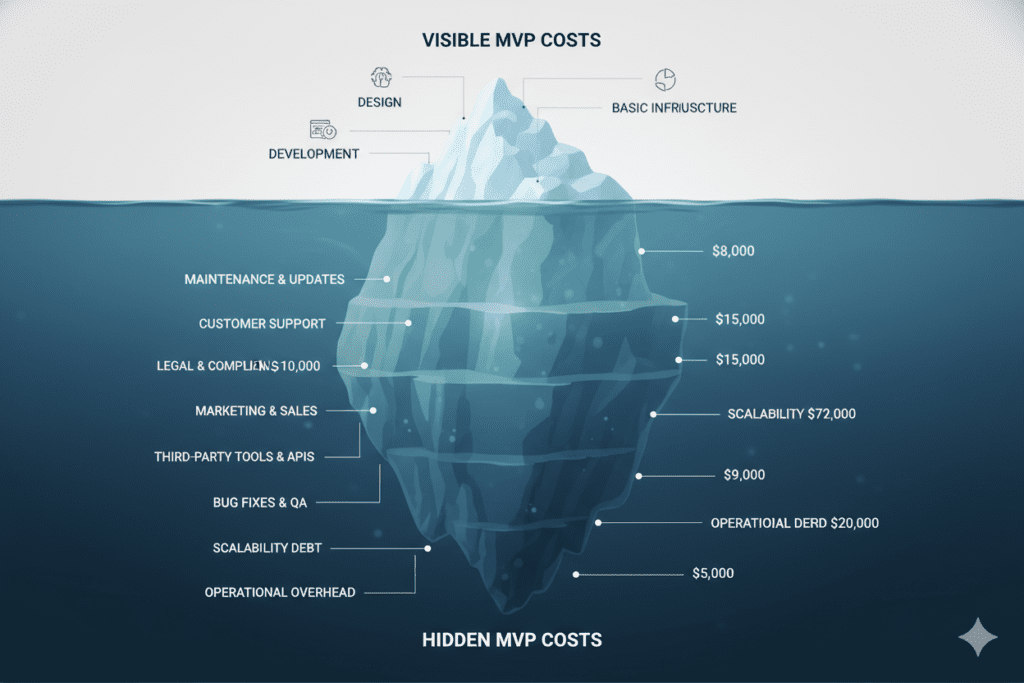
If you’re budgeting the exact amount your developer quoted you for the cost to build SaaS MVP, I have bad news: you’re going to run out of money.
Why? Because beyond the obvious development phases, there are hidden costs that materialize like ninjas in the night, silently draining your runway.
Hidden Cost #1: Third-Party Services & APIs ($200 – $1,500/month)
Your SaaS MVP doesn’t exist in a vacuum. You’ll need:
- Email service (SendGrid, Mailgun): $50-200/month
- Authentication provider (Auth0, Firebase Auth): $0-300/month
- Payment processing (Stripe, PayPal): 2.9% + $0.30 per transaction
- Analytics (Mixpanel, Amplitude): $0-400/month
- Customer support (Intercom, Zendesk): $80-200/month
- Error monitoring (Sentry, Rollbar): $30-100/month
- Cloud storage (AWS S3, Cloudinary): $20-300/month
Annual cost: $3,600 – $18,000
These costs scale with usage. That $200/month total when you have 50 users? It becomes $1,200/month at 500 users. Budget accordingly.
Hidden Cost #2: Compliance & Legal ($2,000 – $25,000)
If your SaaS touches personal data (and it probably does), you need to worry about compliance from day one.
GDPR compliance: If you have any European users, GDPR isn’t optional. Legal review and implementation can cost $3,000-$8,000.
HIPAA compliance: Building health tech? Add $20,000-$50,000 to your cost to build SaaS MVP just for HIPAA-ready infrastructure and audits.
Terms of Service & Privacy Policy: Professional legal documents (not templates): $1,500-$4,000
PCI-DSS compliance: If you’re processing credit cards, budget $5,000-$15,000 for PCI compliance measures.
Real example: A healthcare scheduling SaaS we consulted for initially budgeted $65,000 for their MVP. They completely forgot about HIPAA compliance. Final cost to launch: $102,000—a 57% overrun purely due to regulatory requirements.
Hidden Cost #3: Initial Marketing & User Acquisition ($10,000 – $30,000)
Building your SaaS MVP is useless if nobody uses it. You need users to validate your product—and acquiring users costs money.
In 2026, the average cost per acquisition (CPA) for B2B SaaS ranges from $50 to $200+ per user. If you need 100 early users to validate your MVP, that’s $5,000-$20,000 just in acquisition costs.
Budget for:
- Landing page optimization and A/B testing
- Initial paid advertising (Google Ads, LinkedIn, etc.)
- Content marketing and SEO foundation
- Early customer outreach and sales efforts
- Beta tester incentives
The harsh truth: Founders who spend 100% of their budget on building and 0% on user acquisition end up with a beautiful product that nobody knows exists. Plan to spend at least 10-15% of your total cost to build SaaS MVP on getting it in front of real users.
Hidden Cost #4: Technical Debt Repayment ($15,000 – $50,000)
Here’s the dirty secret about MVPs: they’re built fast, not perfect. That’s intentional. But the shortcuts taken to launch quickly create “technical debt”—code that works now but will need to be refactored later.
When you hit product-market fit and need to scale from 100 users to 10,000 users, that technical debt comes due. Hard.
Common technical debt costs:
- Database optimization for scale: $5,000-$15,000
- Refactoring monolithic code into microservices: $10,000-$25,000
- Security hardening and penetration testing: $3,000-$10,000
- Performance optimization: $5,000-$12,000
Smart strategy: Budget 20-30% of your initial cost to build SaaS MVP as a “scale fund” for when (not if) you need to pay down technical debt.
Hidden Cost #5: Founder Time & Opportunity Cost
This one doesn’t show up on invoices, but it’s real. If you’re a technical founder building your own MVP, you’re not paying cash—but you’re spending something more valuable: time.
At a $150K annual salary (typical for senior engineers in 2026), your time costs about $75/hour. If building your MVP takes 6 months of full-time work, that’s $75,000 in opportunity cost—what you could have earned staying at your job.
Non-technical founders face a different calculation: the learning curve and coordination overhead. Managing developers, making technical decisions without deep expertise, and iterating on specs can easily consume 30-40 hours per week—time that’s not spent on business development, fundraising, or customer discovery.
How Geography Impacts the Cost to Build SaaS MVP in 2026
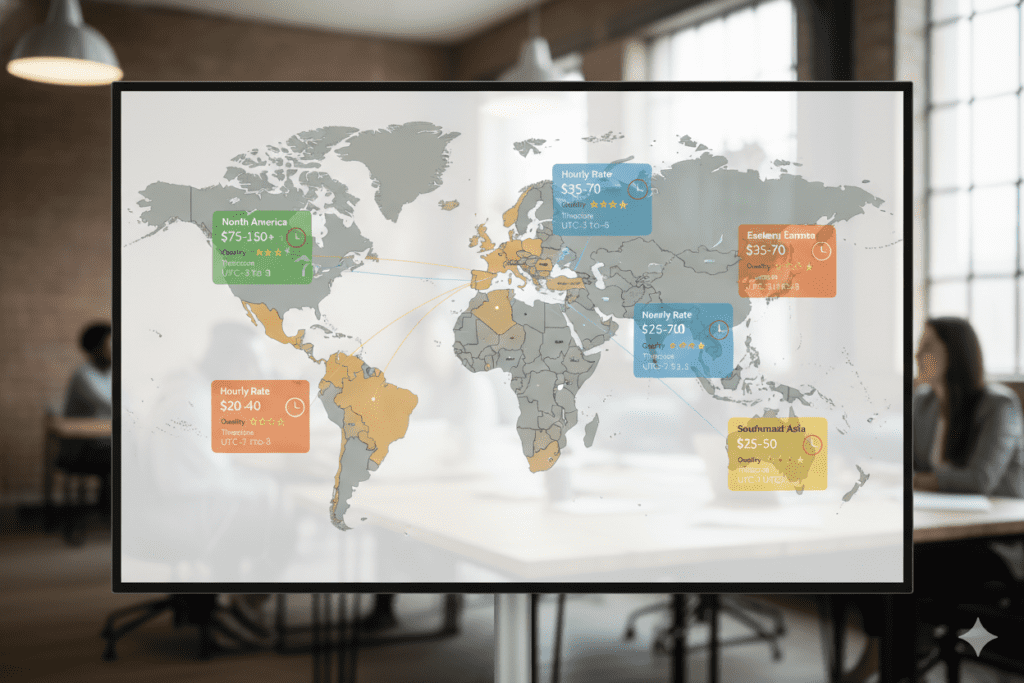
Where you hire your development team dramatically affects the cost to build SaaS MVP. But it’s not just about finding the cheapest option—it’s about finding the right balance of cost, quality, communication, and timezone alignment.
North America: $100 – $200/hour
Total MVP cost range: $80,000 – $200,000+
Pros:
- Same timezone and cultural alignment
- Easy communication and collaboration
- Strong understanding of US/Canadian market needs
- Highest technical expertise on average
- Best for complex, mission-critical SaaS
Cons:
- Highest hourly rates
- Can exhaust seed funding quickly
- May be overkill for simple MVPs
Best for: FinTech, HealthTech, or enterprise SaaS where compliance and security are non-negotiable.
Western Europe: $80 – $150/hour
Total MVP cost range: $60,000 – $150,000
Pros:
- High-quality development standards
- Strong English proficiency
- GDPR expertise built-in
- Similar business culture to North America
- Excellent for European market entry
Cons:
- Timezone overlap challenges with US West Coast
- Still premium pricing
- Holiday schedules can impact timelines
Best for: SaaS targeting European markets or requiring GDPR compliance from day one.
Eastern Europe: $50 – $80/hour
Total MVP cost range: $40,000 – $100,000
Pros:
- Excellent quality-to-cost ratio
- Strong technical education systems
- Good English proficiency
- Timezone overlap with both US and Asia
- Rich talent pool in major tech hubs
Cons:
- 5-8 hour timezone difference from US
- Potential communication delays
- Cultural differences in project management
Best for: Most B2B SaaS MVPs where you need balance between quality and cost.
Latin America: $40 – $70/hour
Total MVP cost range: $30,000 – $80,000
Pros:
- Better timezone alignment with North America
- Growing tech talent pool
- Cultural similarities with US business practices
- Increasingly strong English fluency
- Excellent for US-based remote teams
Cons:
- Quality can vary significantly by region
- Less specialized expertise in cutting-edge tech
- Infrastructure reliability concerns in some areas
Best for: Consumer SaaS, mobile apps, and MVPs needing quick iteration cycles with US-based teams.
Asia (India, Philippines, Vietnam): $30 – $60/hour
Total MVP cost range: $25,000 – $70,000
Pros:
- Lowest hourly rates
- Massive talent pool
- Strong technical universities
- Experience with global clients
- Good for stretching limited budgets
Cons:
- Significant timezone challenges (10-12 hour difference)
- Communication barriers can slow progress
- Quality varies widely between agencies
- May require more hands-on management
- Higher likelihood of scope creep
Best for: Technical founders who can provide detailed specs and active oversight, or simple MVPs where cost is the primary concern.
The BkAbhi Perspective: Geography Isn’t Everything
At BkAbhi, we’ve worked with teams across all these regions. Here’s what we’ve learned: the lowest hourly rate rarely translates to the lowest total cost to build SaaS MVP.
Why? Because a $40/hour developer who takes 800 hours due to miscommunication and rework costs you $32,000. A $100/hour developer who gets it right the first time and completes it in 400 hours costs you $40,000—but saves you three months and countless headaches.
The factors that matter more than hourly rate:
- Communication efficiency: How quickly can you iterate on feedback?
- Technical expertise: Do they understand modern SaaS architecture?
- Autonomy: Do they need constant direction or can they solve problems independently?
- Cultural fit: Do they understand your market and users?
The cost to build SaaS MVP is about total project cost, not hourly rates. Choose developers who can deliver quality within your timeline, not just the cheapest option.
Breaking Down Cost by SaaS Type: Real Examples from 2026
Not all SaaS products are created equal, and the cost to build SaaS MVP varies dramatically based on what you’re actually building. Let’s examine real examples across different SaaS categories.
B2B Project Management Tool
Example: Basic task management with teams, projects, and collaboration
Core features:
- User authentication and team management
- Project and task CRUD operations
- Real-time updates (WebSocket integration)
- File uploads and sharing
- Basic reporting dashboard
- Email notifications
- Third-party calendar integration
Estimated cost to build SaaS MVP: $55,000 – $85,000
Timeline: 3-4 months
Key cost drivers:
- Real-time collaboration features add $8,000-$12,000
- File storage and management adds $5,000-$8,000
- Calendar integrations add $3,000-$5,000
CRM Platform
Example: Customer relationship management with sales pipeline
Core features:
- Contact and company management
- Sales pipeline visualization
- Email integration and tracking
- Activity logging and notes
- Custom fields and tags
- Reporting and analytics
- Email templates and sequences
Estimated cost to build SaaS MVP: $65,000 – $100,000
Timeline: 4-5 months
Key cost drivers:
- Email integration (Gmail, Outlook) adds $8,000-$15,000
- Pipeline drag-and-drop functionality adds $5,000-$8,000
- Custom reporting engine adds $10,000-$15,000
E-commerce Analytics Platform
Example: Shopify analytics and insights dashboard
Core features:
- Shopify API integration
- Data visualization dashboard
- Sales trends and forecasting
- Customer segmentation
- Inventory insights
- Revenue analytics
- Alert system for key metrics
Estimated cost to build SaaS MVP: $70,000 – $110,000
Timeline: 4-6 months
Key cost drivers:
- Complex data processing and ETL pipelines add $12,000-$20,000
- Advanced visualization libraries add $8,000-$12,000
- Forecasting algorithms add $10,000-$15,000
AI-Powered Content Tool
Example: AI writing assistant for marketing teams
Core features:
- User authentication and workspace management
- AI content generation (GPT-4 integration)
- Template library
- Content editing and formatting
- Collaboration features
- Usage tracking and limits
- Payment processing for credits
Estimated cost to build SaaS MVP: $95,000 – $160,000
Timeline: 5-7 months
Key cost drivers:
- OpenAI API integration and optimization adds $15,000-$25,000
- Complex credit system and usage tracking adds $10,000-$15,000
- Rich text editor and formatting adds $8,000-$12,000
- Higher ongoing API costs ($500-$2,000/month once live)
Healthcare Scheduling Platform
Example: Patient appointment booking for medical practices
Core features:
- Multi-practice and provider management
- Calendar and availability system
- Patient portal and booking interface
- Automated reminders (email/SMS)
- Basic EHR integration
- HIPAA-compliant infrastructure
- Reporting and analytics
Estimated cost to build SaaS MVP: $120,000 – $180,000
Timeline: 6-8 months
Key cost drivers:
- HIPAA compliance requirements add $20,000-$35,000
- EHR integration (HL7/FHIR standards) adds $15,000-$25,000
- Complex scheduling logic adds $12,000-$18,000
- SMS notification system adds $5,000-$8,000
Fintech Payment Dashboard
Example: Payment analytics for e-commerce businesses
Core features:
- Stripe/PayPal API integration
- Transaction monitoring dashboard
- Payment reconciliation tools
- Fraud detection alerts
- Multi-currency support
- Automated reporting
- SOC 2 compliant infrastructure
Estimated cost to build SaaS MVP: $140,000 – $220,000
Timeline: 6-9 months
Key cost drivers:
- Financial API integrations add $18,000-$30,000
- SOC 2 compliance infrastructure adds $25,000-$40,000
- Advanced fraud detection algorithms add $15,000-$25,000
- Multi-currency handling adds $8,000-$12,000
The pattern: As you move from simple tools to regulated industries (healthcare, finance), the cost to build SaaS MVP increases by 2-3x, primarily due to compliance, security, and integration requirements.
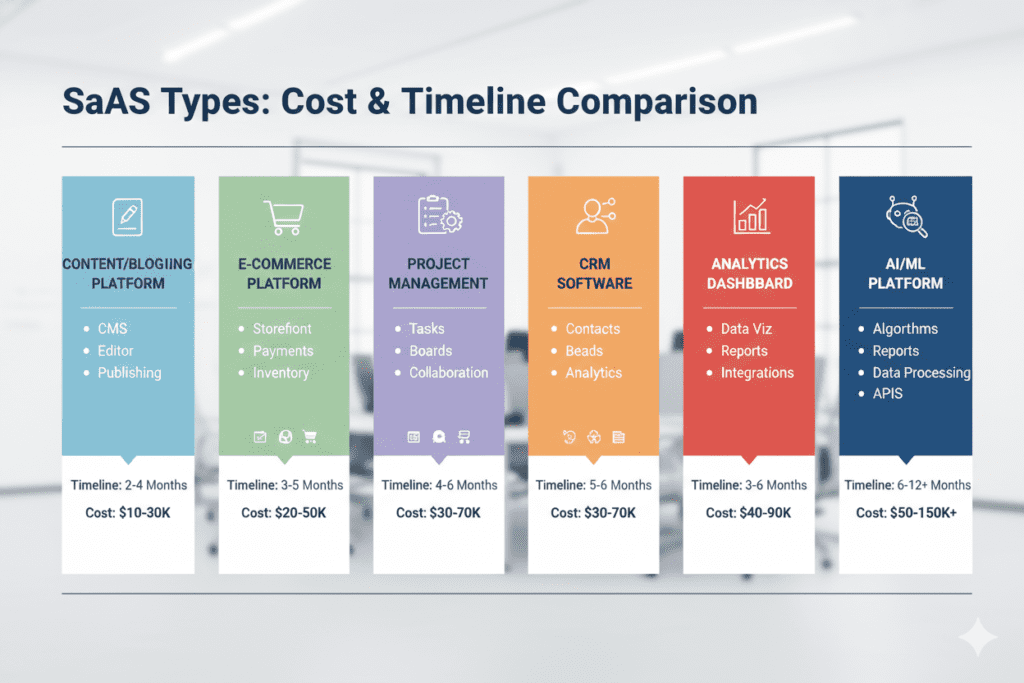
How to Dramatically Reduce Your Cost to Build SaaS MVP (Without Sacrificing Quality)
Okay, you’ve seen the numbers. Maybe you’re panicking a little because your budget is $40,000 but you need to build something in the $80,000 range. Don’t panic yet—there are legitimate ways to cut the cost to build SaaS MVP without building garbage.
Strategy #1: Ruthlessly Prioritize Features
The single biggest cost driver in MVP development is feature creep. You start with “I just need basic task management” and end up with “Oh, and real-time collaboration, and Slack integration, and advanced reporting, and mobile apps, and…”
The MoSCoW Method:
- Must Have: Features without which your MVP doesn’t solve the core problem
- Should Have: Important but not critical for initial validation
- Could Have: Nice additions if budget allows
- Won’t Have: Explicitly deferred to post-MVP
Real example: A founder came to BkAbhi wanting to build a scheduling tool for fitness trainers. Their initial spec included:
- Calendar booking ✅ (Must Have)
- Payment processing ✅ (Must Have)
- Automated reminders ✅ (Must Have)
- Workout plan builder ❌ (Could Have)
- Nutrition tracking ❌ (Could Have)
- Social feed for clients ❌ (Won’t Have)
- Mobile app for trainers ❌ (Should Have – Phase 2)
By ruthlessly prioritizing, we cut their cost to build SaaS MVP from $95,000 to $58,000. They launched in 4 months instead of 7, validated the concept, and raised funding to build Phase 2 with the “Should Have” features.
Action item: Write down every feature you think your MVP needs. Now cut 60% of them. If that sounds terrifying, you’re doing it right.
Strategy #2: Leverage No-Code/Low-Code for Validation
This is controversial in developer circles, but here’s the truth: you don’t always need custom code to validate your SaaS idea.
Tools worth considering:
- Bubble.io: Full-featured no-code web app builder
- Webflow: For landing pages and simple SaaS frontends
- Airtable + Softr: Database-backed apps without coding
- Make (Integromat) + Retool: For complex workflow automation and internal tools
When this works:
- You’re validating business model, not technology
- Your differentiator is the solution, not technical innovation
- You need to get to market in 4-6 weeks, not 4-6 months
- Your budget is under $20,000
When this doesn’t work:
- You need real-time features or complex algorithms
- You’re in a regulated industry (healthcare, finance)
- You need custom API integrations
- Your scale plan requires optimal performance
Real example: A property management SaaS used Airtable + Softr for their first 6 months. Cost to build: $8,000. They signed 23 paying customers at $99/month. Once they validated demand, they invested $75,000 in a proper custom build. Total cost to find product-market fit: $83,000 instead of burning $75,000 before having a single customer.
The cost to build SaaS MVP using no-code can be 60-80% lower than custom development, but with limitations. Use it for validation, not your final product.
Strategy #3: Use Open-Source and Pre-Built Solutions
Why build from scratch what someone else already built for free?
Open-source components that save thousands:
- Authentication: NextAuth.js, Supabase Auth (saves $3,000-$8,000)
- Admin Dashboard: React-Admin, Refine (saves $5,000-$12,000)
- Payment Processing: Stripe Checkout (saves $4,000-$8,000)
- Email Services: React Email + Resend (saves $2,000-$5,000)
- Charts/Analytics: Recharts, Chart.js (saves $3,000-$6,000)
SaaS boilerplates worth considering:
- Shipped: Next.js SaaS boilerplate ($299 one-time)
- SaaS UI: React component library for SaaS ($499 one-time)
- Gravity: Laravel SaaS starter kit ($399 one-time)
Savings: Using a quality SaaS boilerplate can reduce your cost to build SaaS MVP by $15,000-$30,000 by eliminating common setup work (auth, billing, admin, email, etc.).
Caveat: Boilerplates work best when your product fits their architecture. If you need heavy customization, you might end up fighting the boilerplate instead of benefiting from it.
Strategy #4: Build Web-First, Mobile Later
Here’s a fact that will save you $30,000: you probably don’t need a mobile app for your MVP.
Why web-first makes sense:
- Development cost 40-50% lower than native mobile
- Faster iteration and updates (no app store review process)
- One codebase to maintain
- Progressive Web Apps (PWAs) provide mobile-like experience
- Desktop users still dominate B2B SaaS usage
When you DO need mobile:
- Your product requires camera, GPS, or other device hardware
- Your users are primarily mobile (consumer apps, field services)
- Your competitors all have mobile apps and it’s table stakes
Savings: Building web-only instead of web + iOS + Android reduces your cost to build SaaS MVP by $30,000-$60,000 for the initial launch.
Strategy #5: Bootstrap with Hybrid Team Model
You don’t need to choose between “expensive US agency” and “cheap offshore freelancer.” Mix and match.
Hybrid model that works:
- US-based Product Manager/Tech Lead ($8,000-$15,000): Owns strategy, architecture, and quality control
- Eastern Europe Development Team ($30,000-$50,000): Handles core development work
- Your Time as Product Owner (Free but valuable): Defines requirements, tests features, manages communication
Savings: This hybrid approach typically costs 30-40% less than an all-US team while maintaining quality and avoiding the communication challenges of pure offshore development.
Real example from BkAbhi: We often work as the “Tech Lead” layer for founders who’ve hired offshore teams. We charge $6,000-$10,000 to provide architecture guidance, code review, and quality oversight—ensuring the offshore team delivers quality work on time. Our clients save $20,000-$40,000 compared to using a full US agency, while avoiding the common offshore pitfalls.
Here you can also visit all in one ai tool-Aizolo
Strategy #6: Build in Public and Pre-Sell
The cheapest cost to build SaaS MVP is someone else’s money. Seriously.
Pre-selling your MVP works when:
- You have a warm audience (email list, social following, professional network)
- Your idea solves a painful, expensive problem
- You can clearly communicate the value proposition
- You’re willing to work closely with early customers
Pre-selling strategies:
- Launch a waitlist with early-bird pricing (50% off)
- Offer “Founding Member” lifetime deals
- Run a crowdfunding campaign (for consumer SaaS)
- Sell “concierge MVP” services before building automation
Real example: Buffer pre-sold their SaaS using just a landing page and pricing table—before writing a single line of code. They validated willingness to pay and collected emails. Only after confirming demand did they invest in building.
If you can pre-sell $15,000-$30,000 in annual contracts, you’ve just funded a significant portion of your cost to build SaaS MVP. Plus, you’ve validated that people will actually pay for your solution—the hardest thing to prove.
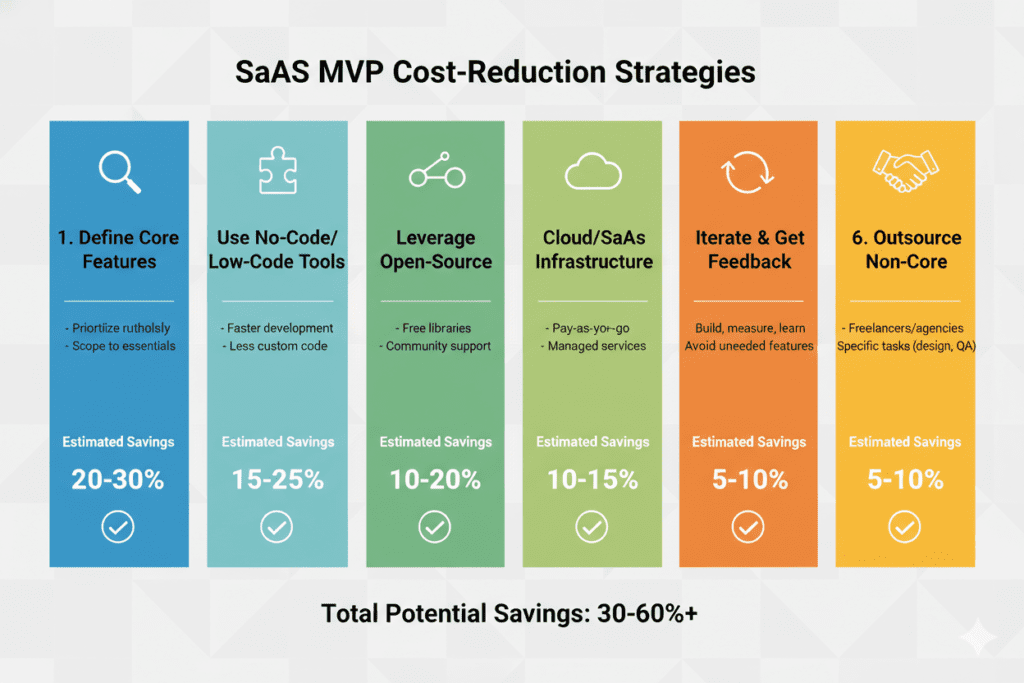
The Biggest Mistake Founders Make When Budgeting SaaS MVP Costs
Remember Michael from the beginning of this article? His biggest mistake wasn’t underestimating the cost to build SaaS MVP. It was spending his ENTIRE budget on building version 1.0.
Here’s the golden rule that successful founders follow:
Never spend more than 60-70% of your available capital on the initial MVP build.
Why? Because the real learning happens