
The Midnight Panic Every Founder Knows
It’s 11:47 PM. You’ve just finished another 14-hour day on your “revolutionary” SaaS idea. Your savings are dwindling. Your co-founder is getting nervous. And that competitor you discovered last week? Build SaaS MVP in 2 weeks They just announced their beta launch.
You’re stuck in what I call the “Founder’s Paradox”: You need to move fast, but you’re terrified of building the wrong thing. You want to launch quickly, but you’re drowning in feature ideas. You know an MVP is the answer, but everywhere you look, “experts” say it takes 3-6 months minimum.
Here’s the truth nobody tells you: You can build a SaaS MVP in 2 weeks—if you know exactly what to cut, what to keep, and how to move with surgical precision.
I’ve seen it happen. I’ve helped make it happen. And in this guide, I’m going to show you exactly how to do it, without the fluff, without the theory, and without the BS that most MVP guides are full of.
This isn’t about cutting corners. It’s about cutting through the noise.
Why Most “2-Week MVP” Claims Are Lies (And When It’s Actually Possible)
Let’s address the elephant in the room: Most articles promising you can build a SaaS MVP in 2 weeks are either lying or talking about a landing page with a signup form.
That’s not an MVP. That’s marketing theater.
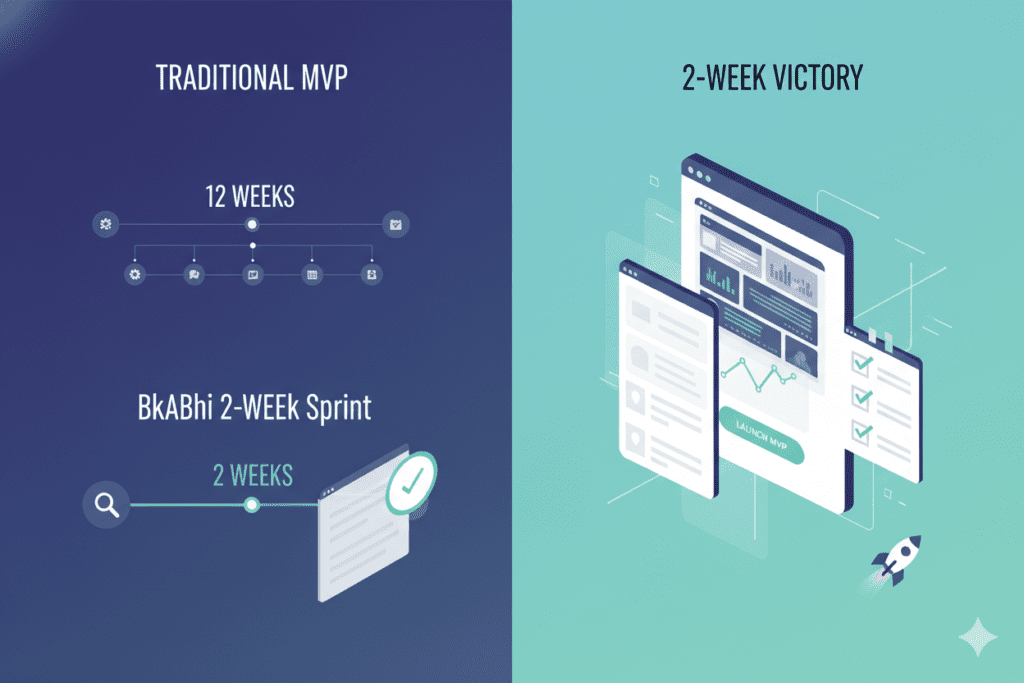
A real MVP—one that delivers actual value, processes real data, and solves a real problem—typically takes 8-12 weeks with a traditional approach. The 2-week timeline is achievable, but only under specific conditions:
You CAN build a SaaS MVP in 2 weeks if:
- You’re solving ONE specific problem exceptionally well (not five problems adequately)
- You’re willing to use no-code/low-code tools strategically
- You have clarity on your core feature BEFORE you start building
- You’re comfortable launching “embarrassingly simple” (as the best founders do)
- You have either technical skills or a technical co-founder/partner who can execute quickly
You CANNOT build it in 2 weeks if:
- You’re building a complex multi-sided marketplace
- You need extensive third-party integrations
- You’re in a heavily regulated industry (fintech, healthtech) requiring compliance
- You’re trying to replicate Slack, Notion, or Salesforce in miniature
- You haven’t validated the problem with real potential customers
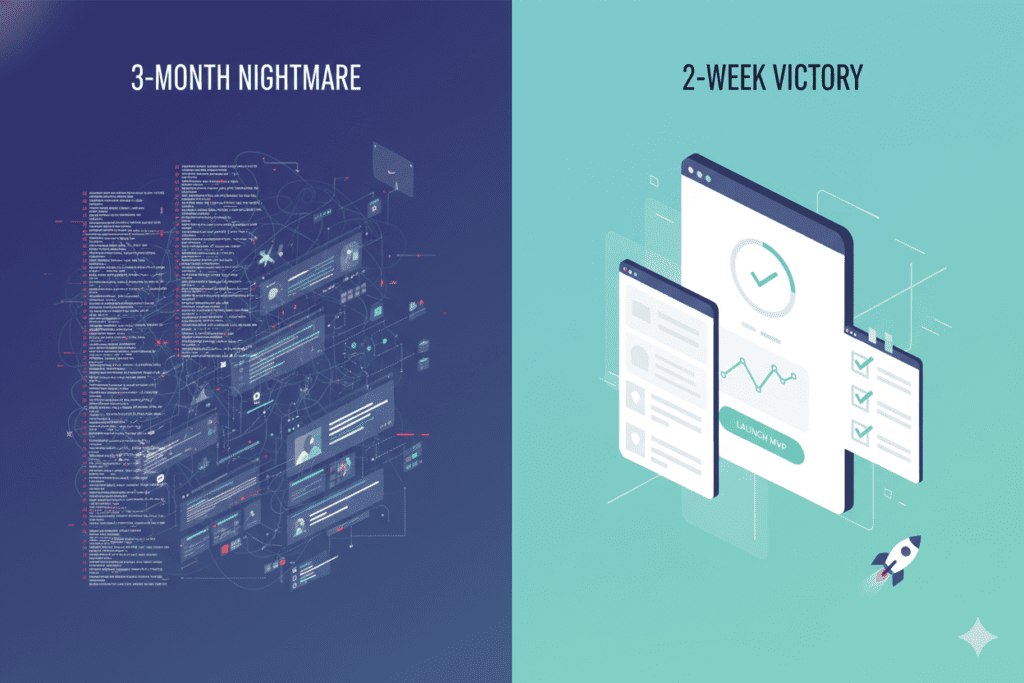
The difference between a 2-week sprint and a 3-month slog comes down to one thing: build SaaS MVP fast ruthless prioritization.
The Problem: Why Founders Waste Months Building What Nobody Wants
Before we dive into the how, let’s understand the why. Why do smart, build SaaS MVP fast capable founders spend 6 months building something that gets 47 signups and zero revenue?
The Feature Fallacy
Most founders confuse “viable” with “complete.” They think their MVP needs:
- User profiles with customizable avatars
- Real-time notifications
- Advanced search with filters
- Social sharing capabilities
- Dark mode
- Mobile responsiveness across 12 devices
- Integration with 8 different tools
By the time they build all this, the market has moved, their competitor has launched, and they’re out of runway.
Here’s what actually happened to Sarah, a founder I advised last year. She spent 5 months building a “simple” project management tool with 23 features. When she finally launched, she got 12 users. When I asked what feature they used most, it was literally just the task creation function. Everything else? build SaaS MVP fast Ignored.
We stripped her product down to just that core feature, rebuilt it in 2 weeks, and relaunched. 300 users in the first month. Why? build SaaS MVP fast Because it did ONE thing brilliantly instead of 23 things poorly.
The Perfection Prison
The second trap is waiting for “just one more feature” before launch. Founders tell themselves:
- “I’ll launch once I add that API integration”
- “I need to polish the UI first”
- “Let me just build the admin dashboard”
- “Users will expect this basic feature”
Meanwhile, their competitor launches with 40% of the features and captures the market.
Jeff Bezos has a quote that haunts most successful founders: “If you’re not embarrassed by the first version of your product, build SaaS MVP fast you’ve launched too late.”
Most founders who successfully build a SaaS MVP in 2 weeks share one trait: They’re comfortable with embarrassingly simple.
The BkAbhi Approach: Building Smart, Not Just Fast
At BkAbhi, we’ve seen the full spectrum—from founders who rush and regret it, build SaaS MVP fast to those who overthink and miss their window. Through dozens of projects, we’ve developed a framework that balances speed with strategic thinking.
When clients come to us saying they need to build a SaaS MVP in 2 weeks, we don’t immediately say yes. We start with three questions:
- What’s the ONE problem you’re solving? (Not three. Not “workflow optimization.” One specific, painful problem.)
- Who feels this pain most acutely? (Not “small businesses.” Not “freelancers.” A specific persona with a specific context.)
- What’s the simplest possible solution? (Not the cleverest. Not the most innovative. The simplest.)
This might seem like basic startup advice, but you’d be shocked how many founders skip straight to wireframes without answering these questions properly.
Real-World Example: The Email Parser MVP
A founder approached us wanting to build an “AI-powered email management system.” build SaaS MVP fast Sounds impressive. Totally wrong for a 2-week MVP.
We dug deeper:
- The real problem: Marketing agencies waste 3 hours daily manually extracting client feedback from email threads
- The painful persona: Agency account managers handling 15+ client projects
- The simplest solution: Upload email thread → Get structured feedback report
We built this in 11 days. No AI (we used basic regex and string matching). No fancy dashboard. Just a simple upload interface and a downloadable CSV.
It looked basic. It felt basic. Clients loved it because it solved their actual problem.
Three months later, with paying users and real feedback, we added the AI features. build SaaS MVP fast But they launched first, validated demand, build SaaS MVP fast and built exactly what users needed—not what they guessed users might want.
This is the BkAbhi philosophy: Launch lean, learn fast, iterate based on reality.
Week 1: Validation & Foundation (Days 1-7)
Most guides tell you to start coding immediately. That’s backwards. The fastest way to build a SaaS MVP in 2 weeks is to spend the first week ensuring you’re building the right thing.
Days 1-2: Crystal-Clear Problem Definition
You need radical clarity. Not “people struggle with project management.” Instead:
Bad: “Freelancers need better time tracking”
Good: “Freelance designers working with 5+ clients simultaneously lose 4-6 hours weekly to manual time entry across multiple platforms, causing billing disputes build SaaS MVP fast and cash flow problems”
See the difference? The second version tells you exactly what to build.
Your Action Plan:
- Interview 5-10 people who have this exact problem
- Document their current workaround (this is gold—you’re making their workaround 10x better)
- Identify the single most painful step in their current process
- Get them to describe their ideal solution in under 30 seconds
Pro tip from BkAbhi: If you can’t explain your MVP in one clear sentence, build SaaS MVP fast you don’t understand it well enough to build it in 2 weeks.
Days 3-4: Feature Ruthlessness
Here’s where most founders fail. They make a list of 40 features and try to pick the “top 10.”
Wrong approach.
Instead, use what we call the “One-Feature Rule.” Your 2-week MVP gets ONE core feature. build SaaS MVP fast Everything else supports that one feature or doesn’t exist.
The One-Feature Framework:
Core Feature: [The single action that delivers value]
Supporting Elements: [Only what's essential to make the core feature work]
Everything Else: [Delete it. Seriously.]
Real Example – Invoice Reminder Tool:
Core Feature: Automatically send payment reminders to clients
Supporting Elements:
- Basic invoice data input (amount, due date, client email)
- Email sending functionality
- Simple reminder schedule
What We Cut:
- Invoice creation/design tools
- Payment processing
- Client database management
- Expense tracking
- Reports and analytics
- Mobile app
- Multi-currency support
- Team collaboration
Yes, those are all valuable features. For week 12, not week 2.
BkAbhi’s MoSCoW on Steroids:
Traditional MoSCoW gives you Must-have, Should-have, Could-have, Won’t-have. We simplify further:
- Now: The one core feature (this week)
- Never: Everything else (seriously, delete these ideas for now)
This sounds extreme because it is. But extreme focus is the only way to build a SaaS MVP in 2 weeks that actually works.
Days 5-7: Tech Stack Selection & Setup
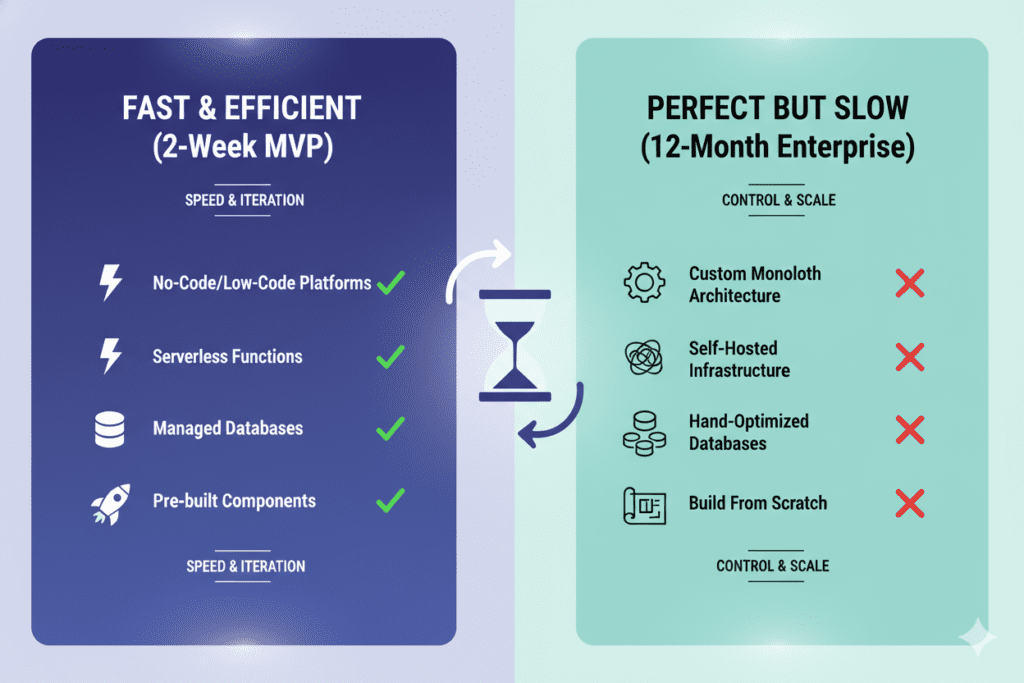
Technology can make or break your 2-week timeline. Forget what’s “best practice.” Choose what’s fastest for YOUR situation.
If you’re technical:
- Frontend: React with a template (CoreUI, Tailwind UI)
- Backend: Whatever you know best (Node.js, Django, Laravel)
- Database: PostgreSQL or Firebase
- Hosting: Vercel (frontend) + Railway (backend) or all-in-one platforms
If you’re non-technical:
- No-code stack: Bubble, Glide, or FlutterFlow
- Low-code option: Webflow + Airtable + Zapier/Make
- Hybrid approach: Buy a template, hire a developer for 20 hours of customization
BkAbhi’s Tech Philosophy:
We don’t chase trends. We use boring, proven technology that works. For a 2-week sprint, build SaaS MVP fast we typically recommend:
- Proven frameworks your team knows (or learn in 48 hours max)
- Services over custom code (Auth0 over custom authentication)
- Templates over custom design (modify, don’t create)
- No-code tools where they make sense (forms, simple workflows)
The Hidden Cost of “Learning”:
Every new technology you adopt adds 2-3 days to your timeline. That new JavaScript framework that’s “way better”? build SaaS MVP fast It’s also way slower when you’re learning it mid-sprint.
Stick with boring. Boring launches products.
Week 2: Build, Test, Launch (Days 8-14)
This is where theory meets reality. You’ve got 7 days to turn your clarity into a working product.
Days 8-10: Core Feature Development
These three days are pure execution. Here’s the brutal schedule that works:
Day 8 – Foundation:
- Set up your basic project structure
- Implement authentication (use Auth0, Clerk, or Supabase—don’t build custom)
- Create your database schema (keep it simple—you can modify later)
- Build the basic UI shell
Day 9 – Core Feature:
- Build the main functionality
- Focus on making ONE user flow work end-to-end
- No error handling beyond the basics
- No edge cases yet
Day 10 – Integration:
- Connect frontend to backend
- Implement the core feature completely
- One working flow from start to finish
- Manual testing as you go
The BkAbhi Development Mindset:
When building to this timeline, we follow these rules:
- Functionality first, polish never (at this stage)
- Happy path only (edge cases are for week 3)
- Manual workarounds are fine (admin tasks you do by hand)
- Copy-paste is your friend (clean code is for later)
- Comment nothing (you’re the only developer for now)
Yes, developers are cringing. But we’re not building production-grade software. We’re building a validation tool that needs to work, not scale to a million users.
Days 11-12: Critical Testing & Fixes
You don’t have time for comprehensive QA. build SaaS MVP fast You need to test the critical path—the one thing that MUST work.
BkAbhi’s Critical Path Testing:
- Can a new user sign up? (5 minutes)
- Can they complete the core action? (the main feature)
- Do they get the expected result?
- Can they do it again?
That’s it. Four checks. If those work, you can launch.
What to ignore:
- Visual bugs that don’t block functionality
- Features you haven’t built yet (obviously)
- Performance optimization
- Browser compatibility beyond Chrome/Safari
- Mobile responsiveness (unless your users are primarily mobile)
Find 3-5 people who match your target user profile. Have them use your MVP with you watching build SaaS MVP fast (screen share is fine). Don’t explain anything—watch where they struggle.
Fix only the blockers—issues that prevent them from completing the core action.
Days 13-14: Launch Preparation & Go-Live
You’re not launching to TechCrunch. build SaaS MVP fast You’re launching to 20-50 early adopters who know you’re showing them something early.
Day 13 – Polish & Prepare:
- Write clear onboarding instructions
- Create a simple help doc or FAQ
- Set up basic analytics (Plausible, Simple Analytics, or just Google Analytics)
- Prepare your launch message
- Set up a feedback mechanism (form, email, calendar for calls)
Day 14 – Launch:
Morning:
- Final smoke test (run through the critical path 3 times)
- Deploy to production
- Test live version
- Send to your early user list (start with 5-10 people)
Afternoon:
- Monitor for critical bugs
- Respond to every piece of feedback
- Watch how people actually use it
This isn’t a fireworks launch. It’s a “hey, I built this thing, want to try it?” launch.
BkAbhi’s Launch Strategy:
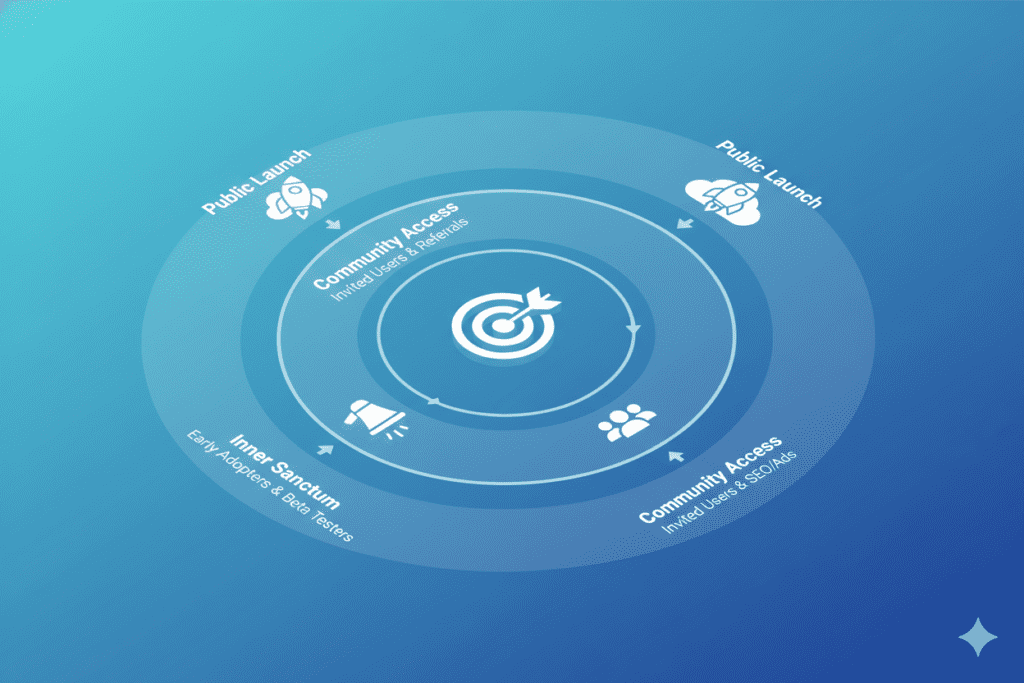
We advise clients to launch in concentric circles:
Circle 1 (Day 14): 5-10 people you personally know Circle 2 (Week 3): Friends of friends, professional network Circle 3 (Week 4): build SaaS MVP fast Public launch (Product Hunt, social media, etc.)
Why? Because launching to 5 people lets you fix major issues before 500 people see them.
Real Use Cases: Who Can Actually Build a SaaS MVP in 2 Weeks?
Let’s get specific. This approach works brilliantly for certain types of SaaS and certain types of founders.
For Solo Founders
Scenario: You’re a technical founder with full-stack skills and a validated problem
Best Fits:
- Internal tools for specific industries
- Workflow automation tools
- Data transformation utilities
- Simple CRUD applications with one clever feature
Example: A developer building a tool to convert Figma designs to React components. build SaaS MVP fast Core feature: Upload Figma file, get React code. That’s it.
For Developer-First Products
Scenario: You’re building tools for other developers
Best Fits:
- API testing tools
- Code snippet managers
- Development workflow helpers
- Documentation generators
Example: BkAbhi recently worked with a founder building a tool that auto-generates API documentation from code comments. build SaaS MVP fast Two weeks from concept to working MVP because the scope was laser-focused.
For Vertical SaaS
Scenario: You deeply understand a niche industry and know their exact pain point
Best Fits:
- Appointment scheduling for specific professions
- Industry-specific calculators or estimators
- Compliance checkers
- Specialized reporting tools
Example: A dental practice management tool that only does one thing—build SaaS MVP fast sends automated appointment reminders with two-way SMS confirmation. Not a full practice management system. Just reminders. Nailed it in 13 days.
For Freelancers & Agencies
Scenario: You’ve identified a repetitive task in your workflow that you can productize
Best Fits:
- Client reporting tools
- Proposal generators
- Time tracking with specific use case
- Simple project dashboards
Example: A design agency built an MVP that converts client feedback emails into organized design revision tasks. They built it for themselves first, build SaaS MVP fast then realized other agencies needed it.
For Non-Technical Founders with Budget
Scenario: You have $3K-8K and can hire for 40-60 hours of focused development
Best Fits:
- No-code/low-code friendly concepts
- Simple marketplaces
- Directory or listing sites
- Form-to-workflow automation
At BkAbhi, we’ve helped non-technical founders build and launch MVPs by combining:
- Pre-built templates (saves 40-50 hours)
- Strategic use of no-code tools for non-critical features
- Focused developer time on the core feature only
What doesn’t work in 2 weeks:
Let me be clear about what you should NOT attempt:
- Two-sided marketplaces (unless incredibly simplified)
- Real-time collaboration tools
- Complex AI/ML implementations
- Heavily regulated industry products requiring compliance
- Social networks or community platforms
- Products requiring complex integrations with 5+ services
These aren’t impossible MVPs—they’re impossible 2-week MVPs. Build them in 8-12 weeks instead.
The 80/20 of SaaS MVP Development
After helping dozens of founders through this process, here’s what actually matters:
The 20% that drives 80% of success:
- Problem Clarity – A perfectly articulated problem is half the solution
- Single Core Feature – One thing done exceptionally well
- Speed to Feedback – Launch ugly, learn fast, iterate quickly
- Technical Confidence – Use what you know or get expert help
- User Access – Having 20 potential users ready to test
The 80% that drives 20% of success:
- Perfect UI/UX design
- Comprehensive feature set
- Scalable architecture
- Extensive documentation
- Marketing website
- SEO optimization
- Social media presence
- Brand identity
I’m not saying these don’t matter. They matter tremendously—in month 3, not week 2.
The hardest lesson for founders to learn: build SaaS MVP fast Your MVP doesn’t need to be good. It needs to be good enough to validate whether you should continue building.
Common Mistakes That Add Weeks to Your Timeline
Let me save you from the mistakes I see repeatedly:
Mistake #1: Building Authentication from Scratch
Don’t. Just don’t. Use Auth0, Supabase Auth, Firebase Auth, build SaaS MVP fast or Clerk. Custom authentication adds 3-5 days minimum. It’s a solved problem. Let someone else solve it.
Mistake #2: Creating Custom UI Components
Buy a template. Seriously. A $49 admin template saves you a week of CSS wrestling. At BkAbhi, we maintain a library of pre-vetted templates we can spin up in hours, not days.
Mistake #3: Building Admin Features
Your first 20 users don’t need an admin panel. You can manually manage user accounts, reset passwords, and handle edge cases via direct database access.
Admin features are for month 2 when you have 100+ users and manual management becomes painful.
Mistake #4: Mobile App Along with Web
Pick one platform. Build for web first (lowest friction). build SaaS MVP fast Mobile can wait unless your product is fundamentally mobile-first (rare for B2B SaaS).
Mistake #5: Trying to Handle Every Edge Case
Your MVP will break. Users will find weird ways to use it. That’s fine. Handle the happy path—the normal, expected usage. Edge cases are features you add based on actual user behavior.
Mistake #6: Over-Engineering for Scale
Your MVP won’t have scaling problems because it won’t have users yet. Don’t optimize for 10,000 concurrent users when you’d be thrilled with 10 total users.
BkAbhi’s Mistake Prevention Checklist:
Before building anything, ask:
- ☑️ Could I use an existing service/API instead of building this?
- ☑️ Could I handle this manually for the first 50 users?
- ☑️ Is this for the core feature or “nice to have”?
- ☑️ Would users pay for this product without this feature?
If you answer yes to questions 1-2, or no to questions 3-4, don’t build it yet.
Tools & Resources for the 2-Week Sprint
Let’s get practical. Here are the exact tools that accelerate development:
No-Code/Low-Code Platforms:
- Bubble.io – Full web apps without code (learning curve: 2-3 days)
- Glide – Turn spreadsheets into apps (learning curve: 4 hours)
- FlutterFlow – Mobile-first apps (learning curve: 1-2 days)
- Webflow – Beautiful frontends fast (learning curve: 1 day)
Backend Services (to avoid building from scratch):
- Supabase – Firebase alternative with PostgreSQL
- Firebase – Real-time database, auth, hosting
- Airtable – Database with built-in API
- Railway – Deploy anything in minutes
Frontend Frameworks & Templates:
- Vercel – Deploy React/Next.js instantly
- Tailwind UI – Pre-built components ($299, worth it)
- CoreUI – Admin templates (free & paid)
- ShadcN – Component library for React
Essential Services:
- Stripe – Payments (use their hosted checkout)
- SendGrid/Postmark – Transactional emails
- Plausible – Privacy-friendly analytics
- Sentry – Error tracking
- Calendly – User interview scheduling
BkAbhi’s Tech Stack for Speed:
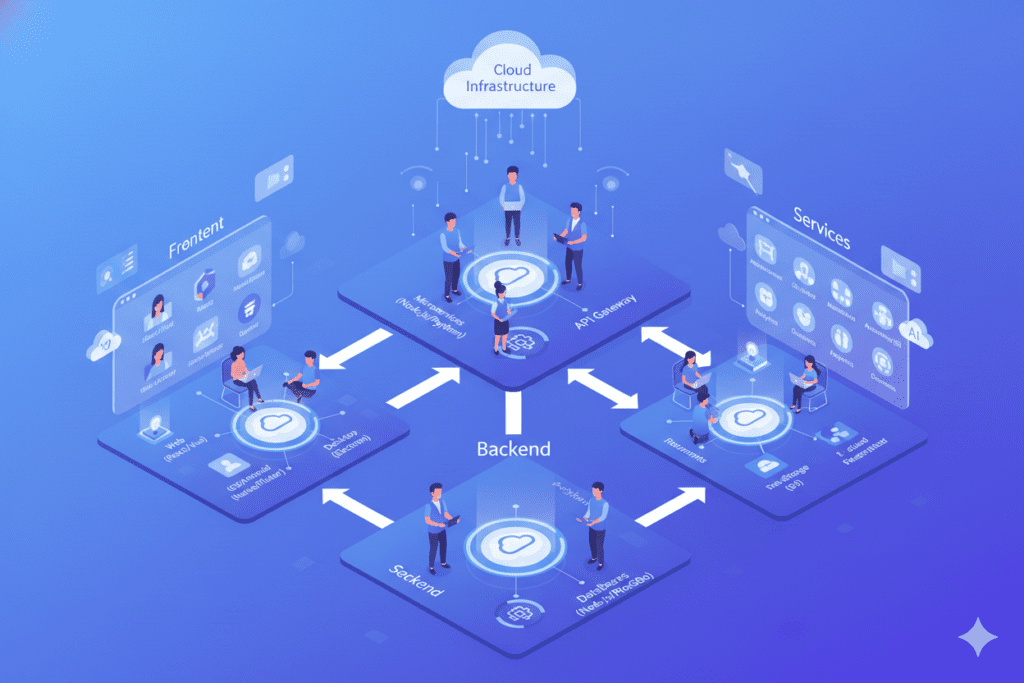
When we need to move fast, here’s our go-to stack:
Frontend: Next.js + Tailwind CSS + Pre-built template
Backend: Supabase (database + auth + real-time)
Payments: Stripe
Email: SendGrid
Hosting: Vercel
Monitoring: Sentry + Plausible
This stack lets us go from zero to deployed MVP in 8-10 days consistently. build SaaS MVP fast Everything is managed, documented, and just works.
What to Do After Launch: The First 30 Days
Congratulations! You built a SaaS MVP in 2 weeks and launched it. Now what?
Most founders think launch is the finish line. It’s actually the starting line.
Days 15-21: Intense User Engagement
Your job this week is to talk to every single user. Not survey them—talk to them.
BkAbhi’s First Week Post-Launch Playbook:
- Schedule 20-minute calls with each of your first 10 users
- Ask them to share their screen and show you how they’re using it
- Watch where they struggle (don’t interrupt to explain)
- Ask: “What would make this 10x more valuable to you?”
- Document everything
Days 22-30: Rapid Iteration
Based on your conversations, you’ll notice patterns. Maybe 7 out of 10 users struggle build SaaS MVP fast with the same step. Maybe they all ask for the same feature.
This is where you add your second and third features—based on reality, build SaaS MVP fast not assumptions.
Your Second Sprint:
- Fix the top 3 friction points
- Add the most-requested feature (if it aligns with your vision)
- Improve the onboarding for new users
- Begin thinking about your pricing model (if you haven’t already)
The Validation Metrics That Matter:
Forget vanity metrics. In your first 30 days, watch:
- Activation Rate: What % of signups complete the core action?
- Return Rate: Do users come back within 7 days?
- Manual Usage Time: How long do users spend in your app?
- Recommendation Rate: Do users tell others about it?
If 60%+ activate, 40%+ return, and multiple users recommend it, build SaaS MVP fast you have something. If not, build SaaS MVP fast you need to pivot or iterate significantly.
When You Should NOT Build in 2 Weeks
Let’s be honest: Sometimes slow is smart.
Take 8-12 weeks instead if:
- You’re in healthcare, fintech, or legal tech – Compliance isn’t optional
- Your product requires complex integrations – API hell takes time
- You need real-time collaboration features – This is genuinely hard
- You’re building developer tools – Developers expect polish
- Your idea isn’t validated yet – Do customer interviews first
The Red Flags:
If you hear yourself saying these, slow down:
- “I need to make sure it’s perfect before anyone sees it”
- “I’ll launch once I add just a few more features”
- “My product is complex—it can’t be simplified”
- “I need to build everything myself to maintain quality”
These are fear talking, not strategy.
BkAbhi’s Reality Check:
We’ve turned down projects where a 2-week MVP would set the founder up for failure. Sometimes the right answer is “build it in 6 weeks and do it properly” build SaaS MVP fast rather than cutting corners that will hurt you later.
Fast is good. Fast and wrong is expensive.
The BkAbhi Advantage: Expert Guidance for Your Sprint
Building a SaaS MVP in 2 weeks is possible—build SaaS MVP fast but it’s not easy. The difference between success and a wasted two weeks often comes down to one thing: experienced guidance.
At BkAbhi, we’ve built custom websites, mobile apps, and SaaS products that power real businesses. We don’t just code—we think strategically about what to build, what to cut, build SaaS MVP fast and how to validate your idea as quickly as possible.
What makes BkAbhi different:
- We prioritize ruthlessly – We’ll tell you what NOT to build (most agencies want you to build more)
- We know the shortcuts – Years of experience mean we know which corners can be cut and which can’t
- We focus on validation – Your MVP should prove or disprove your hypothesis, not win design awards
- We speak founder – We understand the pressure, the timeline, the budget constraints
Our Sprint Partnership Model:
When you work with BkAbhi on a 2-week MVP:
Week 0 (before the sprint):
- Strategy session to nail down your core feature
- Technical feasibility assessment
- Stack selection based on your team’s skills
- Timeline and milestone planning
Weeks 1-2 (the sprint):
- Daily sync-ups (15 minutes)
- Continuous development
- Real-time problem-solving
- Deployment and launch support
Week 3 (post-launch):
- User feedback analysis
- Iteration planning
- Growth roadmap creation
We don’t disappear after launch. The real work starts once you have users.
Real Results:
Our clients have launched MVPs that became:
- A $2M ARR vertical SaaS (started with 2-week MVP)
- An agency tool used by 400+ marketing teams
- A developer productivity tool with 5,000+ weekly active users
Every one of them started embarrassingly simple. build SaaS MVP fast Every one of them improved based on user feedback. Every one of them launched fast.
Your 2-Week MVP Action Plan
You’ve read the theory. Here’s your practical, day-by-day execution plan:
Before You Start:
- [ ] Complete 5-10 customer interviews
- [ ] Define your one core feature in a single sentence
- [ ] Choose your tech stack (don’t experiment)
- [ ] Line up 10-20 people for early testing
- [ ] Clear your calendar (seriously—2 weeks of focus)
Week 1: Foundation
Monday-Tuesday:
- Define problem with crystal clarity
- Map out the single user flow
- Create basic wireframes (pen and paper is fine)
- Set up development environment
Wednesday-Thursday:
- Implement authentication (use service, don’t build)
- Create database schema
- Build basic UI shell
- Test can-users-login flow
Friday-Sunday:
- Choose and customize template
- Implement core feature frontend
- Connect frontend to backend
- End-to-end test of happy path
Week 2: Execution
Monday-Tuesday:
- Fix critical bugs from testing
- Add minimal error handling
- Implement core feature completely
- Internal testing marathon
Wednesday-Thursday:
- Beta test with 3-5 target users
- Fix only blocking issues
- Write basic documentation/help
- Set up analytics
Friday:
- Final testing
- Deploy to production
- Soft launch to small group
- Monitor and respond
Weekend:
- Rest (you earned it)
- Respond to early feedback
- Plan week 3 priorities
The Uncomfortable Truth About MVP Success
Here’s what nobody tells you about MVPs:
Most fail.
Not because they’re badly built, build SaaS MVP fast but because they solve problems nobody actually has build SaaS MVP fast or they solve real problems in ways users don’t want.
The 2-week timeline isn’t about building a product. It’s about building a learning machine.
Your MVP has one job: Teach you whether to continue building this product.
Success isn’t measured in:
- Features shipped
- Code quality
- Design awards
- Social media impressions
Success is measured in:
- Real users trying your product
- Actual problems being solved
- Conversations about what to build next
- Clarity on whether to pivot or persist
The Best Outcome:
You build something in 2 weeks. 50 people try it. 30 actually use it. 10 use it weekly. 3 offer to pay for it.
That’s a phenomenal MVP. You learned your core feature solves a real problem. build SaaS MVP fast You have users telling you what to build next. You can now invest 3-6 months building the full product with confidence.
The Second-Best Outcome:
You build something in 2 weeks. 50 people try it. 5 use it once. Nobody returns.
Why is this good? build SaaS MVP fast Because you learned your hypothesis was wrong in 2 weeks, build SaaS MVP fast not 6 months. You saved yourself from building the wrong thing for half a year.
Failure fast is vastly better than failure slow.
Take Action: Start Your 2-Week Sprint Today
Building a SaaS MVP in 2 weeks isn’t about cutting corners. It’s about cutting through the noise to find what actually matters.
It’s about launching imperfect products that solve real problems.
It’s about learning from real users, not hypothetical ones.
It’s about speed as a strategic advantage in a market that waits for nobody.
You don’t need:
- A perfect idea
- A beautiful design
- A complete feature set
- Six months of development time
- A massive budget
You do need:
- A clearly defined problem
- One core solution
- The courage to launch ugly
- The discipline to say no to features
- Expert guidance or technical skill
Your Next Steps:
- Define your one core feature (do this today, seriously)
- Validate it with 5 people (schedule calls this week)
- Choose your tech stack (use what you know or get help)
- Set your 2-week deadline (commitment creates clarity)
- Start building (week 1, day 1, right now)
Or, if you want expert guidance from people who’ve done this dozens of times: build SaaS MVP fast Explore more insights on BkAbhi and discover how we help founders build, launch, and validate MVPs that matter.
Whether you build it yourself or partner with experienced developers, the key is to start. Your perfect MVP doesn’t exist. Your good-enough MVP can launch in 2 weeks.
The market doesn’t reward perfection. It rewards speed and iteration.
Start building smarter with BkAbhi – Where we turn ambitious ideas into launched products, not abandoned projects.
Conclusion: Your 2-Week Window
Two weeks from now, you could have:
- A working product in the hands of real users
- Actual feedback instead of assumptions
- Clear direction for your next steps
- Confidence that you’re building something people want
Or you could have:
- Another week of planning
- More features on your wishlist
- Zero user feedback
- Continued uncertainty
The choice is yours.
But here’s what I know from experience: The founders who win aren’t the ones who build the best first version. They’re the ones who build the fastest first version, learn from real users, build SaaS MVP fast and iterate relentlessly.
Read more expert guides on BkAbhi for proven strategies on building web and mobile products that users actually want.
Follow BkAbhi for practical tech & startup insights that cut through the noise and focus on what actually works in the real world.
The perfect time to start building your SaaS MVP in 2 weeks was two weeks ago.
Here you can also visit all in one ai tool-Aizolo