

It was 3:47 AM when David’s phone buzzed with the Slack message he’d been dreading for six months.
“The system just crashed. Again. We’ve lost customer data from the last 48 hours. Board meeting is in 4 hours.”
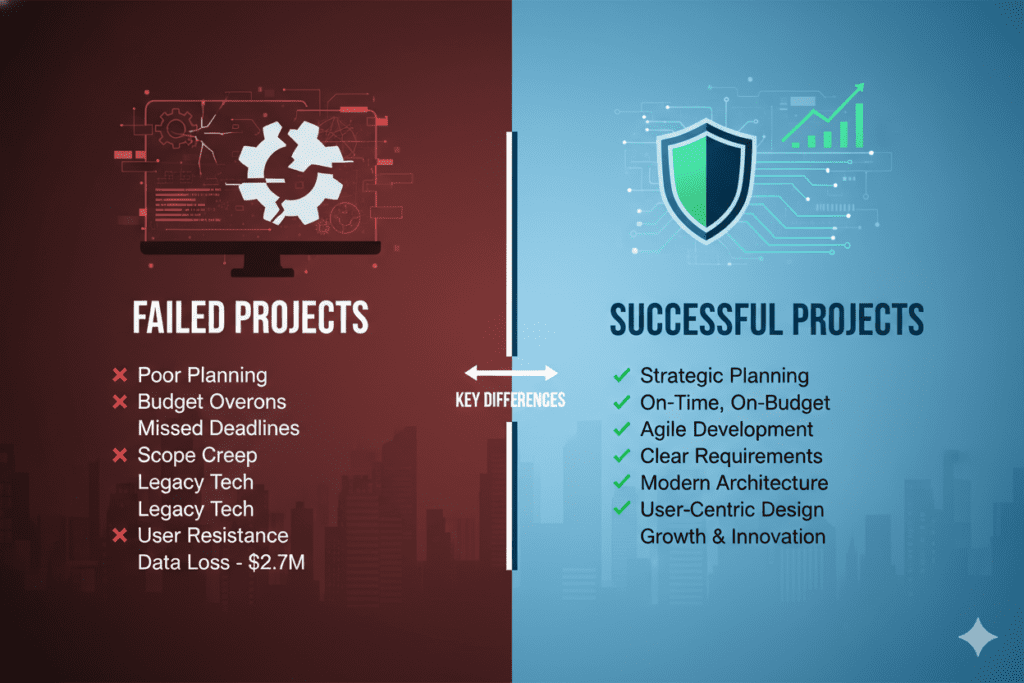
David was the CTO of a mid-sized fintech company with 300 employees and 50,000 active users. Nine months earlier, he’d signed a $2.7 million contract with what seemed like the perfect enterprise software development services provider. The sales pitch was flawless. The case studies looked impressive. The timeline seemed reasonable.
But now, staring at his laptop screen at almost 4 AM, watching error logs scroll endlessly, David realized he’d made a catastrophic mistake. The “enterprise-grade” platform his company had spent millions building was nothing more than a house of cards held together by duct tape and hope.
He wasn’t alone. According to recent industry research, 67% of enterprise software development projects either fail completely or significantly miss their targets. The global enterprise software market, projected to reach $403.90 billion by 2030, is filled with horror stories just like David’s.

Why Most Companies Get Enterprise Software Development Catastrophically Wrong
Here’s the uncomfortable truth nobody talks about: finding the right enterprise software development services provider isn’t just about technical skills or competitive pricing. It’s about understanding the invisible landmines that destroy projects before they even launch.
The Hidden Cost Nobody Mentions
When Sarah, a CFO at a healthcare technology company, approved a $1.8 million budget for their new patient management platform, she thought she’d accounted for everything. The contract was clear. The scope was defined. The timeline was aggressive but achievable.
What she didn’t account for was the additional $940,000 her company would spend over the next 18 months on:
- Emergency bug fixes that should have been caught in QA
- Security patches for vulnerabilities that shouldn’t have existed
- Integration issues with existing systems that were “guaranteed” to work seamlessly
- Extended development cycles because requirements were misunderstood from day one
This is the reality when you choose the wrong enterprise software development services provider. The initial contract is just the beginning.
What Makes an Enterprise Software Development Services Provider Actually “Enterprise-Grade”?
After analyzing hundreds of failed and successful enterprise software projects, a clear pattern emerges. The companies that succeed don’t just hire developers—they partner with strategic technology advisors who understand the brutal complexity of enterprise-level systems.
The Security Nightmare That Keeps CTOs Awake
Enterprise applications handle sensitive data. Customer information. Financial records. Proprietary business intelligence. A vulnerability in one application can compromise an entire corporate network.
Marcus learned this the hard way. His retail company partnered with an enterprise software development services provider that promised “bank-level security.” Six months after launch, a penetration test revealed 47 critical vulnerabilities, including SQL injection flaws and unencrypted data transmission.
The cost to fix? $430,000. The cost to their reputation when the breach made headlines? Incalculable.
A true enterprise software development services provider doesn’t treat security as a checkbox. They embed security practices into every phase:
- Threat modeling during the design stage
- Regular vulnerability assessments
- Encryption for data at rest and in transit
- Role-based access controls that actually work
- Compliance with industry standards like SOC 2, HIPAA, or GDPR
The Scalability Crisis Nobody Sees Coming
“It works perfectly for 5,000 users!” The demo was flawless. The proof of concept exceeded expectations. Then the platform went live.
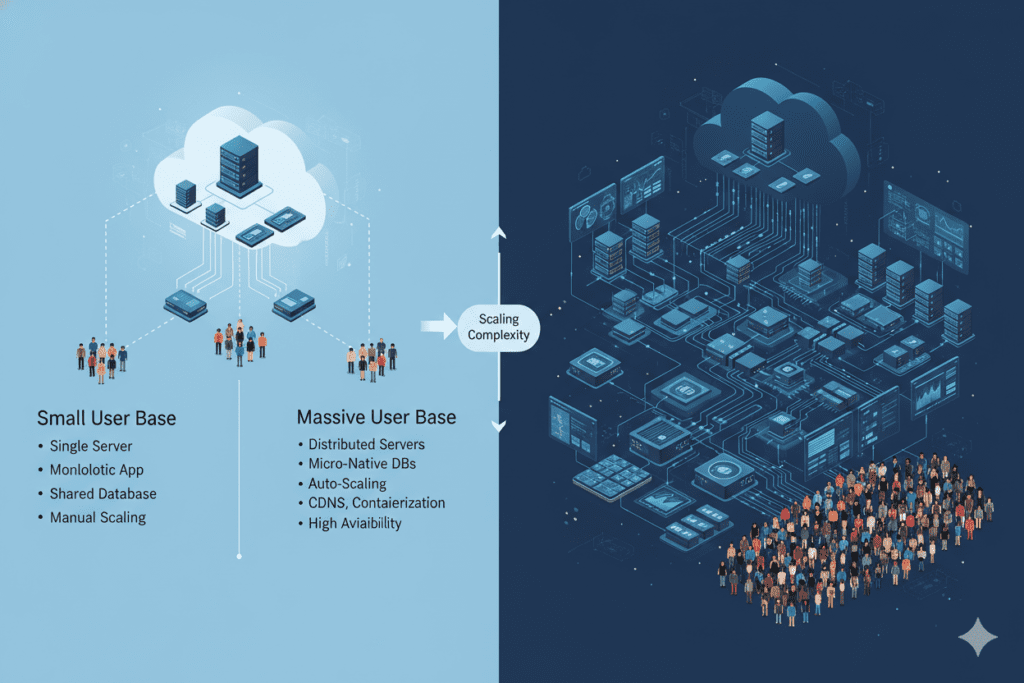
At 15,000 concurrent users, response times started lagging. At 50,000 users, the system became unusable. At 100,000 users, it crashed spectacularly during peak business hours.
This is the scalability trap. An application that performs beautifully in a controlled environment can collapse under real-world pressure if it’s not architected correctly from the ground up.
The right enterprise software development services provider thinks in terms of horizontal and vertical scaling from day one. They design with:
- Microservices architecture that allows independent scaling
- Load balancing strategies
- Database optimization for high-volume transactions
- Caching mechanisms
- Cloud-native infrastructure
The BkAbhi Approach: Real-World Experience Meets Strategic Execution
At BkAbhi, we’ve seen what happens when companies treat enterprise software development as a transaction instead of a transformation. We’ve helped founders, CTOs, and technical leaders navigate the minefield of enterprise development with one core philosophy: ship smart, ship fast, ship right.
How BkAbhi Solves Enterprise Development Challenges
For Founders Building Their First Enterprise Product: Rachel had built three successful consumer apps, but enterprise software was different. Her SaaS platform needed multi-tenancy, advanced role permissions, audit logging, and seamless integrations with enterprise tools like Salesforce and Microsoft Teams.
Working with BkAbhi, she learned that enterprise software development services provider selection isn’t about finding the cheapest option—it’s about finding partners who understand enterprise buyer psychology, compliance requirements, and the long sales cycles that come with B2B products.
We helped her:
- Define an MVP that addressed core enterprise needs without feature bloat
- Implement proper security and compliance frameworks from day one
- Build integration architecture that could scale with customer demands
- Create comprehensive documentation that enterprise buyers demand
For Technical Leaders Modernizing Legacy Systems: James inherited a nightmare: a 15-year-old monolithic application that powered a Fortune 500 company’s core operations. The codebase was fragile. Dependencies were outdated. The original developers had left years ago.
The challenge wasn’t building something new—it was transitioning from the old system without breaking the business. This required an enterprise software development services provider who understood both legacy modernization and business continuity.
BkAbhi’s approach:
- Gradual migration strategy with parallel systems
- API-first architecture to enable incremental replacement
- Comprehensive testing at every migration phase
- Zero-downtime deployment strategies
For Product Teams Scaling Rapidly: Maria’s B2B platform had gone from 50 enterprise clients to 500 in 18 months. What started as a simple application now needed to support millions of transactions daily, complex reporting, and integrations with dozens of third-party systems.
Her original development team couldn’t scale with the demand. She needed an enterprise software development services provider who could step in, understand the existing architecture, and accelerate development without creating technical debt.
We focused on:
- Code audits to identify performance bottlenecks
- Refactoring critical paths for efficiency
- Implementing proper DevOps pipelines
- Building scalable microservices for new features

The 7 Non-Negotiable Qualities of a True Enterprise Software Development Services Provider
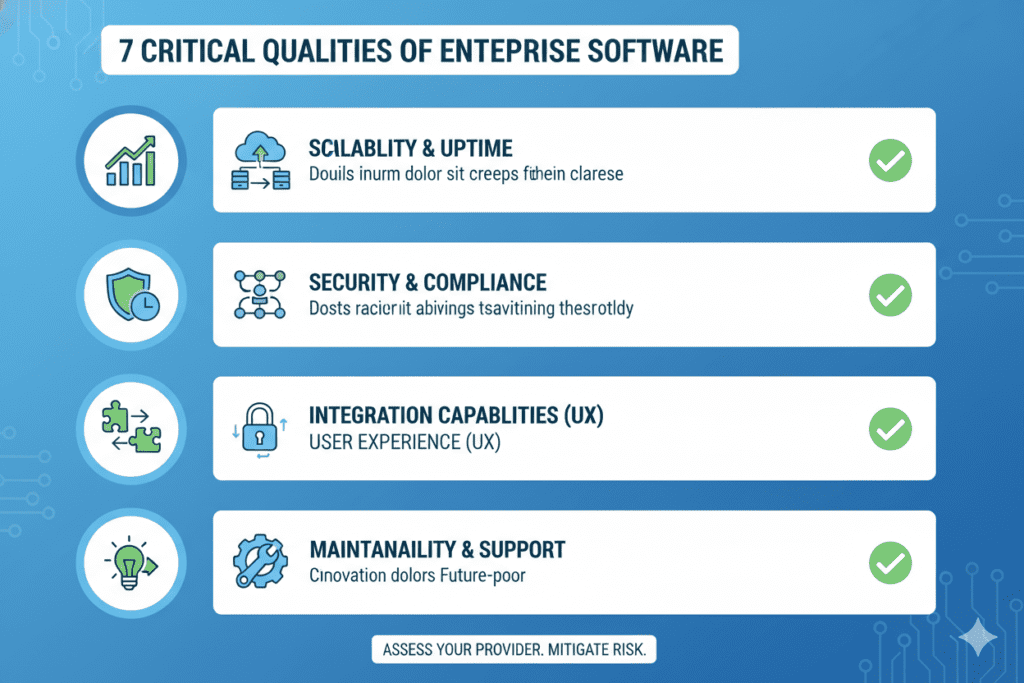
After working with hundreds of enterprise projects, these are the differentiators that separate genuine enterprise development partners from vendors who simply claim the title:
1. Battle-Tested Architecture Knowledge
Theory is cheap. Experience is priceless. The right enterprise software development services provider has built systems that handle millions of users, process billions in transactions, and operate 24/7 without downtime.
They know the difference between patterns that work in tutorials and architectures that work in production. They’ve debugged race conditions at 3 AM. They’ve optimized queries that were bringing databases to their knees. They’ve handled traffic spikes that would crash lesser systems.
2. Obsessive Focus on Security and Compliance
Security isn’t a feature—it’s the foundation. In 2026, a single data breach can destroy decades of reputation building. The right provider treats every line of code as a potential attack vector.
They implement:
- Defense in depth strategies
- Regular security audits
- Penetration testing
- Compliance documentation
- Incident response plans
3. Transparent Communication That Respects Your Intelligence
The worst enterprise software development services provider mistake? Treating clients like they don’t understand technology.
The best providers communicate clearly without condescension. They explain trade-offs. They present options. They admit when something will take longer or cost more than initially estimated.
When problems arise (and they always do), they communicate proactively rather than hiding behind jargon or making excuses.
4. Proven Integration Expertise
Enterprise software never exists in isolation. It needs to talk to your CRM, your ERP, your data warehouse, your analytics platform, your communication tools, and a dozen other systems.
The right provider has extensive experience with:
- RESTful and GraphQL APIs
- Enterprise service buses
- Event-driven architectures
- Legacy system integration
- Third-party API management
5. Commitment to Code Quality and Maintainability
Quick and dirty code might ship faster, but it becomes expensive technical debt within months. Enterprise systems need to be maintained for years, not months.
Quality-focused providers implement:
- Comprehensive code reviews
- Automated testing (unit, integration, end-to-end)
- Continuous integration and deployment
- Proper documentation
- Clean, readable code that new developers can understand
6. Strategic Business Understanding
The best enterprise software development services provider doesn’t just build what you ask for—they challenge assumptions and suggest better approaches based on your business goals.
They understand:
- Your competitive landscape
- Your customer acquisition costs
- Your revenue model
- Your growth constraints
- Your market positioning
7. Post-Launch Support That Actually Works
Launching is just the beginning. Enterprise software requires ongoing maintenance, updates, security patches, and feature enhancements.
Too many providers disappear after launch or charge exorbitant rates for basic support. The right partner provides:
- Proactive monitoring and alerts
- Rapid response to critical issues
- Regular performance optimization
- Scalability planning as you grow
- Knowledge transfer to internal teams
The Real-World Enterprise Development Playbook
Here’s what the enterprise software development process actually looks like when done correctly:
Phase 1: Discovery and Strategic Alignment (Weeks 1-2)
This is where most projects either succeed or fail. Rushing through discovery to “start building faster” is the fastest way to waste millions.
The right enterprise software development services provider spends serious time understanding:
- Your current systems and constraints
- Your business processes and workflows
- Your users (both internal and external)
- Your compliance and security requirements
- Your growth projections and scalability needs
Phase 2: Architecture and Technical Design (Weeks 2-4)
Before writing a single line of code, the architecture must be solid. This includes:
- System architecture diagrams
- Database schema design
- API specifications
- Security model
- Integration architecture
- Deployment strategy
- Disaster recovery plans
Phase 3: Iterative Development with Continuous Validation (Months 2-6+)
Enterprise development isn’t waterfall. It’s not pure agile either. It’s strategic iteration with regular validation.
This means:
- Building in priority order based on business value
- Regular demos and stakeholder feedback
- Automated testing from day one
- Performance testing at every milestone
- Security reviews throughout development
Phase 4: Pre-Launch Hardening (Final Month)
This is where many projects rush and regret it later. Proper pre-launch hardening includes:
- Comprehensive security audits
- Load testing under realistic conditions
- User acceptance testing with real users
- Documentation completion
- Team training
- Rollback procedures
Phase 5: Monitored Launch and Optimization (Ongoing)
Launch day isn’t the finish line—it’s the starting line. The right provider:
- Monitors everything obsessively during initial rollout
- Has engineers on standby for rapid response
- Gathers real user feedback immediately
- Optimizes based on actual usage patterns
- Plans the roadmap for future iterations
Common Enterprise Software Pitfalls and How to Avoid Them
The “Everything at Once” Trap
When Alex’s logistics company decided to digitize their operations, they wanted it all: real-time tracking, route optimization, customer portal, mobile apps for drivers, analytics dashboard, and integration with seven different systems.
The enterprise software development services provider they hired said “yes” to everything. Eighteen months and $3.2 million later, they had a bloated system that did everything poorly instead of doing core features exceptionally well.
The Solution: Start with an MVP focused on the highest-value use cases. Ship it. Validate it. Then expand systematically based on real user feedback and business impact.
The “Offshore Arbitrage” Disaster
Cost savings sound attractive. Hiring developers at $25/hour instead of $150/hour seems like smart business. Until the reality hits.
Time zone coordination nightmares. Communication barriers. Code quality issues. Security vulnerabilities. Cultural misalignment. Hidden costs that dwarf the initial savings.
The Solution: Evaluate enterprise software development services provider options based on total value, not just hourly rates. Consider communication efficiency, code quality, security practices, and long-term maintainability.
The “We’ll Fix It Later” Technical Debt Bomb
“Let’s just get this feature out, we’ll refactor later.” Famous last words in enterprise software development.
Technical debt compounds like financial debt—with interest. What seems like a small shortcut today becomes a massive roadblock six months later when you need to scale or add new features.
The Solution: Work with an enterprise software development services provider who refuses to compromise on fundamental architecture and security, even when timelines are tight.

Why This Matters More in 2026 Than Ever Before
The enterprise software landscape is more complex now than at any point in history. Consider:
- AI Integration Demands: Enterprises expect AI-powered features. This requires expertise in machine learning infrastructure, model deployment, and responsible AI practices.
- Security Threats Evolution: Attack vectors multiply daily. Zero-trust architecture isn’t optional anymore—it’s mandatory.
- Compliance Complexity: GDPR, CCPA, SOC 2, HIPAA, and industry-specific regulations create a compliance minefield that requires expert navigation.
- Cloud-Native Expectations: Enterprises expect cloud scalability, multi-region deployment, and infrastructure-as-code practices.
- Integration Ecosystem Expansion: The average enterprise uses 130+ SaaS applications. Your software needs to play nicely with all of them.
An enterprise software development services provider who isn’t keeping pace with these changes will deliver systems that are outdated before they launch.
The BkAbhi Difference: Built from Real-World Battle Scars
At BkAbhi, our expertise comes from shipping real products that real users depend on. We’ve built MVPs that scaled to millions of users. We’ve modernized legacy systems that companies bet their future on. We’ve integrated with systems that had documentation from 2008.
We don’t just write code—we architect solutions that align with your business strategy, scale with your growth, and evolve with your market.
Our approach for enterprise clients:
- Strategy First: Understanding your business model, competitive landscape, and growth constraints before writing code
- Security by Default: Implementing security best practices from the first commit, not as an afterthought
- Scalable Architecture: Building systems that handle 10x growth without requiring rewrites
- Integration Expertise: Seamlessly connecting your software with existing enterprise ecosystems
- Clear Communication: Transparent updates, honest timelines, and no technical jargon meant to confuse
Whether you’re a founder building your first enterprise product, a technical leader modernizing legacy systems, or a product team scaling rapidly, we help you avoid the pitfalls that destroy enterprise software projects.

Making the Right Choice: Your Enterprise Software Future Starts Now
Choosing an enterprise software development services provider isn’t a vendor selection process—it’s choosing a strategic partner who will impact your company’s trajectory for years to come.
The wrong choice costs millions in wasted development, lost opportunities, security breaches, and technical debt. The right choice accelerates your business, delights your users, and creates competitive advantages that last.
As the enterprise software market continues its explosive growth toward $403.90 billion by 2030, the companies that thrive will be those who partner with development teams that understand the full complexity of enterprise systems—from architecture to security to scalability to business alignment.
Don’t be the next David, staring at error logs at 4 AM, wondering how it all went wrong. Don’t be the next Sarah, explaining to the board why the budget doubled. Don’t be the next Marcus, dealing with a security breach that could have been prevented.
Partner with teams who’ve been in the trenches, who understand that enterprise software development is about more than code—it’s about building systems that businesses stake their future on.
Start Building Smarter Enterprise Software Today
The difference between enterprise software that transforms your business and software that becomes a millstone around your neck comes down to one decision: choosing the right development partner.
At BkAbhi, we’ve helped companies navigate the complexity of enterprise software development with clarity, expertise, and a track record of shipping products that work. We combine technical excellence with strategic thinking to deliver solutions that scale with your ambitions.
Explore more insights on BkAbhi about building enterprise-grade software, avoiding common pitfalls, and shipping products that users love.
Read more expert guides on BkAbhi covering MVP development, technical architecture, security best practices, and scaling strategies.
Learn from real-world experience at BkAbhi where we share the lessons learned from hundreds of successful projects.
Follow BkAbhi for practical tech & startup insights that help you make better decisions about your technology investments.
The enterprise software you build today determines your competitive position tomorrow. Make it count.
About BkAbhi: BkAbhi Innovations Lab helps founders, developers, and technical leaders ship MVPs and enterprise software that users love. With expertise across modern tech stacks, security practices, and scalable architecture, we turn complex business requirements into elegant software solutions. Learn more at bkabhi.com.
Suggested Internal Links:
- Cost to Build MVP in 2026 – Understanding enterprise software budgeting
- SaaS Development Company Guide – Choosing the right development partner
- Hire React Developer for Dashboard – Building enterprise-grade interfaces
- Micro SaaS Development Cost – Scaling from micro to enterprise
- MVP Development for Non-Technical Founders – Starting your enterprise journey
Suggested External Links:
- Gartner Enterprise Software Market Analysis – Industry insights and trends
- OWASP Security Best Practices – Enterprise security standards
- AWS Enterprise Architecture Framework – Cloud infrastructure guidance
- SOC 2 Compliance Guide – Security compliance standards
- Statista Enterprise Software Market Data – Market research and projections