
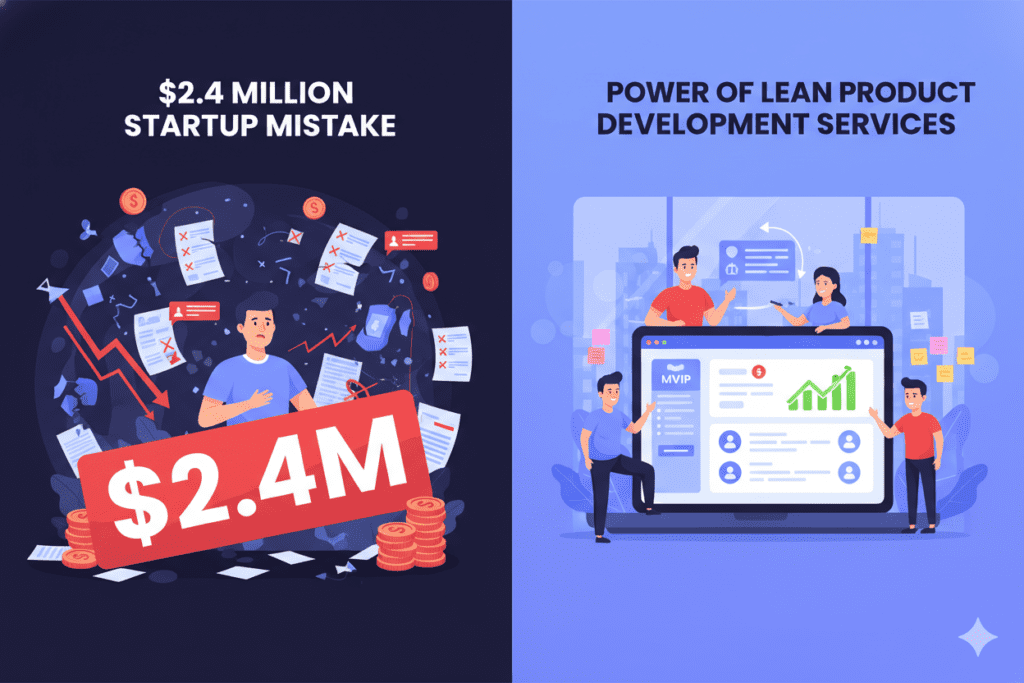
It was 3:47 AM when Rachel finally shut her laptop. Her eyes stung from staring at spreadsheets for the past fourteen hours. Six months ago, she’d raised $800,000 in seed funding for her healthcare scheduling platform. Today, she had $43,000 left in the bank, a half-built product nobody wanted, and a development team that had just quit.
“We spent nine months building every feature I could imagine,” Rachel told me over coffee three weeks later, her hands wrapped around the cup like it was the only warm thing left in her world. “Beautiful interface. Complex algorithms. Integration with seventeen different systems. And you know what? When we finally launched last month, we got eleven sign-ups. Eleven.”
Rachel’s story isn’t unique. According to CB Insights, 42% of startups fail because they build products nobody wants. But here’s the crushing part: most founders realize this truth only after they’ve burned through their runway, exhausted their team, and lost precious months that could have been spent learning what customers actually need.
This is precisely why lean product development services have become the lifeline for smart founders who refuse to gamble their entire vision on assumptions. But what exactly makes lean product development different from traditional approaches? And more importantly, how can it prevent your startup from becoming another cautionary tale?
What Lean Product Development Services Really Mean (And Why Most People Get It Wrong)
When most founders hear “lean product development services,” they think it means “cheap” or “quick and dirty.” That’s the first misconception that leads teams down the wrong path.
Lean product development services aren’t about cutting corners or building inferior products. They’re about building the right product through systematic validation, rapid iteration, and ruthless prioritization. It’s a philosophy born from Toyota’s manufacturing revolution, adapted by Eric Ries for the startup world, and refined by thousands of founders who learned these lessons the expensive way so you don’t have to.
(Image prompt: Split-screen illustration showing traditional product development as a massive ship being built in dock versus lean product development as a series of progressively refined boats, each one tested on water)
At its core, lean product development services focus on three fundamental principles:
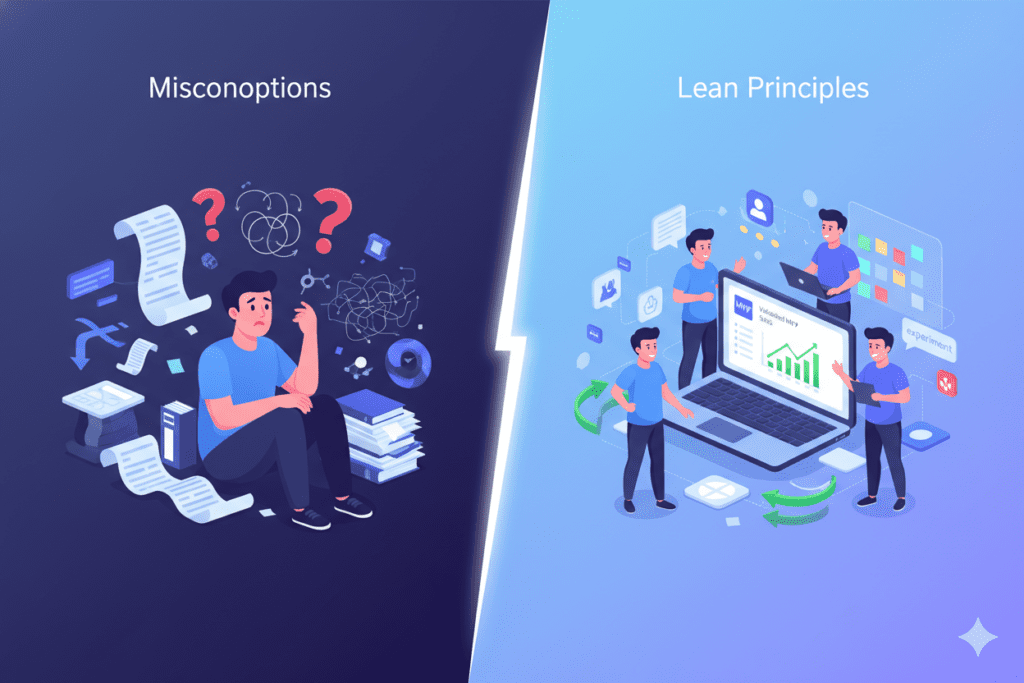
Build-Measure-Learn cycles that compress time to insight. Instead of spending eighteen months building your “perfect” product, lean services help you ship a functional version in 6-12 weeks, measure real user behavior, and learn what actually matters. The goal isn’t perfection—it’s validated learning.
Customer development over product development. Traditional approaches start with building, then try to find customers. Lean product development services flip this script entirely. You identify real customer pain points first, validate that people will pay to solve them, then build only what’s necessary to deliver that value.
Waste elimination through feature prioritization. Every feature in your product costs money to build, maintain, and support. Lean services help you identify the 20% of features that will deliver 80% of the value, allowing you to ship faster and learn quicker.
Marcus, a fintech founder I worked with last year, learned this lesson after wasting $340,000 on the wrong features. “We built this sophisticated dashboard with forty-seven different data visualizations,” he explained during our first consultation call. “Our users just wanted to see two numbers: how much they spent this month and how much they had left. Everything else was noise we’d convinced ourselves they needed.”
The Hidden Cost of Traditional Product Development (That Nobody Talks About Until It’s Too Late)
Here’s what most development agencies won’t tell you: traditional product development isn’t just expensive—it’s dangerously optimistic.
The typical agency approach looks something like this: You describe your vision, they provide a fixed-scope proposal, you sign a contract, and six months later, you get a product. Sounds reasonable, right? Except this model assumes three things that are rarely true for startups:
First, it assumes you know exactly what your customers want before you’ve talked to any real users. Second, it assumes market conditions won’t change during your development cycle. Third, it assumes your first product hypothesis will be correct.
In my seven years helping founders build their MVPs, I’ve never seen all three of these assumptions hold true simultaneously. Not once.
(Image prompt: Visual metaphor showing a founder building a bridge in one direction while their customers are waiting on the opposite shore)
Sarah runs a B2B SaaS company that nearly collapsed because of this very problem. She spent $580,000 building a project management tool with advanced AI-powered task automation. “I was so proud of our AI engine,” she told me. “It took our developers four months just to build that feature. When we launched, exactly zero customers used it. They just wanted a simple kanban board that synced with Slack.”
This is where lean product development services create their real value. Instead of betting your entire budget on a single product version, they help you place smaller, smarter bets that generate learning. You build enough to test your riskiest assumptions, gather real data, then iterate or pivot based on what you discover.
Why Lean Product Development Services Work for Founders, Developers, and Everyone Between
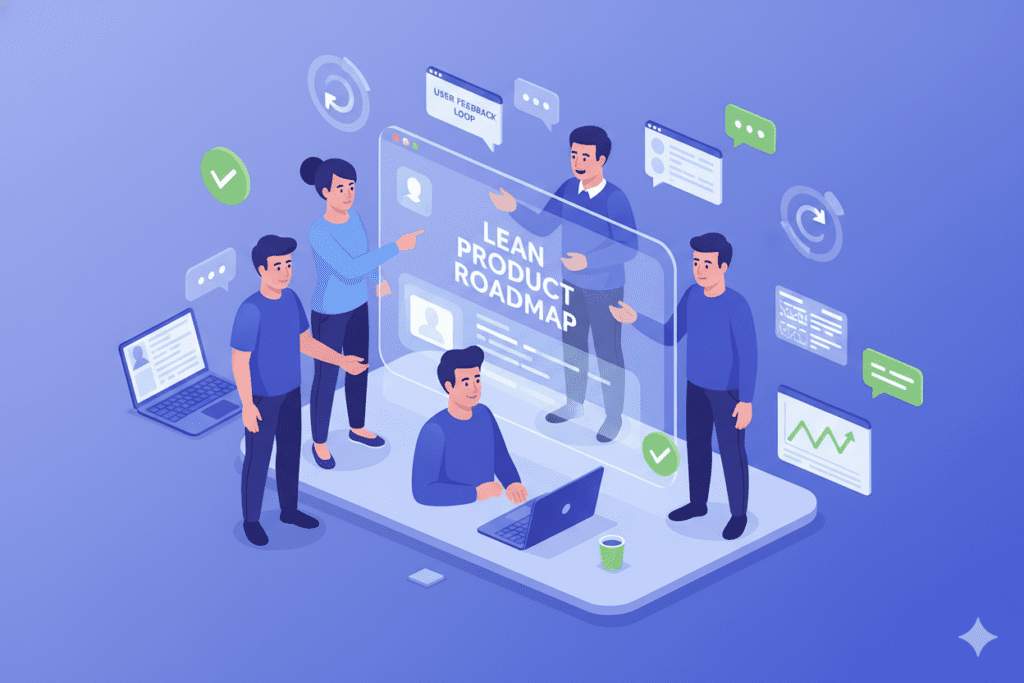
Let me share something that might surprise you: lean product development services aren’t just for non-technical founders. Some of my most successful clients have been experienced developers who understood that building the right thing matters more than building things right.
For Non-Technical Founders: Navigating the Technical Maze Without Getting Lost
If you’re a non-technical founder, traditional development can feel like navigating a foreign country where you don’t speak the language. Agencies throw around terms like “microservices architecture,” “API-first design,” and “containerized deployments,” and you’re left nodding along while having no idea if these decisions align with your business goals.
Lean product development services at BkAbhi translate technical decisions into business outcomes. Instead of debating whether to use React or Vue.js, we focus on questions that actually matter: Will this help us validate our core assumption faster? Does this feature reduce the biggest risk in our business model? Can we test this with real users in the next two weeks?
Take Jennifer, who came to us with an idea for a virtual event platform but zero technical background. “I didn’t want to spend six months learning to code, but I also didn’t want to hand over my entire vision to developers who might not understand the market,” she explained.
We helped Jennifer build a concierge MVP in three weeks—a simple landing page, a Zoom integration, and a manual booking process she handled herself. It wasn’t scalable, but it didn’t need to be. She validated that event organizers would pay $497 per event before writing a single line of custom code. Only after proving demand did we invest in automation.
For Technical Founders: Escaping the Feature Factory Trap
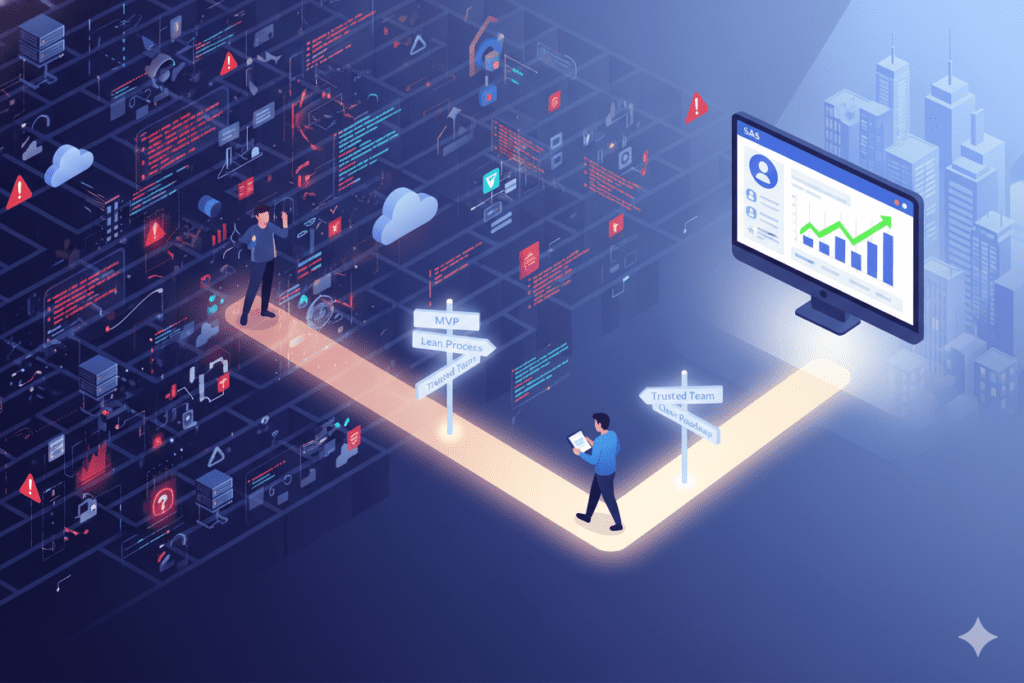
If you’re a developer-founder, you face a different challenge: the seductive pull of building cool technology that might not matter. I’ve coached dozens of brilliant technical founders who spent months building elegant solutions to problems their customers didn’t actually have.
Lean product development services provide the discipline you need to stay focused on business outcomes, not technical perfection. They help you answer the hard question every technical founder must face: “Is this the highest-value thing I could be building right now?”
David, a backend engineer with fifteen years of experience, came to BkAbhi after spending eight months building a highly scalable notification system for his social app. “I built this beautiful microservices architecture that could handle millions of users,” he said, laughing bitterly. “We had forty-seven daily active users. I optimized for a problem we didn’t have instead of solving the problem that would get us our next hundred users.”
Through lean product development services, David learned to timebox his technical ambitions and focus on rapid validation. His next product took six weeks to build and acquired 2,400 users in the first month.
For Product Managers and Marketers: Aligning Teams Around Real Customer Insights
Product managers and marketers face their own challenge with traditional development: by the time a feature ships, the market insights that inspired it are six months old. Customer needs have evolved. Competitors have moved. Your assumptions might no longer be valid.
Lean product development services create tight feedback loops between market reality and product decisions. Instead of annual roadmap planning sessions based on gut feelings, you’re making weekly prioritization decisions based on actual user behavior and feedback.
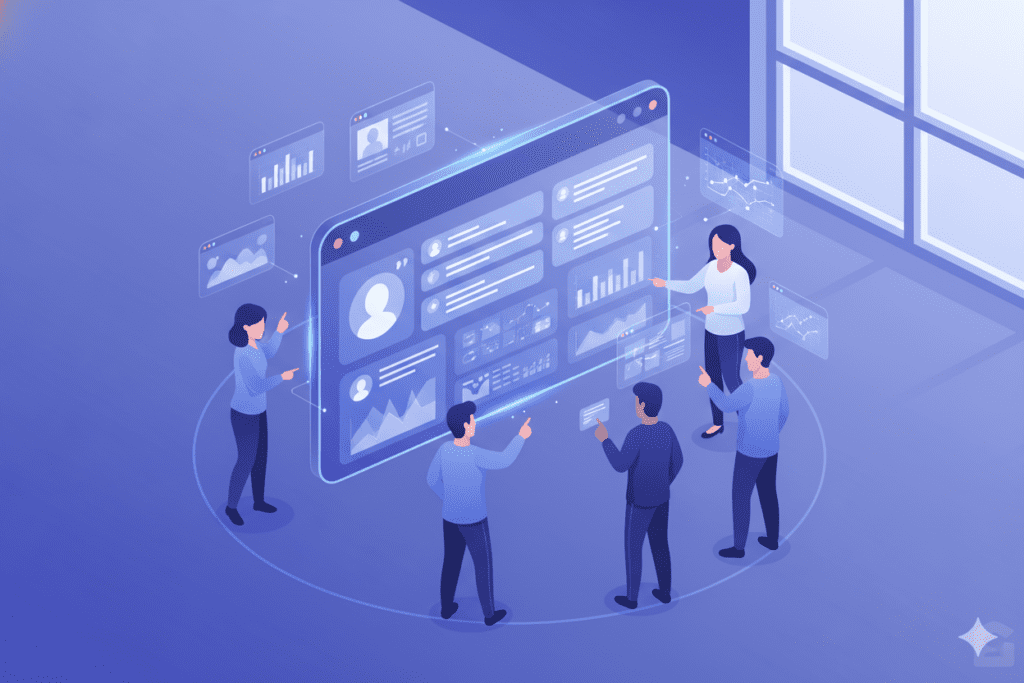
Maria, a product manager at a growing startup, described her frustration with traditional processes: “We’d spend three months building a feature based on surveys and focus groups. By the time it launched, it would either miss the mark or the competitive landscape had shifted. We were always playing catch-up.”
After adopting lean product development services, Maria’s team cut their average feature cycle from thirteen weeks to three weeks. More importantly, their feature success rate—measured by adoption and retention—jumped from 31% to 67%.
The BkAbhi Approach to Lean Product Development Services: Real-World Strategy That Works
At BkAbhi, we’ve helped over a hundred founders transform their ideas into validated products without burning their runway. Our approach to lean product development services isn’t theoretical—it’s battle-tested through dozens of successful MVPs, countless pivots, and yes, a few instructive failures that taught us what not to do.
Here’s how we think about lean product development differently:
Week 1-2: Ruthless Problem Validation
We don’t start by discussing technology stacks or feature lists. We start by interrogating your core assumptions. Who exactly is your customer? What specific problem keeps them awake at night? How are they solving this problem today? Would they pay to solve it better?
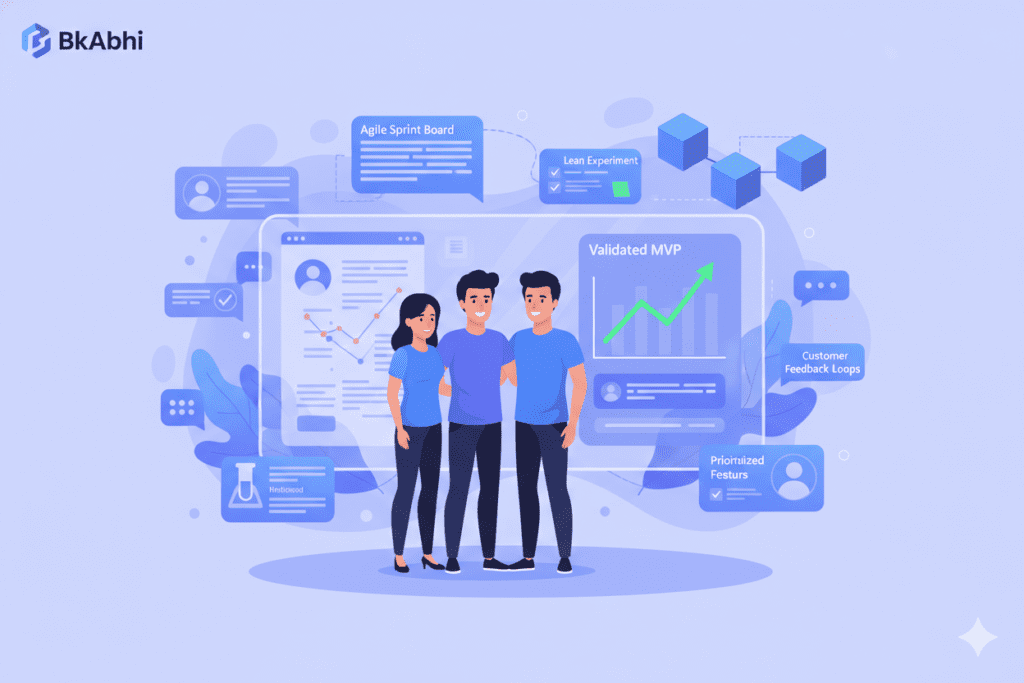
We’ve developed a framework we call the “Assumption Risk Matrix” that helps founders identify which hypotheses are most dangerous to their business model. Not all assumptions are equally risky. The assumption that “small business owners want better invoicing software” is low-risk and well-validated. The assumption that “they’ll pay $299 per month for it” is high-risk and needs immediate validation.
During these first two weeks, we help founders conduct real customer development interviews, not sales pitches disguised as research. We teach you to listen for pain intensity, not feature requests. We help you identify the job your customer is actually hiring your product to do.
Week 3-8: Build Only What Tests Your Riskiest Assumption
Once we’ve identified your highest-risk assumptions, we help you design the leanest possible test to validate or invalidate them. This is where BkAbhi’s lean product development services really shine—our team has built dozens of MVPs, so we know exactly which corners you can cut without compromising learning.
Sometimes the right MVP isn’t software at all. We’ve helped founders validate business models through landing pages with Stripe integration, concierge services where founders manually deliver the value proposition, or wizard-of-oz MVPs where users think they’re interacting with automation but it’s actually you behind the curtain.
When code is necessary, we build for learning, not scale. We use proven technology stacks that allow rapid iteration. We ruthlessly descope features that don’t directly test your hypothesis. We deploy fast and measure faster.
Week 9-12: Learn, Iterate, or Pivot
This is where most traditional development approaches fail—they have no systematic process for incorporating learning. They built what you asked for, here’s your product, good luck.
Our lean product development services include structured learning frameworks. We help you define clear success metrics before you launch. We implement proper analytics from day one. We conduct user interviews to understand not just what users do, but why they do it.
Then we help you make the hard decisions. Do the metrics suggest you’re on the right track? Then it’s time to iterate and improve. Do they suggest your initial hypothesis was wrong? Then we help you pivot to a new approach without losing momentum or morale.
Kyle, who built a developer tools startup with our support, described this phase as “the most valuable part of the process.” He explained, “BkAbhi helped us realize our initial positioning was wrong within three weeks of launch. We pivoted from targeting senior developers to junior developers, changed our pricing model from subscription to pay-per-use, and 10x’d our conversion rate. That pivot would have taken six months and drained our entire budget if we’d built the traditional way.”
Real Success Stories: How Lean Product Development Services Transform Outcomes
Let me share three recent examples of how BkAbhi’s lean product development services helped founders avoid expensive mistakes and build products people actually want:
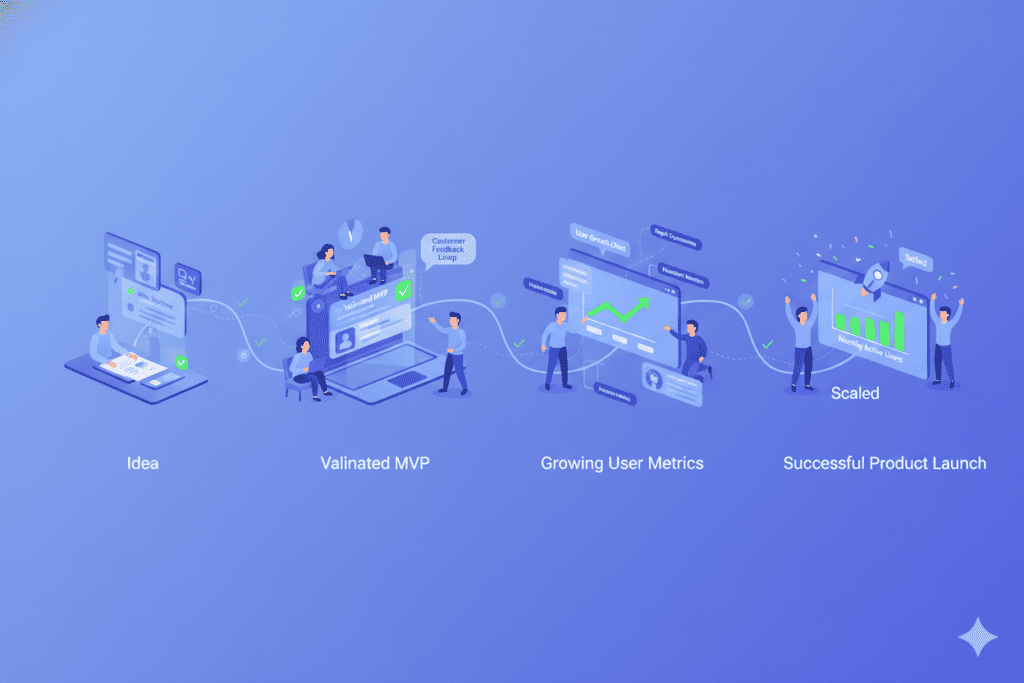
Case Study: Healthcare Tech Startup Saves $420,000 Through Strategic Descoping
Priya approached us with a comprehensive telehealth platform concept. Her initial specification document was forty-seven pages long and included features for patients, doctors, administrators, insurance companies, and pharmacy integrations. Her quotes from traditional agencies ranged from $780,000 to $1.2 million, with timelines of 18-24 months.
Through our lean product development services, we helped Priya identify her core assumption: would doctors pay for easier patient scheduling? We built an MVP in nine weeks for $68,000 that focused solely on this question—a scheduling interface for doctors with automated reminders for patients.
The result? Fifteen medical practices signed up in the first month, paying $197 per month each. More importantly, we learned that doctors actually wanted patient intake forms more than scheduling automation. Priya pivoted her roadmap, and within six months, her platform was generating $47,000 in monthly recurring revenue. By starting lean, she saved over $400,000 in development costs and gained eighteen months of runway.
Case Study: SaaS Founder Discovers His Target Market Was Completely Wrong
Thomas built an analytics dashboard for marketing agencies. He’d spent $240,000 with a traditional agency building sophisticated features for tracking campaigns, generating reports, and managing client data. After six months of development and a launch that generated eleven customers, he was ready to give up.
When Thomas came to BkAbhi, we helped him use lean product development services to understand why his product wasn’t gaining traction. Through systematic customer interviews, we discovered his actual power users weren’t marketing agencies—they were in-house marketing managers at mid-sized companies who needed something much simpler.
We rebuilt his MVP from scratch in five weeks, cutting 60% of the features and simplifying the interface for individual marketers rather than agencies. Within three months, he had 340 paying customers. Today, his platform serves over 2,000 marketing professionals and generates $89,000 in monthly recurring revenue.
The lesson? Building the wrong thing perfectly is infinitely more expensive than building the right thing imperfectly.
Case Study: Marketplace Platform Reaches Profitability in Eight Months
Lisa had an ambitious vision for a marketplace connecting freelance designers with small businesses. Traditional agencies told her she’d need $600,000 and a year to build the platform with all the features she envisioned: designer profiles, project management tools, payment processing, review systems, messaging, file sharing, and more.
Using lean product development services from BkAbhi, we took a radically different approach. In week one, Lisa created a Facebook group and manually connected ten designers with ten small businesses. No code. No platform. Just validation that the need existed and people would engage.
In weeks two through six, we built a simple landing page with Stripe integration and a Google Form for project requests. Lisa manually matched designers with clients and took a 15% commission through Stripe. She processed $12,000 in transactions in her first month—proof that her business model worked.
Only after validating demand did we invest in building custom marketplace features. We prioritized based on what Lisa learned from manually running the marketplace: automated matching could wait, but built-in messaging was critical because email threads were getting lost.
Eight months after starting, Lisa’s marketplace was profitable, processing $67,000 per month in transactions. She raised $400,000 in seed funding based on her traction, not on promises.
The Technical Foundation: How BkAbhi Delivers Lean Product Development Services That Scale
Let me pull back the curtain on how we actually build products at BkAbhi. Our technical approach is designed to support rapid iteration while maintaining code quality that can scale when you’re ready.
Technology Stack Optimized for Speed and Flexibility
We use battle-tested technology stacks that balance speed of development with long-term maintainability. For web applications, we typically build with React for the frontend and Node.js for the backend, giving us the flexibility to iterate quickly while maintaining a codebase that can handle growth.
For mobile apps, we often recommend React Native for startups that need iOS and Android presence. This allows us to write code once and deploy to both platforms, cutting development time by 40-60% compared to native development.
We’re pragmatic about technology choices. If your MVP needs are simple, we might recommend no-code tools like Bubble or Webflow. If you need more control and scalability, we’ll use full-stack frameworks like Next.js that give you the best of both worlds: rapid development and production-ready infrastructure.
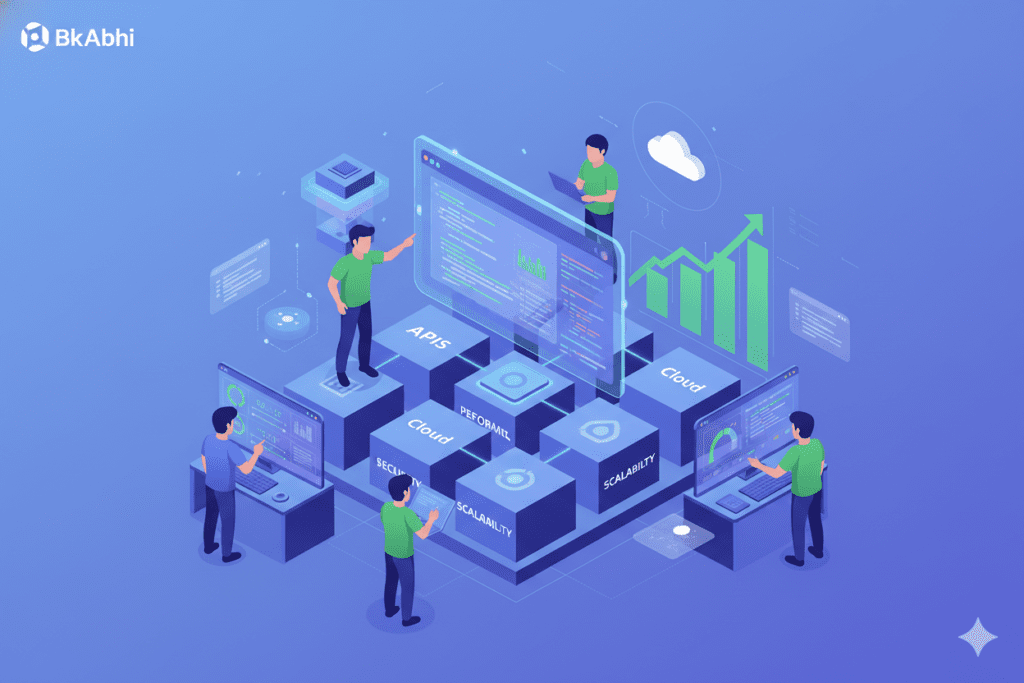
Built-in Analytics and Learning Infrastructure
One critical difference in our lean product development services is that we build measurement capabilities from day one. Every BkAbhi MVP includes:
Event tracking that captures how users interact with core features. We don’t just track pageviews—we track button clicks, feature usage, workflow completions, and drop-off points. This gives you the data you need to make informed decisions about what’s working and what’s not.
User feedback loops built directly into the product. We implement in-app feedback mechanisms, automated email follow-ups, and structured user interview scheduling. Learning from users isn’t an afterthought—it’s embedded in your product architecture.
Funnel analytics that show you exactly where users are succeeding and where they’re getting stuck. We set up conversion tracking from landing page to signup to activation to retention, giving you a complete picture of your user journey.
Deployment Architecture That Supports Rapid Iteration
Our lean product development services include modern deployment practices that let you ship updates quickly and safely. We use continuous integration and deployment pipelines that allow you to push code changes multiple times per day if needed.
We deploy to cloud infrastructure that scales automatically as you grow, so you’re not making expensive over-provisioning decisions before you have traction. Start with infrastructure that costs $47 per month, scale to infrastructure that costs $470 per month when you have paying customers, and only invest in enterprise-grade infrastructure when your revenue justifies it.
Common Mistakes Founders Make When Shopping for Lean Product Development Services (And How to Avoid Them)
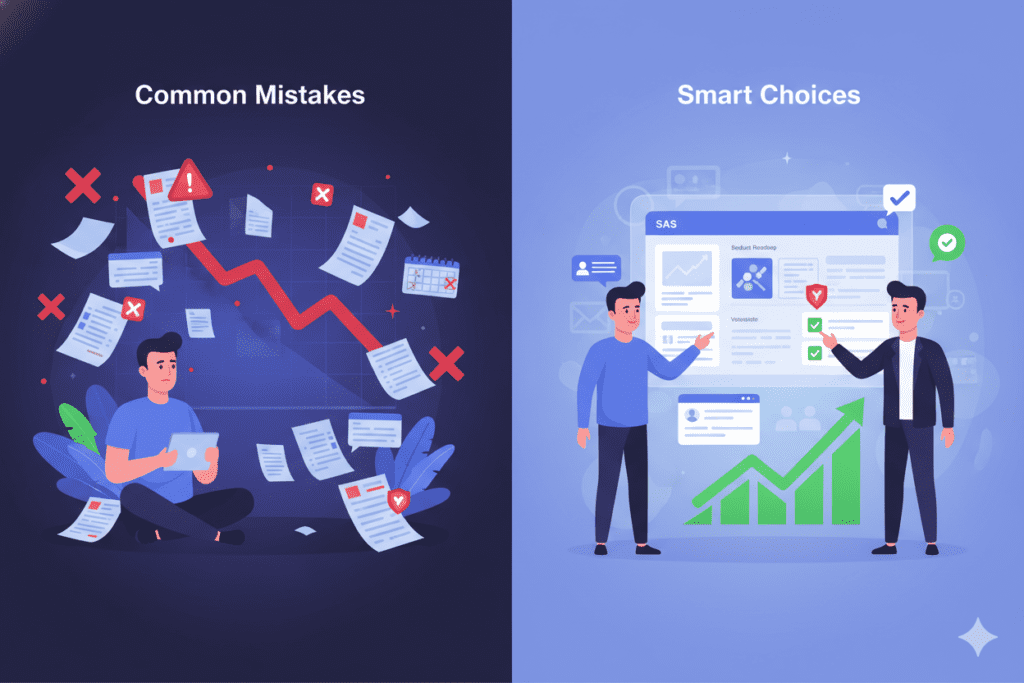
After helping dozens of founders navigate the process of selecting development partners, I’ve seen the same mistakes repeated over and over. Let me save you from the most expensive ones:
Mistake #1: Choosing Based on Portfolio, Not Process
Many founders select development services based on how impressive their portfolio looks. “They built apps for these big companies, so they must be good,” is the logic. But here’s what that logic misses: building a feature-complete product for an established company with a million-dollar budget is fundamentally different from building an MVP for a startup with constrained resources.
What matters more than past clients is whether the team has a systematic process for validating assumptions, prioritizing features, and incorporating user feedback. Ask potential partners: “How do you decide what to build first?” and “How do you handle it when initial assumptions prove wrong?” Their answers will tell you everything you need to know about whether they understand lean product development services.
Mistake #2: Optimizing for Cheap, Not for Learning
Some founders see “lean” and think “cheap.” They find the lowest-cost development option and wonder why their product fails to gain traction. Here’s the truth: a $15,000 MVP built without proper customer development and learning infrastructure is more expensive than a $68,000 MVP that validates your business model and sets you up to scale.
Lean product development services should be evaluated on how much validated learning they generate per dollar spent, not on absolute cost. The right question isn’t “How cheaply can you build this?” It’s “How quickly and cost-effectively can you help me figure out if this is the right thing to build?”
Mistake #3: Skipping Customer Development to Start Coding Faster
I can’t tell you how many founders I’ve met who are frustrated because their development team “wasted” three weeks on customer interviews and wireframes instead of jumping straight into coding. Six months later, these same founders are frustrated because the product they built doesn’t resonate with users.
Customer development isn’t a delay—it’s an investment that pays massive dividends. Those three weeks of interviews and validation work often save three months of building the wrong features. At BkAbhi, we’ve seen projects where spending 20% of the timeline on discovery and validation reduced total development time by 60% because we built the right thing the first time.
Mistake #4: Treating Your MVP Like Your Final Product
Some founders expect their MVP to be polished, scalable, and feature-complete. That’s not what lean product development services are for. Your MVP should be the minimum you need to learn, not the minimum you need to be embarrassed about.
Reid Hoffman, LinkedIn’s founder, has a famous quote: “If you’re not embarrassed by the first version of your product, you’ve launched too late.” That doesn’t mean shipping broken software—it means shipping something focused enough that it feels incomplete. Because it should be incomplete. You’re not building a product yet; you’re testing whether you should build a product.
Pricing Models for Lean Product Development Services: What You Should Actually Expect to Pay
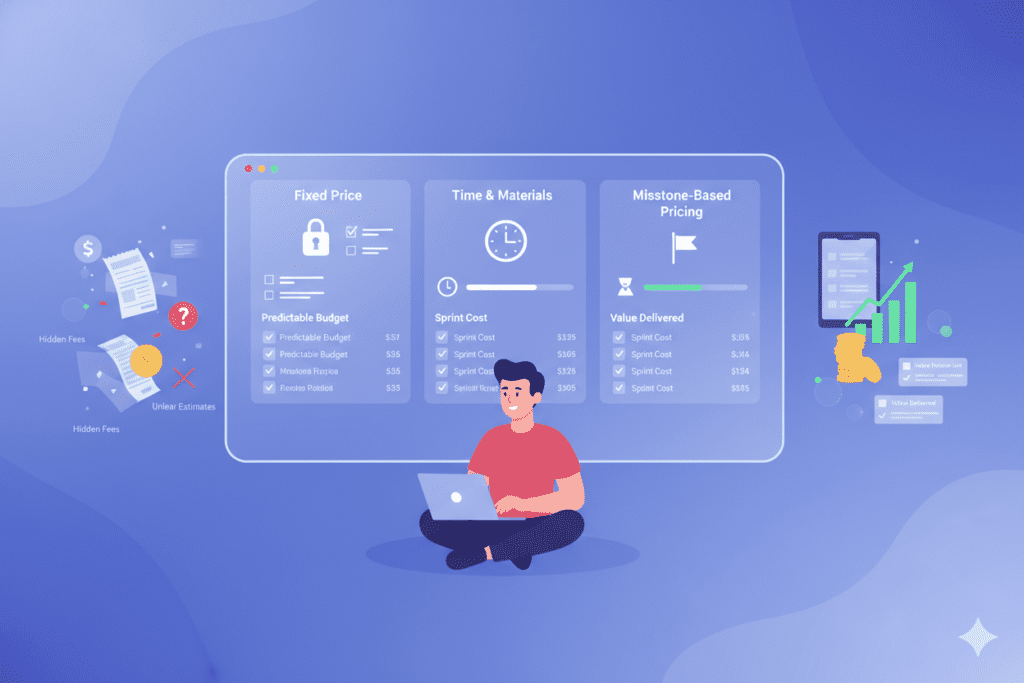
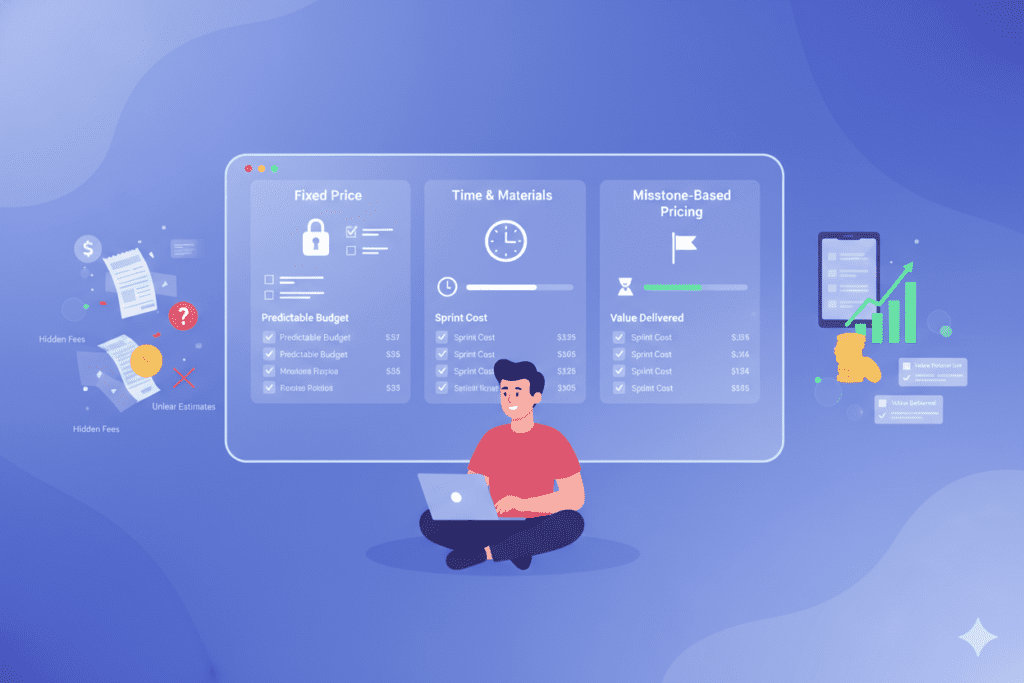
Let’s talk about money, because I know that’s what you’re wondering. “This all sounds great, but what does lean product development services actually cost?”
The honest answer: it varies wildly based on complexity, but here are realistic ranges for 2026:
Landing Page + Concierge MVP: $8,000-$25,000
For validating a business model without custom software, you can build a professional landing page with payment integration, email automation, and manual service delivery for $8,000-$25,000. This is perfect for testing whether people will pay for your value proposition before investing in automation.
Timeline: 2-4 weeks Best for: Service-based businesses, simple transaction marketplaces, content platforms
Simple Web MVP (3-5 Core Features): $35,000-$75,000
A functional web application with user authentication, a database, core workflow, and basic analytics typically costs $35,000-$75,000. This gets you a real product that users can adopt, not just a prototype.
Timeline: 6-10 weeks Best for: SaaS tools, internal business software, community platforms
Mobile App MVP (iOS + Android): $55,000-$120,000
A native or cross-platform mobile app with core features, backend API, user accounts, and app store deployment costs $55,000-$120,000 using lean development practices. We can cut costs significantly by using React Native instead of building separate native apps.
Timeline: 8-14 weeks Best for: Consumer apps, mobile-first services, location-based tools
Complex Marketplace or Multi-Sided Platform: $80,000-$180,000
Marketplaces with separate experiences for different user types, payment processing, matching algorithms, and communication tools require more investment: typically $80,000-$180,000 for an MVP.
Timeline: 12-18 weeks Best for: Freelance platforms, rental marketplaces, B2B service marketplaces
At BkAbhi, we work with founders to find the leanest path to validation regardless of budget. We’ve helped founders test million-dollar ideas with $12,000 MVPs by getting creative about what “minimum viable” really means for their specific assumptions.
How to Evaluate If Your Product Idea Is Ready for Lean Product Development Services
Not every idea is ready for development—even lean development. Before engaging any development service, including BkAbhi, you should be able to answer these questions clearly:
Can you articulate the specific problem you’re solving in one sentence?
If you can’t explain your product’s core value proposition in a single, clear sentence, you’re not ready to build. Spend more time understanding the problem space first.
Good example: “We help freelance designers find consistent clients without spending hours on proposals that go nowhere.”
Bad example: “We’re building a platform that connects creative professionals with opportunities using AI-powered matching and blockchain-verified portfolios while also providing project management and community features.”
Do you know who your first 100 customers will be and how to reach them?
You don’t need a massive marketing budget, but you do need a credible plan for getting your product in front of real users. If your distribution strategy is “we’ll go viral” or “it’s so good people will just find it,” you’re not ready to build.
Have you talked to at least 20 potential customers about their problem?
Notice I said “their problem,” not “your solution.” Customer development conversations should happen before development, not after. If you haven’t validated that your target customers actually experience the problem you think they do, you’re building on sand.
Are you prepared to pivot or even kill your idea based on user feedback?
Lean product development services only work if you’re willing to follow where the data leads. If you’re so attached to your initial vision that you’ll ignore contradictory evidence, save your money. Don’t build an MVP—just build what you want and hope for the best.
If you can answer these questions confidently, you’re ready to explore lean product development services. If you can’t, spend more time on customer development first.
The BkAbhi Difference: Why Founders Choose Us for Lean Product Development Services
Let me be direct: there are dozens of development agencies that claim to offer lean product development services. Some of them are genuinely excellent. So why do founders consistently choose BkAbhi?
We’ve Walked Your Path
BkAbhi wasn’t started by career agency owners. It was started by founders who’ve experienced the pain of building the wrong thing, running out of runway, and pivoting frantically to survive. We understand the fear you feel when you’re watching your bank account drain while your product still isn’t finished. We’ve been there.
This lived experience shapes everything about how we work. We don’t just build what you ask for—we challenge your assumptions because we know how expensive wrong assumptions can be. We’re not order-takers; we’re partners who’ve sat in your chair and want to help you avoid the mistakes we made.
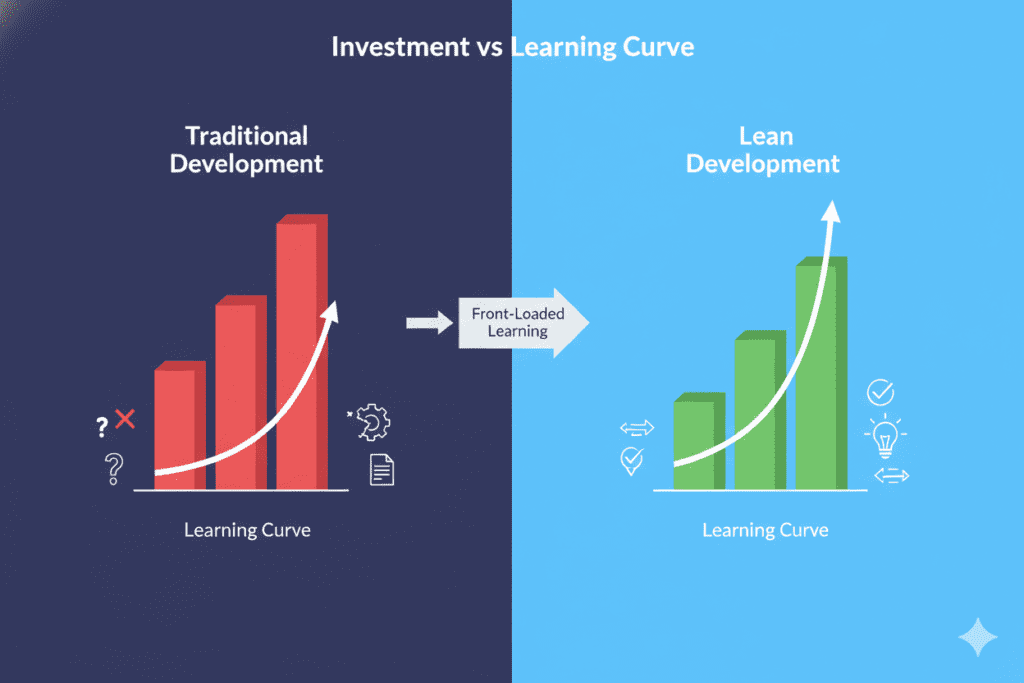
We Focus on Business Outcomes, Not Technical Perfection
Many development agencies are run by engineers who love solving technical puzzles. That’s not a criticism—technical excellence matters. But startups fail because they build products nobody wants, not because they chose MongoDB instead of PostgreSQL.
At BkAbhi, every technical decision is evaluated against business outcomes. Will this help us ship faster? Will this make learning from users easier? Does this directly support testing our riskiest assumption? If the answer is no, we probably don’t need it in the MVP.
We Provide Honest Guidance, Even When It’s Not What You Want to Hear
I’ve turned down projects because I didn’t think the founder’s idea was ready for development. I’ve told potential clients to spend four more weeks doing customer interviews instead of jumping into coding. Sometimes this costs us projects, but it builds trust with the founders we do work with.
We’d rather have you succeed with a smaller project than fail with a big one. If we don’t think your idea is ready, or if we think there’s a leaner path to validation than the one you’re proposing, we’ll tell you. Honestly.
We Set You Up for Life After the MVP
Our lean product development services don’t end when we hand over your MVP. We provide comprehensive documentation, architecture diagrams, and codebase walkthroughs so you understand what you’re getting. We help you hire or transition to an in-house team when the time is right. We create roadmaps for scaling when you’ve validated product-market fit.
Most importantly, we teach you our thinking process so you can make better product decisions going forward. Our goal isn’t to create dependency—it’s to empower you to run your product organization confidently, whether you continue working with us or not.
Taking the Next Step: How to Start Your Lean Product Development Journey

You’ve read this far, which means you’re serious about building your product the right way. You understand that lean product development services aren’t about cutting corners—they’re about cutting through uncertainty to find what customers actually value.
So what’s your next move?
Step 1: Document Your Core Assumptions
Before reaching out to any development service, spend a few hours writing down your assumptions. What do you believe about your customers? About your market? About what problem matters most? About what people will pay?
Write them down and rank them by risk. Which assumptions, if wrong, would completely invalidate your business model? Those are the ones your MVP needs to test first.
Step 2: Conduct Real Customer Development
Talk to 20 potential customers. Not to pitch them on your solution, but to understand their problem. Ask about their current approach, what frustrates them about it, what they’ve tried before, and what they’d be willing to pay to solve it better.
You’ll learn more from these 20 conversations than from three months of building based on assumptions.
Step 3: Define What “Validated” Looks Like
Before you build anything, decide what success looks like. Not vague goals like “people like it,” but specific metrics: “15 people pay $47 for a three-month subscription” or “100 people complete the core workflow within their first week.”
Having clear validation criteria prevents you from moving goalposts when results don’t match expectations.
Step 4: Reach Out to BkAbhi for a Strategy Session
Once you’ve done this foundational work, you’re ready to explore lean product development services. At BkAbhi, we offer free 45-minute strategy sessions where we review your assumptions, discuss your validation goals, and map out the leanest path from here to validated learning.
We’ll be honest about whether we think you’re ready to build, what we’d recommend building first, and what a partnership with BkAbhi would look like. No pressure, no sales tactics—just honest assessment based on our experience helping hundreds of founders.
Explore more insights on BkAbhi and learn from real-world experience at BkAbhi. Whether you’re a first-time founder or a serial entrepreneur, our blog shares practical strategies, honest lessons, and actionable frameworks for building products that matter.
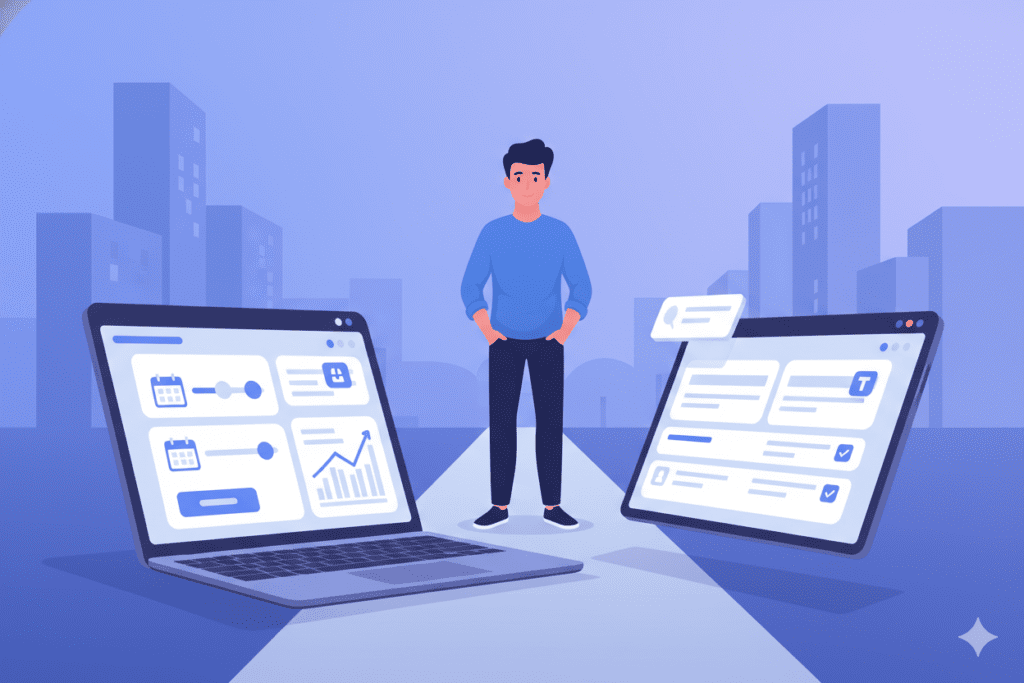
The Fork in the Road: Two Paths, One Decision
Here’s the reality you’re facing right now: you have two paths forward.
Path One: You can take the traditional approach. Hire a development agency, spec out every feature you can imagine, sign a contract for $400,000 and 18 months, and hope that when you finally launch, customers want what you’ve built. Statistically, you have about a 42% chance of discovering they don’t—after you’ve spent most of your runway.
Path Two: You can embrace lean product development services. Build only what you need to test your riskiest assumptions. Launch in weeks, not months. Learn from real users while you still have runway to pivot. Iterate based on evidence, not opinions. And when you do find product-market fit, scale from a foundation of validated learning.
Rachel, the founder I mentioned at the beginning of this article, eventually chose Path Two. After her expensive failure, she rebuilt using lean principles. Her new product cost $48,000 to build, took nine weeks, and reached $30,000 in monthly recurring revenue within four months of launch.
“The hardest part wasn’t learning to build lean,” Rachel told me recently. “It was letting go of my attachment to the original vision and embracing what customers actually needed. My new product is completely different from what I initially imagined—and infinitely more successful.”
Your Product, Your Terms, Your Timeline
The startup world is full of stories about unicorns that seemed to appear overnight. What those stories rarely mention is the months or years of validated learning, failed experiments, and strategic pivots that preceded success. Behind every “overnight success” is a team that learned to build lean, measure ruthlessly, and pivot without ego.
Lean product development services don’t guarantee success. No development approach can do that. Markets are uncertain, competition is fierce, and sometimes great products fail for reasons beyond your control.
But what lean product development services can guarantee is that you’ll learn faster, spend smarter, and maintain the runway necessary to keep iterating until you find what works. You’ll make decisions based on data instead of hope. You’ll ship real products instead of perfect fantasies.
Most importantly, you’ll still be in the game when competitors who built the traditional way have already burned out.
Start building smarter with BkAbhi. Our lean product development services help founders like you transform ideas into validated products without gambling your entire vision on untested assumptions.
The question isn’t whether you’ll build your product. The question is whether you’ll build it the expensive way or the smart way.
Choose wisely.
Suggested Internal Links
- The Real Truth About Micro SaaS Development Cost – Links to the discussion about eliminating waste and focusing on core features
- MVP Development Roadmap for Non-Technical Founders – Links to the section about non-technical founders
- Cost to Build MVP in 2026 – Links to the pricing models section
- 7 Reasons Why Choosing the Right SaaS Development Company – Links to the section about selecting development partners
- Hire React Developer for Dashboard Projects – Links to the technical foundation discussion
Suggested External Links
- CB Insights – Why Startups Fail Report (https://www.cbinsights.com/research/report/startup-failure-reasons-top/) – Links to the statistic about 42% of startups failing due to lack of market need
- Eric Ries – The Lean Startup Principles (https://theleanstartup.com/principles) – Links to the discussion of Build-Measure-Learn cycles
- Harvard Business Review – The Lean Startup Movement – Links to validation of lean methodologies in enterprise contexts
- Product Management Resources – Jobs to Be Done Framework (official JTBD documentation) – Links to customer development discussion
- Y Combinator – How to Build an MVP (https://www.ycombinator.com/) – Links to the validation and iteration section