

Sarah had spent three years as a hospital administrator, watching doctors waste precious minutes navigating clunky, outdated software systems. Every day, she witnessed the same frustration: physicians clicking through seven different screens just to update a patient’s medication. The healthcare system was drowning in inefficiency, and Sarah knew there had to be a better way.
She had an idea for a streamlined patient management SaaS platform that could reduce administrative time by 60%. But when she approached a development agency with her vision, they quoted her $250,000 and an 18-month timeline. Sarah’s heart sank. She didn’t have that kind of money or time—and neither did the patients whose care was suffering every single day.
This is the exact moment where healthcare SaaS MVP development becomes not just a smart business strategy, but a lifeline for innovation in an industry desperate for change.
Why Healthcare SaaS MVP Development Matters More Than Ever
The healthcare industry is at a breaking point. According to recent market analysis, 68% of healthcare organizations report that inefficient, disconnected software systems are actively hindering their digital transformation efforts. Meanwhile, healthcare data breaches now cost an average of $9.77 million—nearly double the financial sector’s average.
Yet here’s the paradox: while the demand for innovative healthcare solutions has never been higher, 73% of healthcare SaaS projects fail within their first five years, primarily due to cost overruns and compliance complexity.
Healthcare SaaS MVP development offers a smarter path forward. Instead of betting your entire budget on an unproven concept, you can validate your idea with real users, ensure regulatory compliance from day one, and iterate based on actual feedback—all while keeping costs manageable.
Understanding Healthcare SaaS MVP Development: More Than Just a Prototype
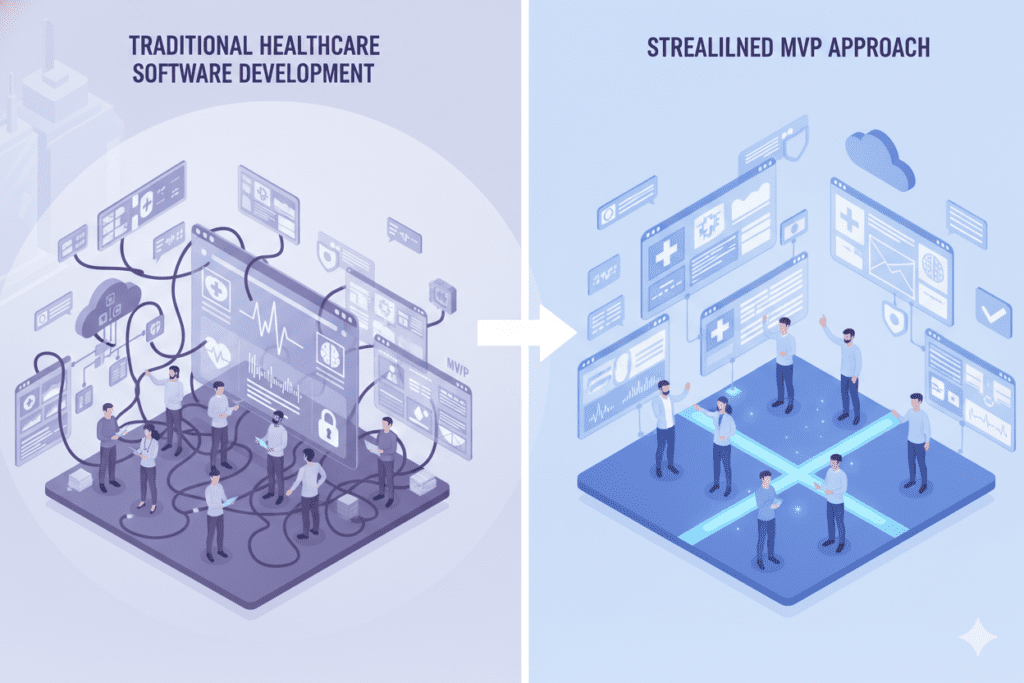
Let’s be crystal clear about what we’re discussing. A healthcare SaaS MVP (Minimum Viable Product) isn’t just a stripped-down prototype or a proof of concept. It’s a functional, compliant, market-ready version of your software that focuses exclusively on solving one critical problem exceptionally well.
Think of it this way: if your vision is to build a comprehensive electronic health records system, your MVP might focus solely on appointment scheduling with seamless calendar integration and automated patient reminders. It won’t have every feature you’ve dreamed of, but what it does have works flawlessly and solves a real pain point for your target users.
The beauty of healthcare SaaS MVP development lies in its strategic restraint. You’re not compromising on quality or compliance—you’re simply being ruthlessly focused on what matters most to validate your core hypothesis.
The Healthcare SaaS Market Reality Check
Before we dive deeper, let’s examine the landscape you’re entering. The global SaaS market is projected to reach $1,016.44 billion by 2032, growing at a compound annual growth rate of 13.92%. Healthcare represents one of the fastest-growing segments within this ecosystem.
But here’s what most founders don’t realize: healthcare SaaS companies that achieve compliance certifications command 37% higher valuations than general tech companies. The compliance burden that scares away many competitors is actually your competitive moat—if you approach it correctly from the start.
The Real Cost of Healthcare SaaS MVP Development (And Why It’s Worth Every Penny)
Let’s talk numbers, because this is where many founders make their first critical mistake.
Standard SaaS MVP development typically runs between $25,000 and $50,000. Add healthcare compliance requirements, and you’re looking at $72,000 to $210,000—a 200-300% increase. Some founders see these numbers and immediately look for shortcuts. Don’t. This is exactly where cutting corners will cost you exponentially more later.
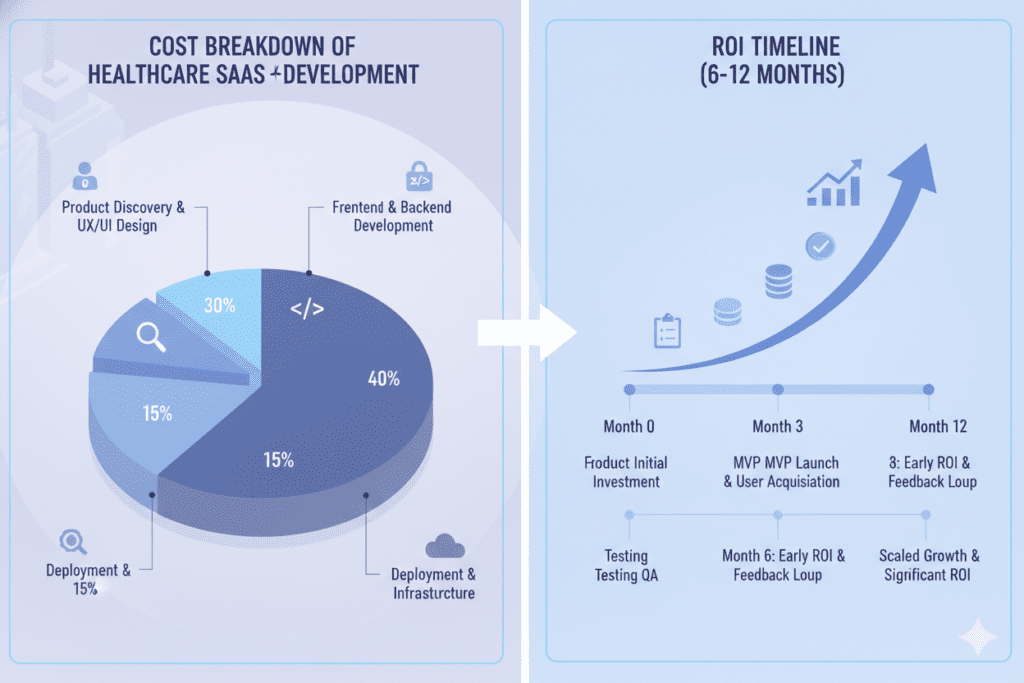
Here’s the breakdown of where your investment actually goes in healthcare SaaS MVP development:
Core Development (40-50% of budget): This covers your actual application development—frontend, backend, database architecture, and basic feature implementation. For a typical healthcare MVP, expect 3-6 months of development time with a dedicated team.
Compliance & Security (30-40% of budget): HIPAA compliance isn’t optional, and it’s not cheap. This includes implementing encryption for data at rest and in transit, role-based access controls, audit logging, secure authentication systems, and comprehensive security documentation. You’re also paying for the expertise needed to navigate regulations correctly the first time.
Infrastructure & Hosting (10-15% of budget): HIPAA-compliant hosting environments cost more than standard cloud services. You’ll need to partner with certified providers like AWS, Google Cloud, or Microsoft Azure, all of which offer HIPAA-eligible services but at premium pricing tiers.
Testing & Quality Assurance (10-15% of budget): Healthcare software can’t afford bugs that compromise patient data or clinical workflows. Comprehensive testing, including security audits and compliance verification, is non-negotiable.
But here’s the game-changer that justifies every dollar: compliance-first companies can charge 3-5x more for enterprise contracts. A 15-employee healthcare SaaS company that invested $95,000 in initial compliance and $35,000 annually in maintenance was able to command premium pricing that generated 8x ROI within 24 months.
The HIPAA Compliance Maze: Navigating Healthcare SaaS MVP Development’s Biggest Challenge
If you’re building any healthcare SaaS MVP that touches Protected Health Information (PHI), HIPAA compliance isn’t just important—it’s the law. And violations carry penalties of up to $1.5 million per violation category per year.
Let me share a story that illustrates why getting this right matters. In 2020, there were 616 data breaches affecting healthcare records, exposing over 28 million patient records. The companies responsible paid millions in fines, suffered irreparable reputation damage, and many ultimately failed.
What Actually Triggers HIPAA in Healthcare SaaS MVP Development?
Here’s the critical question every founder asks: “Does my MVP actually need to be HIPAA compliant?”
HIPAA applies whenever you create, receive, maintain, or transmit PHI. PHI includes any health information that can be linked to an individual—medical records, treatment histories, billing information, even appointment schedules if they contain patient names.
If your healthcare SaaS MVP falls into this category, you’re classified as either a Covered Entity (if you’re a healthcare provider) or a Business Associate (if you’re a vendor providing services to healthcare organizations). Both require full HIPAA compliance.
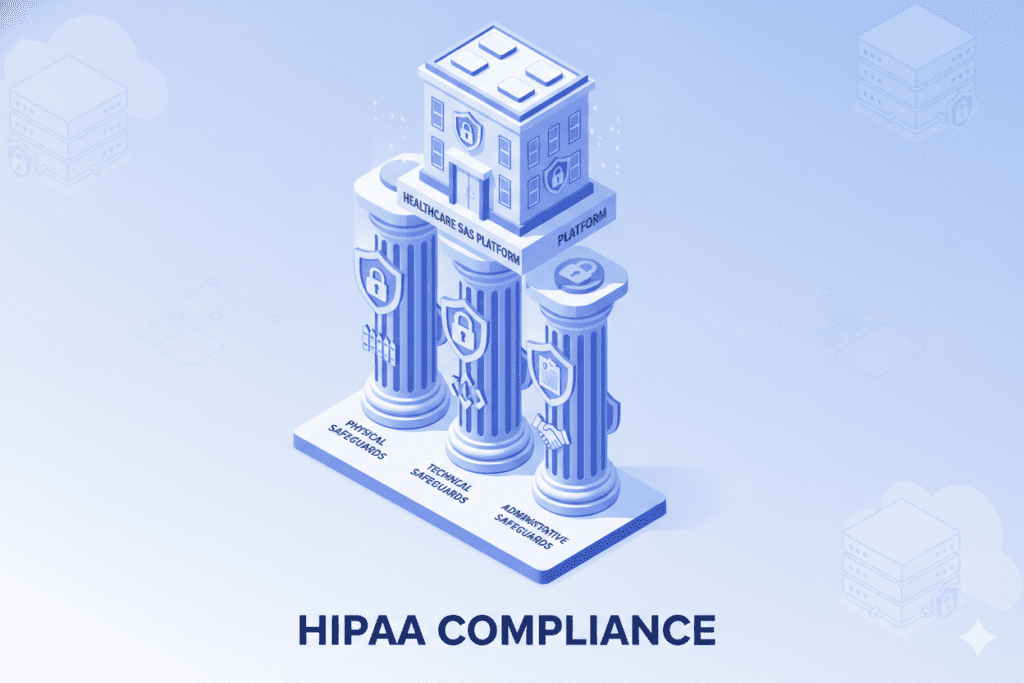
The Three Pillars of HIPAA Compliance in Healthcare SaaS MVP Development
The Privacy Rule: This governs how PHI can be used and disclosed. Your MVP must have clear policies about data usage, patient rights (including access, amendment, and deletion requests), and minimum necessary standards (only accessing the data you actually need for your specific purpose).
The Security Rule: This mandates specific safeguards for electronic PHI (ePHI). You need:
- Administrative Safeguards: Risk assessments, workforce training, incident response procedures, and Business Associate Agreements with all third-party vendors
- Physical Safeguards: Facility access controls, workstation security, device and media controls
- Technical Safeguards: Encryption, access controls, audit controls, transmission security, and authentication mechanisms
The Breach Notification Rule: If you experience a data breach affecting 500 or more individuals, you must notify affected parties, the Department of Health and Human Services, and potentially the media—all within 60 days. Your healthcare SaaS MVP development must include a comprehensive breach response plan from day one.
The Business Associate Agreement: Your Compliance Foundation
Every HIPAA-compliant healthcare SaaS MVP requires Business Associate Agreements (BAAs) with any vendor that might access PHI. This includes your cloud hosting provider, email service, analytics platforms, and even your project management tools if they might contain patient information.
At BkAbhi, we’ve guided numerous healthcare startups through this compliance maze. The key is treating compliance as a product feature, not a checkbox. When you build security and privacy into your healthcare SaaS MVP development process from the foundation, it becomes a competitive advantage rather than a burden.
Choosing Your Tech Stack for Healthcare SaaS MVP Development
Your technology choices will determine whether your healthcare SaaS MVP scales efficiently or collapses under regulatory requirements. Here’s what actually works in production healthcare environments.
Backend Architecture: The Foundation of Your Healthcare SaaS MVP
For healthcare SaaS MVP development, microservices architecture offers significant advantages over monolithic systems. While monolithic might seem simpler initially, microservices provide:
Isolation of sensitive data: You can compartmentalize PHI handling into specific services with enhanced security Easier compliance auditing: Security teams can audit individual services rather than entire systems Scalability: Individual components can scale independently based on demand Resilience: Service failures don’t crash your entire system
Recommended Backend Technologies:
- Node.js: Excellent for real-time healthcare applications like telemedicine platforms or patient monitoring systems. Its event-driven architecture handles concurrent connections efficiently.
- Python (Django/Flask): Ideal for data-heavy healthcare applications. Python’s extensive libraries for data analysis and machine learning make it perfect for MVPs involving diagnostic support or predictive analytics.
- Ruby on Rails: Enables rapid healthcare SaaS MVP development with excellent security features built-in. Rails’ convention-over-configuration philosophy accelerates development without compromising quality.
Database Choices for HIPAA-Compliant Healthcare SaaS MVP Development
Your database must support encryption at rest and in transit while maintaining performance. Leading options include:
PostgreSQL: Open-source, highly secure, supports advanced encryption, and offers excellent compliance audit capabilities. Many healthcare organizations prefer PostgreSQL for its reliability and security track record.
MongoDB: NoSQL flexibility for healthcare data that doesn’t fit traditional schemas. Particularly useful for patient records with varying data structures across different departments or specialties.
AWS Aurora or Google Cloud SQL: Managed database services that come pre-configured for HIPAA compliance, reducing your operational burden significantly.
Frontend Frameworks That Work in Healthcare Environments
Healthcare users demand intuitive interfaces that work flawlessly across devices. Your healthcare SaaS MVP development should consider:
React: Industry standard with extensive component libraries. React’s virtual DOM ensures smooth performance even with complex healthcare dashboards displaying real-time patient data.
Vue.js: Excellent for smaller teams building healthcare SaaS MVPs. Its gentle learning curve means faster development without sacrificing capability.
Angular: Best for enterprise-grade healthcare applications where you need strict typing and comprehensive tooling from day one.
The Cloud Hosting Decision for Healthcare SaaS MVP Development
Not all cloud providers are created equal when it comes to healthcare compliance. You need a HIPAA-eligible hosting environment, which narrows your options to:
Amazon Web Services (AWS): Offers the most comprehensive suite of HIPAA-eligible services. AWS will sign a BAA and provides detailed compliance documentation. Their HIPAA-eligible services include EC2, RDS, S3, and many others.
Google Cloud Platform (GCP): Excellent for healthcare SaaS MVPs leveraging AI/ML capabilities. Google’s healthcare API integrations and FHIR support make interoperability easier.
Microsoft Azure: Particularly strong for healthcare organizations already in the Microsoft ecosystem. Azure’s compliance certifications extend beyond HIPAA to HITRUST, making enterprise sales easier.
Essential Third-Party Integrations for Healthcare SaaS MVP Development
Your MVP likely needs to integrate with existing healthcare infrastructure. Plan for these standards from the start:
HL7 and FHIR: Industry standards for health information exchange. If your healthcare SaaS MVP needs to communicate with Electronic Health Record (EHR) systems, FHIR (Fast Healthcare Interoperability Resources) is becoming the modern standard.
Single Sign-On (SSO): Healthcare organizations often require SSO for security and user convenience. Support for SAML 2.0 and OAuth 2.0 is typically expected.
Billing and Payment Systems: If your MVP handles transactions, you’ll also need PCI DSS compliance in addition to HIPAA.
The 90-Day Healthcare SaaS MVP Development Roadmap
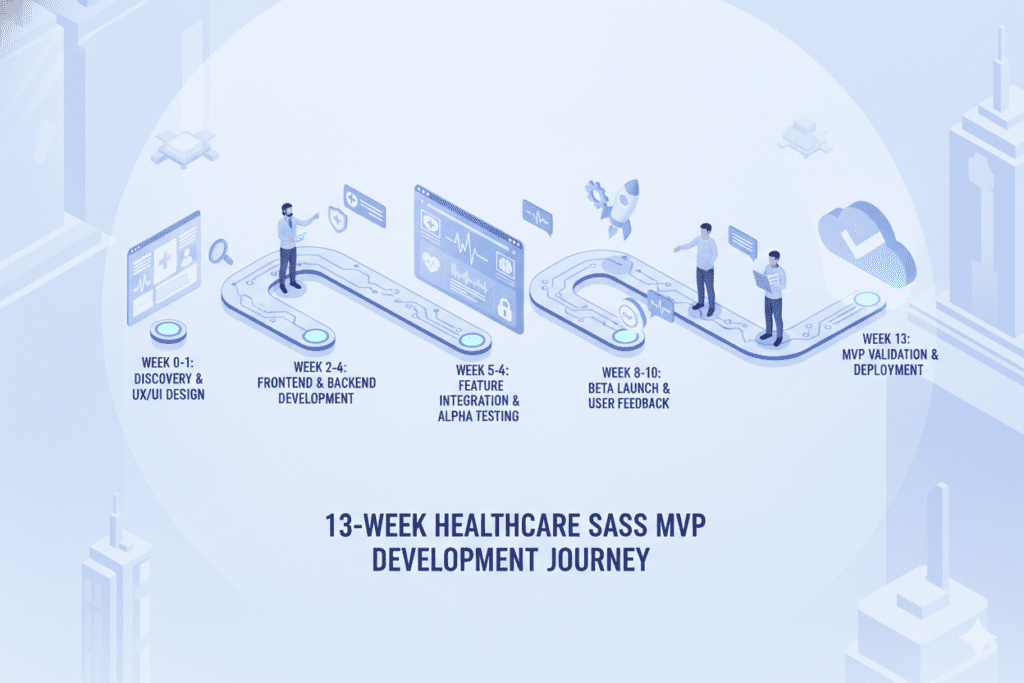
Let’s get tactical. Here’s how to go from concept to functioning healthcare SaaS MVP in 90 days—a timeline we’ve refined with real clients at BkAbhi.
Weeks 1-2: Discovery and Compliance Planning
User Research and Validation: Interview at least 20-30 potential users across different roles. For a patient management system, that means talking to physicians, nurses, administrative staff, and actual patients. Document their workflows, pain points, and dealbreakers.
Define Your Core Value Proposition: What is the ONE problem your healthcare SaaS MVP solves better than any existing solution? Write it down in a single sentence. This becomes your north star for every development decision.
Compliance Assessment: Identify which regulations apply to your specific use case. Will you handle PHI? Do you need FDA clearance if your software makes clinical decisions? Document all requirements upfront.
Technical Architecture Planning: Create your system architecture diagram, identifying how data flows through your application and where PHI will be stored, processed, and transmitted.
At BkAbhi, we conduct intensive discovery workshops during these first two weeks, creating high-fidelity wireframes and brand systems that align your vision with compliance requirements. This upfront investment prevents costly pivots later.
Weeks 3-4: MVP Scope Definition and Design
Feature Prioritization: List every feature you’ve imagined, then ruthlessly cut to the absolute minimum. Use the MoSCoW method:
- Must Have: Features without which the MVP cannot function
- Should Have: Important but not critical for initial launch
- Could Have: Nice-to-haves that can wait for v2.0
- Won’t Have: Explicitly document what’s out of scope
UI/UX Design: Create user flows and mockups for your core features. Healthcare interfaces must be intuitive—clinicians won’t tolerate complicated navigation when they’re treating patients.
Security Design: Map out your authentication flows, data encryption approach, access control models, and audit logging strategy. This isn’t something you bolt on later.
Weeks 5-10: Core Development Sprint
This is where your healthcare SaaS MVP development accelerates. Following agile methodology with weekly sprints:
Sprint 1-2: Infrastructure setup and authentication
- Configure HIPAA-compliant hosting environment
- Implement secure user authentication with MFA
- Set up encrypted database and backup systems
- Establish CI/CD pipeline with security scanning
Sprint 3-4: Core feature development
- Build your primary user flows
- Implement data models and business logic
- Create basic admin dashboards
- Integrate necessary third-party services
Sprint 5-6: Security and compliance implementation
- Implement comprehensive audit logging
- Add role-based access controls
- Configure data encryption for all PHI
- Build user consent and privacy controls
Weeks 11-12: Testing, Security Audits, and Compliance Verification
Functional Testing: Verify every user flow works as intended across different devices and browsers. Healthcare professionals use everything from desktop workstations to tablets to smartphones.
Security Testing: Conduct penetration testing, vulnerability scanning, and security code review. Even for an MVP, security cannot be compromised.
Compliance Verification: Review your implementation against HIPAA requirements. Document how you’ve addressed each required safeguard.
User Acceptance Testing: Get your MVP in front of real users. Watch them use it without guidance—you’ll discover usability issues you never anticipated.
Week 13: Soft Launch and Iteration Planning
Limited Release: Deploy to a small group of beta users (5-10 organizations or individual practitioners). Monitor closely for bugs, usability issues, and security concerns.
Gather Feedback: Implement analytics and user feedback mechanisms. Which features are most used? Where do users get stuck? What unexpected workflows emerge?
Document and Learn: Create a comprehensive post-launch report documenting what worked, what didn’t, and what you learned about your market.
Plan Your Roadmap: Based on real user data, prioritize your next development cycle. What features will provide maximum value to the most users?
Real-World Healthcare SaaS MVP Development Case Studies
Case Study 1: Telehealth Platform MVP
The Challenge: A founding team wanted to create a comprehensive telehealth platform connecting patients with specialists for remote consultations.
The Smart Approach: Instead of building every feature, they focused their healthcare SaaS MVP development on a single specialty—dermatology consultations. Patients could upload photos, schedule appointments, and conduct video consultations with dermatologists.
Key Decisions:
- Used Twilio for HIPAA-compliant video calls rather than building custom video infrastructure
- Integrated with existing scheduling software instead of building from scratch
- Limited initial launch to three dermatology practices in one geographic region
Results: They launched in 4 months with a $75,000 budget. The focused MVP validated market demand, secured $500,000 in seed funding, and provided the foundation to expand to other specialties.
Lessons Learned: Specialization beats generalization in healthcare SaaS MVP development. A solution that works exceptionally well for one use case will attract users faster than a mediocre solution trying to serve everyone.
Case Study 2: Patient Data Management System
The Challenge: A hospital administrator (similar to our opening story about Sarah) wanted to streamline patient data updates across departments.
The Smart Approach: The healthcare SaaS MVP development focused exclusively on medication management—allowing physicians to update prescriptions with automatic notifications to pharmacy and nursing staff.
Key Decisions:
- Built RESTful APIs for EHR integration from day one
- Implemented HL7 FHIR standards for data exchange
- Partnered with AWS for HIPAA-compliant infrastructure
- Started with just two hospital departments before expanding
Results: Within 6 months, they demonstrated a 43% reduction in medication update errors and saved an average of 12 minutes per physician per day. The hospital system expanded the solution to all departments and later licensed it to other healthcare networks.
Lessons Learned: Integration capabilities matter more than feature quantity. The ability to work seamlessly with existing systems made this MVP immediately valuable despite its limited scope.
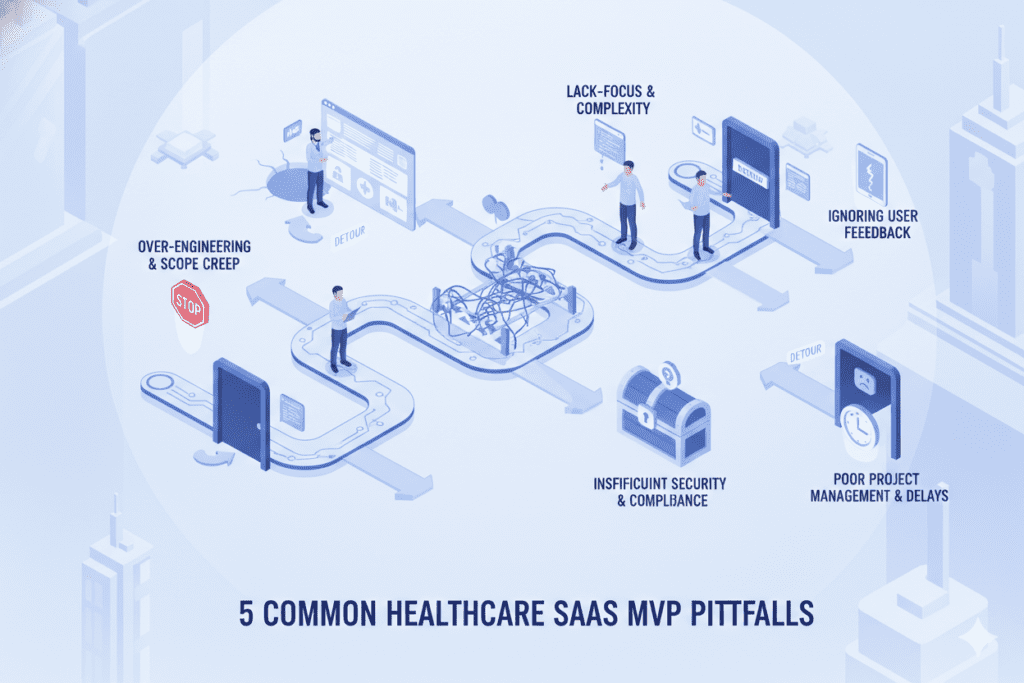
Common Healthcare SaaS MVP Development Mistakes (And How to Avoid Them)
After working with dozens of healthcare startups at BkAbhi, I’ve seen the same mistakes repeated. Here’s how to avoid them.
Mistake 1: Treating Compliance as an Afterthought
The Problem: Founders build their entire MVP, then try to “add compliance” at the end. This results in expensive rewrites, security vulnerabilities, and sometimes complete rebuilds.
The Solution: Design compliance into your healthcare SaaS MVP development architecture from day one. Choose HIPAA-eligible hosting, implement encryption from the start, and build audit logging into every feature as you develop it.
BkAbhi’s Approach: We begin every healthcare project with a compliance-first workshop, mapping regulatory requirements to technical architecture before writing a single line of code. This adds 2-3 weeks upfront but prevents 6+ months of rework.
Mistake 2: Building Too Many Features
The Problem: Founders create a “minimum” viable product with 47 features because they’re afraid of launching something too simple. The result? Extended development time, higher costs, and delayed market validation.
The Solution: Ruthlessly focus on your core value proposition. Your healthcare SaaS MVP development should solve ONE problem exceptionally well. Additional features come after you’ve proven users want and will pay for your core solution.
Real Example: A medical scheduling startup initially planned 23 features. We convinced them to launch with just 3: book appointment, send reminder, sync calendar. They validated their market in 3 months instead of the planned 12 and added features based on actual user requests rather than assumptions.
Mistake 3: Ignoring Interoperability Requirements
The Problem: Healthcare SaaS tools don’t exist in isolation. If your MVP can’t integrate with existing EHR systems, practice management software, or billing systems, healthcare organizations won’t adopt it—no matter how good your standalone features are.
The Solution: Plan for integration from the beginning of your healthcare SaaS MVP development. Implement industry-standard APIs (FHIR, HL7), provide webhook support, and offer export capabilities in common formats.
Mistake 4: Underestimating User Training and Change Management
The Problem: Healthcare professionals are extraordinarily busy and often resistant to workflow changes. A technically perfect MVP fails if users don’t understand how to use it or see it as adding work rather than reducing it.
The Solution: Build simplicity and intuitive design into your healthcare SaaS MVP development process. Include contextual help, video tutorials, and responsive support. Consider offering implementation assistance as part of your early customer acquisition strategy.
Mistake 5: Choosing the Wrong First Customer
The Problem: Desperate to get any early adopter, founders partner with organizations that aren’t a good fit for their MVP’s capabilities. This leads to scope creep, feature requests that derail your roadmap, and dissatisfied reference customers.
The Solution: Be strategic about early partnerships. Target organizations that match your MVP’s current capabilities and share your vision for where the product is heading. A thrilled customer using 5 features is more valuable than a disappointed customer wanting 50.
How BkAbhi Accelerates Healthcare SaaS MVP Development
Let me be transparent about what makes our approach to healthcare SaaS MVP development different at BkAbhi.
Our Compliance-First Development Philosophy
We don’t treat HIPAA compliance as a separate workstream that happens alongside development. It’s woven into every technical decision, every architectural choice, and every line of code we write.
When you engage BkAbhi for healthcare SaaS MVP development, compliance isn’t bolted on at the end—it’s baked into the foundation. Our development teams include professionals who understand both healthcare regulations and modern software architecture, ensuring your MVP meets legal requirements without sacrificing innovation.
Rapid Prototyping with Real-World Testing
Our approach to healthcare SaaS MVP development emphasizes rapid iteration with real user feedback. We create high-fidelity prototypes in the first two weeks that look and feel like the final product. This allows healthcare stakeholders to interact with your vision before we write production code, catching usability issues when they’re cheap to fix.
We’ve refined a process that compresses traditional 12-18 month healthcare software development cycles into focused 90-day sprints, without cutting corners on quality or compliance.
End-to-End Service from Concept to Launch
Healthcare SaaS MVP development requires more than just coding. You need:
- Strategic Planning: Market research, competitive analysis, and business model validation
- Compliance Consulting: Regulatory assessment and implementation guidance
- User Experience Design: Interfaces that work for busy healthcare professionals
- Technical Architecture: Scalable, secure infrastructure that grows with your success
- Quality Assurance: Comprehensive testing that catches issues before users do
- Launch Support: Deployment, monitoring, and rapid issue resolution
At BkAbhi, we provide all these services under one roof, eliminating the coordination headaches of managing multiple vendors while ensuring every piece of your healthcare SaaS MVP development aligns with your vision.
Proven Track Record in Healthcare Technology
We’ve guided healthcare startups through successful MVP launches across multiple specialties—from telemedicine platforms to practice management systems to patient engagement tools. Our experience means we can anticipate challenges you haven’t encountered yet and guide you around pitfalls that sink less experienced teams.
Every healthcare SaaS MVP development project teaches us something new, and we bring those learnings to every client engagement. You benefit from the collective wisdom of dozens of healthcare technology implementations.
The Future of Healthcare SaaS MVP Development: Trends to Watch
As you plan your healthcare SaaS MVP development strategy, consider these emerging trends shaping the industry’s future.
AI and Machine Learning Integration
Healthcare is rapidly embracing AI for diagnostic support, predictive analytics, and workflow automation. Smart healthcare SaaS MVP development considers how AI might enhance your core features, even if initial implementation is limited. Build your data architecture to support future machine learning applications.
Interoperability as a Competitive Advantage
The healthcare industry is moving toward true data interoperability through standards like FHIR. MVPs that embrace these standards from day one position themselves as integration-friendly solutions that larger healthcare systems want to adopt.
Patient-Centric Design
The best healthcare SaaS products are moving beyond serving only clinicians to creating exceptional patient experiences. Even B2B healthcare SaaS MVP development should consider the end patient experience, as healthcare organizations increasingly evaluate tools based on patient satisfaction metrics.
Value-Based Care Support
As healthcare shifts from fee-for-service to value-based care models, SaaS tools that demonstrate measurable impact on patient outcomes and cost reduction will command premium pricing. Consider how your healthcare SaaS MVP can track and report on value metrics relevant to your target market.
Remote Care Capabilities
The pandemic permanently shifted healthcare toward hybrid in-person/remote models. Healthcare SaaS MVP development should assume that remote access, mobile functionality, and asynchronous communication aren’t optional features—they’re table stakes.
Taking the Next Step in Your Healthcare SaaS MVP Development Journey
If you’ve read this far, you’re serious about building a healthcare SaaS solution that makes a real difference. Let’s talk about your next concrete steps.
Validate Your Market Opportunity
Before investing in healthcare SaaS MVP development, confirm that your solution solves a real problem people will pay to solve. Conduct at least 20-30 user interviews with potential customers. Ask about their current workflows, pain points, and willingness to adopt new solutions. The insights you gain will shape every aspect of your MVP.
Secure Strategic Partnerships Early
Identify healthcare organizations willing to collaborate on your MVP development. These design partners provide invaluable feedback, beta testing, and potentially your first reference customers. They’re also more forgiving of early-stage limitations because they’re invested in your success.
Assemble the Right Team
Healthcare SaaS MVP development requires expertise spanning healthcare domain knowledge, regulatory compliance, user experience design, and software engineering. Whether you’re building an internal team or partnering with an agency like BkAbhi, ensure you have all these bases covered.
Create a Realistic Budget and Timeline
Factor in the full cost of healthcare SaaS MVP development, including compliance, security, hosting, and post-launch support. Underfunding your MVP leads to either cutting critical corners or running out of resources before launch. Plan for $75,000-$150,000 and 3-6 months as a baseline for a properly built healthcare SaaS MVP.
Start with Compliance Architecture
Engage compliance expertise early—ideally during your initial planning phase. Understanding regulatory requirements before making technical decisions prevents expensive rebuilds. This is exactly where partnering with experienced healthcare SaaS developers provides immediate ROI.
Your Healthcare SaaS MVP Development Success Starts Here
The healthcare industry desperately needs better software solutions. Clinicians are buried in administrative work, patients struggle to navigate fragmented systems, and healthcare organizations face mounting pressure to improve outcomes while reducing costs.
Your healthcare SaaS MVP could be part of the solution—but only if you approach development strategically. The path from concept to successful launch requires expertise in healthcare regulations, user-centered design, secure architecture, and agile development practices.
This is where BkAbhi’s specialized healthcare SaaS MVP development services make the difference. We’ve guided numerous healthcare innovators through the complexity of building compliant, user-friendly, market-ready MVPs that validate ideas and attract investment.
Whether you’re a healthcare professional frustrated with existing tools, an entrepreneur who’s identified a massive market opportunity, or an established company expanding into healthcare technology, your next step is clear: transform your vision into a concrete plan.
Explore more insights on BkAbhi about healthcare technology development, SaaS architecture, and compliance best practices. Our blog features real-world case studies, technical deep-dives, and strategic guidance from teams who’ve successfully navigated the healthcare SaaS landscape.
Start building smarter with BkAbhi. Schedule a discovery call with our healthcare SaaS specialists to discuss your project, get a realistic scope and timeline, and learn how we can accelerate your path from idea to market-ready MVP.
Learn from real-world experience at BkAbhi. Every healthcare SaaS MVP development project teaches new lessons about what works, what doesn’t, and how to navigate the unique challenges of healthcare technology. We bring that expertise to every client engagement, helping you avoid costly mistakes and capitalize on proven strategies.
The healthcare industry needs your innovation. Let’s build it right—compliant, user-focused, and positioned for success from day one.
Your future users are waiting. Let’s get started.
Suggested External Links
- HIPAA Official Website (https://www.hhs.gov/hipaa/) – when discussing compliance requirements
- FHIR Documentation (https://www.hl7.org/fhir/) – when mentioning interoperability standards
- AWS HIPAA Compliance (https://aws.amazon.com/compliance/hipaa-compliance/) – when discussing cloud hosting options
- Healthcare IT News (https://www.healthcareitnews.com/) – when referencing industry trends
- TechCrunch Healthcare (https://techcrunch.com/tag/healthcare/) – for market research context
- Grand View Research Healthcare SaaS Market Report – when citing market size statistics