
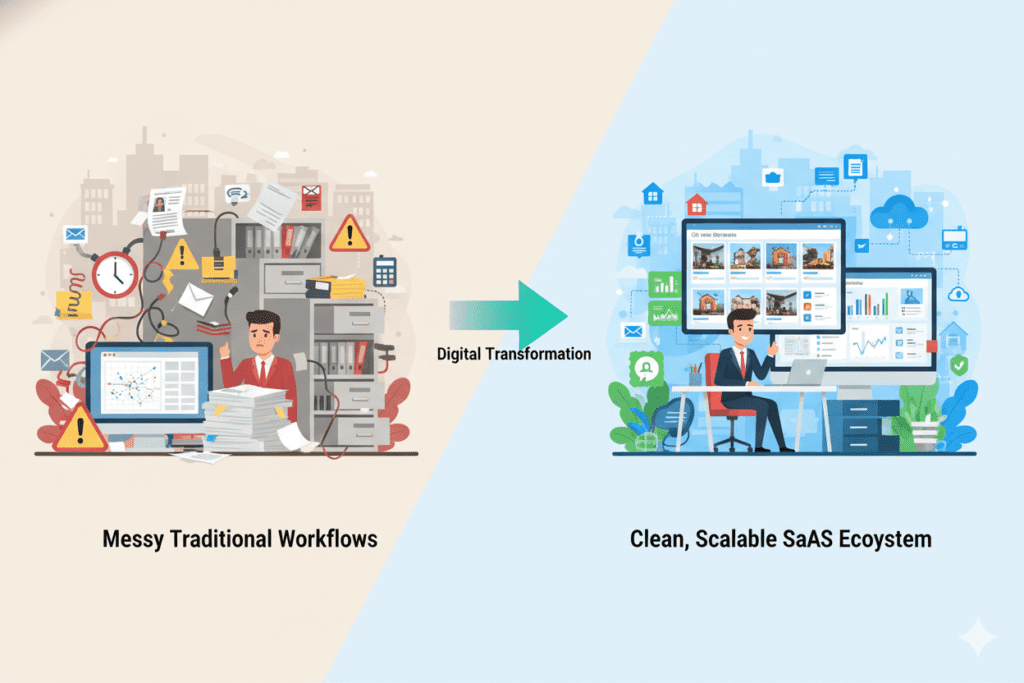
Sarah Martinez sat in her cramped office, surrounded by stacks of papers, three different Excel files open on her screen, and a phone that wouldn’t stop ringing. As a property manager for a mid-sized real estate firm, she was drowning in manual processes—tracking lease renewals on sticky notes, juggling maintenance requests through email threads, and constantly updating spreadsheets that somehow always had outdated information.
“There has to be a better way,” she muttered, closing yet another browser tab.
Sarah’s frustration isn’t unique. Across the real estate industry, professionals are trapped in workflows designed for a pre-digital era. They’re using tools built for general business operations, not the specific complexities of property management, brokerage operations, or real estate investment. And this gap? It represents one of the most significant opportunities in modern software development.
This is where real estate SaaS development enters the picture—not as another buzzword, but as a genuine solution to decades-old operational nightmares.
Why Real Estate Desperately Needs SaaS Solutions
The real estate industry is worth $4.34 trillion globally, making it the third-largest industry in the world. Yet despite its massive scale, it remains one of the least digitized sectors. According to Deloitte’s 2025 commercial real estate outlook, 81% of industry leaders are now prioritizing data and technology spending—a clear signal that transformation is no longer optional.
But here’s what makes this shift different from other industries: real estate professionals aren’t just looking for any software. They need solutions built specifically for their unique challenges.
Consider the typical workflow of a real estate agent. On any given day, they might:
- Show properties to three different clients with vastly different needs
- Update listings across multiple platforms (MLS, Zillow, company website)
- Follow up on 15+ leads at various stages of the buyer’s journey
- Coordinate with lenders, inspectors, and title companies
- Track commission splits and transaction details
- Manage client relationships that span months or even years
Now try doing all of that with a generic CRM, separate email platforms, manual document management, and paper-based contracts. The inefficiency isn’t just frustrating—it’s costing real money and losing deals.
This is precisely the problem that real estate SaaS development solves. But building these solutions requires more than just coding skills. It demands deep industry knowledge, an understanding of complex workflows, and the ability to translate messy real-world operations into clean, intuitive software.
Understanding Real Estate SaaS Development: What Makes It Different
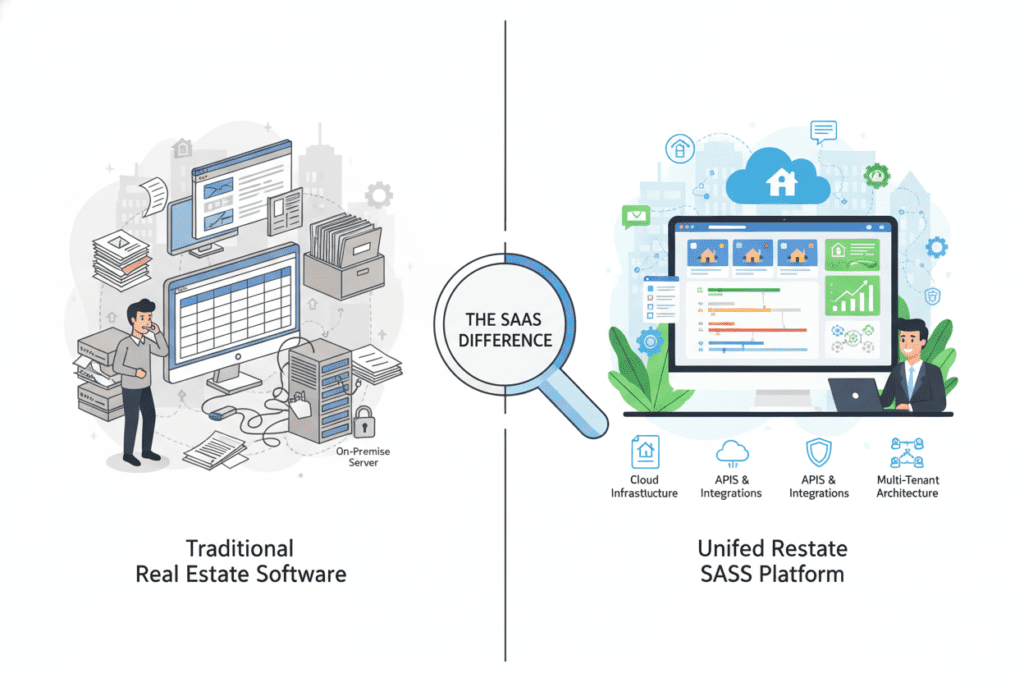
Real estate SaaS development isn’t about building yet another property listing website. It’s about creating cloud-based platforms that fundamentally change how real estate businesses operate.
At its core, Software-as-a-Service delivers applications via the internet, eliminating the need for installation, manual updates, or expensive on-premise infrastructure. For real estate professionals who spend most of their time outside the office, this accessibility is transformative.
But what makes real estate SaaS development uniquely challenging—and uniquely rewarding—is the diversity of stakeholders and use cases:
Property Managers need tools to handle tenant communication, maintenance scheduling, rent collection, and compliance documentation—all while managing dozens or hundreds of units simultaneously.
Real Estate Brokers require CRM systems that track lead sources, automate follow-ups, integrate with MLS data, and provide visibility into their agents’ pipelines without micromanaging.
Developers and Investors need analytics platforms that can perform comparative market analysis, forecast ROI, track construction milestones, and manage complex financing arrangements.
Tenants and Buyers want transparent platforms where they can schedule viewings, submit applications, sign documents electronically, and communicate seamlessly with property professionals.
Each of these groups has different needs, but they’re all part of the same ecosystem. Successful real estate SaaS development connects these stakeholders through integrated workflows that eliminate redundancy and create transparency.
The Three Core Categories of Real Estate SaaS Solutions
According to the National Association of Realtors, the most commonly used tools in real estate firms include e-signature capabilities, comparative market analysis software, multiple listing services, and electronic contract forms. But these represent just the starting point.
Real estate SaaS development typically falls into three main categories:
1. Property Operations & Management Platforms
These are the workhorses of the industry—solutions that handle day-to-day operational tasks:
- Rental Management Tools that automate rent collection, track payments, send late fee reminders, and generate financial reports for property owners
- Maintenance Coordination Systems that allow tenants to submit tickets, automatically route them to appropriate vendors, track completion, and maintain service histories
- Lease Administration Platforms that manage lease terms, monitor expiration dates, automate renewals, and ensure compliance with local regulations
- Tenant Communication Portals that centralize announcements, rent statements, policy updates, and Q&A in one organized space
The development challenge here is creating systems robust enough to handle hundreds of properties and thousands of tenants while remaining simple enough that busy property managers can use them without extensive training.
2. Transaction & Sales Enablement Solutions
These platforms focus on the buying, selling, and leasing process:
- CRM Systems designed specifically for real estate agents, with features like automated lead scoring, property matching algorithms, and transaction pipeline visualization
- Virtual Tour Platforms that enable immersive 360-degree property experiences, reducing the need for in-person showings while maintaining engagement
- Document Management Systems that handle offer letters, counteroffers, disclosures, inspection reports, and closing documents in secure, compliant environments
- Marketplace Platforms that aggregate listings from multiple sources, provide advanced search capabilities, and connect buyers directly with agents
Real estate SaaS development in this category must balance rich functionality with user experience. A clunky interface means lost deals, while a beautiful but limited platform doesn’t serve the complex realities of real estate transactions.
3. Analytics & Investment Platforms
These are the intelligence layers that help stakeholders make smarter decisions:
- Market Analysis Tools that aggregate comparable sales data, forecast price trends, and identify emerging opportunities
- Investment Calculators that model cash flows, calculate cap rates, analyze financing scenarios, and project long-term returns
- Portfolio Management Systems that track property performance, compare assets, identify underperformers, and optimize investment strategies
- Predictive Maintenance Platforms that use AI to forecast when building systems might fail, preventing costly emergency repairs
Developing these solutions requires not just software expertise but also deep understanding of real estate finance, market dynamics, and investment analysis.
The Real Estate SaaS Development Process: From Idea to Launch
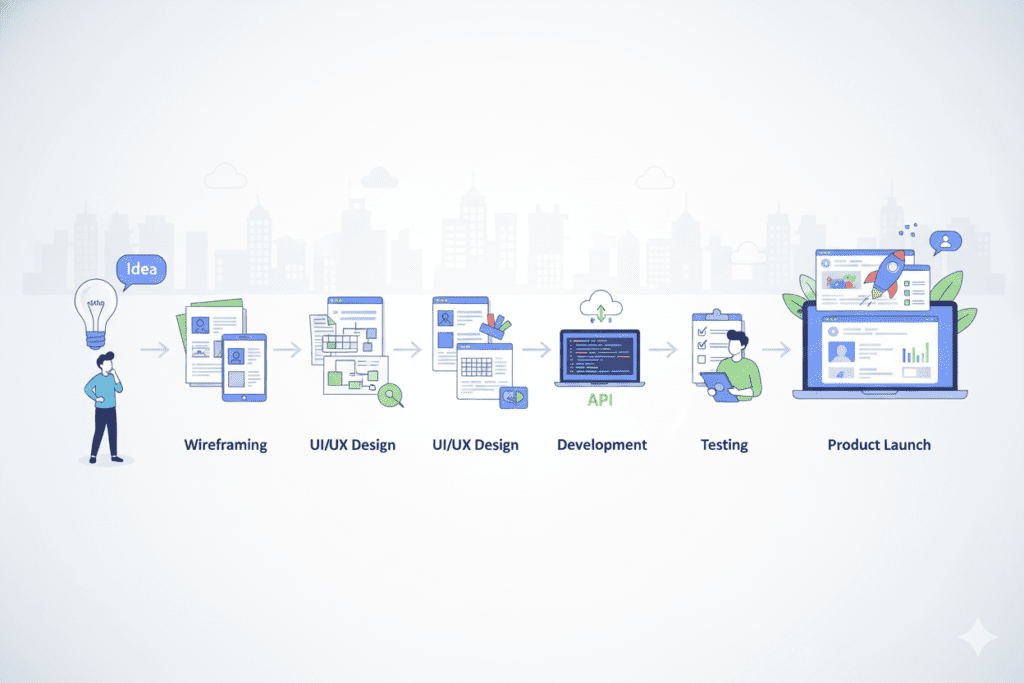
Let me tell you about Marcus, a real estate broker who approached BkAbhi with an idea. His brokerage was losing deals because agents couldn’t respond to leads quickly enough. By the time someone manually assigned a lead, researched comparable properties, and reached out to the potential buyer, competitors had already swooped in.
“I need something that does all of this automatically,” Marcus explained. “And I need it to work on phones, because my agents are never at their desks.”
This is where thoughtful real estate SaaS development begins—not with features lists or technology stacks, but with understanding the actual pain point that’s costing someone time, money, or sanity.
Phase 1: Deep Discovery and Problem Validation
The biggest mistake in real estate SaaS development is building something nobody needs. Before writing a single line of code, successful development partners dig deep:
- Shadow real users to understand their actual workflows (not what they say they do, but what they actually do)
- Identify the highest-impact pain point that, if solved, would dramatically improve operations
- Map the ecosystem to understand who else is involved in each transaction or process
- Quantify the problem to ensure there’s genuine business value in solving it
For Marcus, the discovery phase revealed that the real bottleneck wasn’t just lead assignment—it was the time agents spent researching properties to have intelligent conversations with buyers. This insight shifted the entire product concept.
Phase 2: MVP Development with Real Estate Context
The MVP (Minimum Viable Product) approach is particularly well-suited to real estate SaaS development. Rather than building a comprehensive platform with dozens of features, you create the simplest version that solves the core problem.
For Marcus, this meant:
- Automated lead distribution based on agent availability, specialization, and location
- Integration with MLS data to instantly pull comparable properties
- Mobile-first interface with one-tap calling and texting
- Simple dashboard showing response times and conversion rates
What didn’t make the MVP:
- Complex marketing automation
- Advanced reporting and analytics
- Integration with accounting systems
- Team collaboration features
This focused approach meant Marcus’s team could start testing the platform with real agents within eight weeks instead of waiting six months for a “complete” solution that might miss the mark.
At BkAbhi, we’ve seen this pattern repeatedly: the teams that ship focused MVPs and iterate based on real usage outperform those that try to build everything at once. Real estate SaaS development thrives on this lean methodology because the industry changes quickly, and user needs evolve as they experience the software.
Phase 3: Architecture for Scale and Security
Real estate deals with sensitive financial information, personal data, and legally binding documents. Your real estate SaaS development must prioritize security from day one, not as an afterthought.
This means:
- End-to-end encryption for all data transmission and storage
- Role-based access control so that agents, brokers, and administrators see only what they need
- Audit trails that track every document view, edit, and signature
- Compliance with regulations like GDPR, CCPA, and industry-specific requirements
- Regular security audits and penetration testing
But security can’t come at the cost of usability. The architecture must also support:
- Fast load times even when accessing property images and virtual tours
- Offline functionality so agents can work without constant connectivity
- Multi-device synchronization that keeps data consistent across phones, tablets, and desktops
- Scalable infrastructure that handles traffic spikes during hot market periods
The technology choices matter significantly. Modern real estate SaaS development typically leverages:
- Cloud platforms like AWS or Azure for reliable hosting and global reach
- React or Vue.js for responsive, interactive front-ends
- Node.js, Python/Django, or Ruby on Rails for robust back-end services
- PostgreSQL or MongoDB for flexible, scalable data storage
- RESTful APIs to enable integrations with third-party services
Phase 4: Integration Strategy That Actually Works
Here’s a truth that sinks many real estate SaaS development projects: integration is not optional.
Real estate professionals already use:
- MLS (Multiple Listing Service) platforms
- E-signature tools like DocuSign
- Accounting software like QuickBooks
- Communication platforms like Gmail and Outlook
- Payment processors like Stripe or PayPal
- Marketing tools like Mailchimp or HubSpot
If your SaaS platform forces users to re-enter data or switch between systems, you’ve already lost. Successful real estate SaaS development treats integrations as core features, not nice-to-haves.
For Marcus’s brokerage platform, this meant:
- Real-time MLS data synchronization
- Two-way calendar sync with Google and Outlook
- Automatic lead import from Zillow, Realtor.com, and company website forms
- Native integration with e-signature services
Founders who relegate integrations to “phase two” consistently face client pushback at launch. Plan for them from the start.
Phase 5: User Experience That Drives Adoption
The most powerful real estate SaaS development project is worthless if people won’t use it. And real estate professionals are notoriously resistant to new technology—not because they’re technophobic, but because they’ve been burned by clunky software before.
Your UX must:
Be instantly intuitive: Real estate agents don’t have time for multi-day training programs. If your interface requires more than 15 minutes to understand, you’ve failed.
Match their mental models: Don’t force users to think in terms of “records” and “databases.” Use language like “properties,” “clients,” and “deals” that reflect how they already conceptualize their work.
Minimize clicks: Every additional click is a point of friction. If a common task requires more than three interactions, redesign it.
Provide contextual help: Rather than burying documentation in a separate knowledge base, surface relevant tips and guidance exactly when and where users need them.
Work on mobile first: Many real estate professionals spend 70% of their time away from desks. If your platform doesn’t work seamlessly on phones, it doesn’t really work at all.
The design phase should involve actual users—not just gathering their opinions, but watching them attempt to complete real tasks with your interface. Every point of confusion is a design failure, not a user failure.
The 7 Deadly Mistakes in Real Estate SaaS Development

After years of building SaaS solutions at BkAbhi, we’ve seen certain mistakes kill projects repeatedly. Here’s what to avoid:
Mistake #1: Trying to Solve Everything in Version 1
The most common real estate SaaS development failure happens before a single line of code is written. Founders see 20 problems in the industry and decide to solve all of them simultaneously.
The result? A platform so complex that nobody understands it, development that takes 18 months instead of 3, and a product that’s outdated before it launches.
Winners pick ONE workflow, nail it completely, then expand. Start with property management OR transaction management OR investment analysis—not all three.
Mistake #2: Building for the Wrong User
Real estate has multiple stakeholders, but they’re not equally important to your product’s success.
Ask yourself:
- Who has the budget authority?
- Who experiences the pain most acutely?
- Who has the power to mandate adoption?
Build for that person first. You can expand to other users later, but trying to serve everyone equally from day one pleases nobody.
Mistake #3: Underestimating the Complexity of Real Estate Workflows
Developers from other industries often assume real estate is simpler than it is. They’re wrong.
A single property transaction might involve:
- Buyer, seller, buyer’s agent, seller’s agent
- Lender, appraiser, inspector, title company
- Multiple contingencies with different timelines
- Legal compliance that varies by state or even county
- Financial calculations with numerous variables
Your real estate SaaS development must account for edge cases, exceptions, and the messy reality of how deals actually happen—not the idealized version you imagine.
Mistake #4: Leaving Integrations for “Phase Two”
We’ve covered this, but it bears repeating: if your platform doesn’t integrate with MLS systems, you’re building a toy, not a tool.
Real estate runs on integrations. Teams that deprioritize them discover this painful truth when prospects ask during demos: “How does this work with our existing MLS?” or “Can it sync with QuickBooks?” or “Does it integrate with DocuSign?”
If the answer is “not yet,” that’s a lost deal.
Mistake #5: Neglecting Mobile Experience
Designing a beautiful desktop interface and then “making it responsive” is backwards.
Real estate professionals are mobile-first users. They’re in properties, in cars, in coffee shops between showings. Your real estate SaaS development should start with the mobile experience and expand to desktop, not the other way around.
Mistake #6: Ignoring Compliance and Security
Real estate deals with:
- Social Security numbers
- Bank account information
- Credit reports
- Legally binding contracts
- Protected personal information
A security breach doesn’t just lose you customers—it could end your business entirely. Build security and compliance into your architecture from day one, not as an afterthought.
Mistake #7: Building Without Real User Feedback
Too many founders spend months in isolation, building what they think users need, then launch to crickets.
Successful real estate SaaS development involves users throughout:
- Show mockups before coding
- Release beta versions to a small group
- Watch people use the software and note confusion points
- Iterate based on actual behavior, not survey responses
Your assumptions will be wrong. Accept this early, and build feedback loops into your development process.
Real-World Applications: Who Benefits from Real Estate SaaS Development
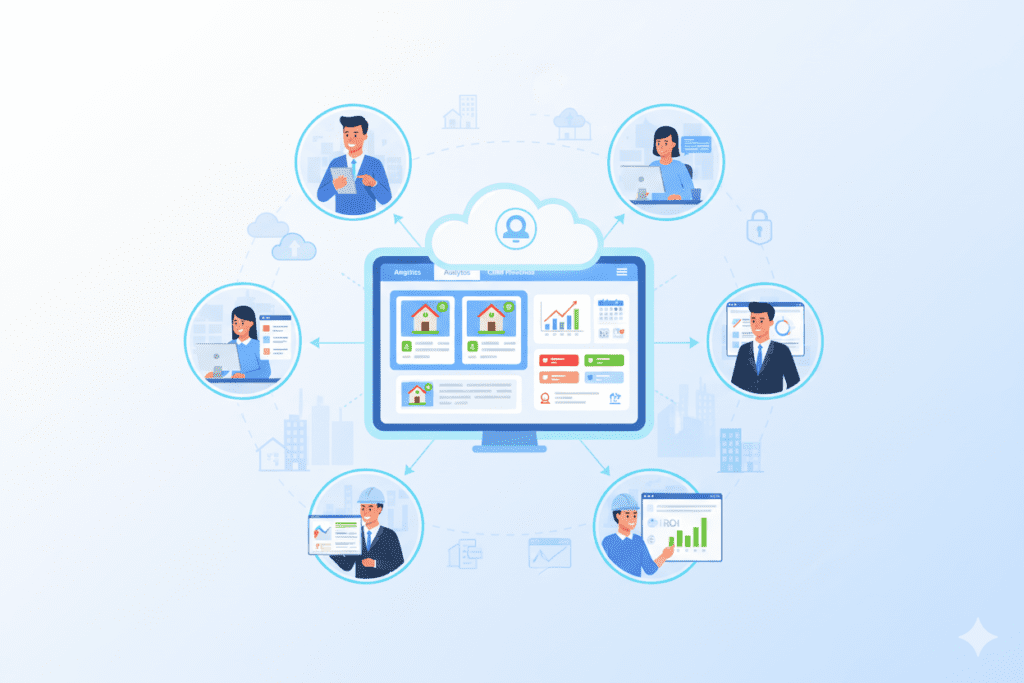
The beauty of well-executed real estate SaaS development is its versatility. Different professionals leverage these platforms in unique ways:
For Solo Real Estate Agents
Emma, a solo agent in Austin, uses a transaction management SaaS that automatically:
- Logs communications with clients
- Sends follow-up reminders based on deal stage
- Generates market reports for buyers
- Tracks commission calculations
- Manages document signing workflows
Before adopting this platform, Emma spent 10+ hours weekly on administrative tasks. Now she invests that time in client relationships and closes 30% more deals.
For Property Management Companies
A mid-sized property management firm overseeing 300 units implemented a comprehensive platform that handles:
- Automated rent collection and late fee assessment
- Maintenance request routing to pre-vetted vendors
- Lease renewal workflows with e-signature integration
- Financial reporting for property owners
- Tenant screening and application processing
Their office staff shrunk from 8 people to 4, while customer satisfaction scores increased 40% due to faster response times and better transparency.
For Real Estate Developers
A commercial development firm uses specialized SaaS for:
- Construction milestone tracking
- Budget vs. actual cost analysis
- Investor reporting and capital calls
- Permitting and compliance documentation
- Pro forma modeling with real-time market data
This platform reduced their project coordination overhead by 35% and improved investor confidence through transparent, real-time reporting.
For Real Estate Tech Startups
A PropTech startup building an AI-powered property valuation tool needed to:
- Aggregate data from multiple MLS sources
- Process millions of historical transactions
- Train machine learning models on local market dynamics
- Deliver instant valuations via API
Their real estate SaaS development created a scalable platform that now serves 50+ clients ranging from individual agents to large brokerages, processing 10,000+ valuation requests daily.
The Technology Stack: Choosing the Right Tools for Real Estate SaaS Development

Modern real estate SaaS development leverages a carefully chosen technology stack that balances performance, scalability, security, and development speed.
Front-End Development:
- React.js or Vue.js for building responsive, interactive interfaces
- Tailwind CSS or Material-UI for consistent, professional design systems
- Progressive Web App (PWA) capabilities for mobile-like experiences in browsers
Back-End Development:
- Node.js with Express for JavaScript-based architectures
- Python with Django or Flask for data-intensive applications
- Ruby on Rails for rapid development of complex business logic
- Microservices architecture for scaling different components independently
Database and Storage:
- PostgreSQL for structured, relational data with strong consistency
- MongoDB for flexible document storage and rapid schema evolution
- Redis for caching and session management
- Amazon S3 or similar for document and image storage
Third-Party Integrations:
- MLS APIs (RESO Web API standard)
- Payment processors (Stripe, Square)
- E-signature services (DocuSign, HelloSign API)
- Mapping and geolocation (Google Maps API, Mapbox)
- Communication services (Twilio for SMS, SendGrid for email)
DevOps and Infrastructure:
- AWS, Google Cloud, or Azure for hosting
- Docker for containerization
- Kubernetes for orchestration
- CI/CD pipelines with GitHub Actions or GitLab
- Monitoring with tools like New Relic or Datadog
The specific choices depend on your team’s expertise, performance requirements, and long-term scalability needs. What matters most isn’t using the “coolest” technologies—it’s selecting tools that enable rapid iteration while maintaining security and performance.
Making Real Estate SaaS Development Work: Practical Strategies
Building successful real estate SaaS isn’t just about code—it’s about strategy, market understanding, and execution discipline.
Start with a Pilot Program
Don’t launch to everyone at once. Find one brokerage, property management company, or development firm willing to beta test. Learn from their real-world usage before scaling.
Ideal pilot partners:
- Have the pain you’re solving acutely
- Are willing to provide regular feedback
- Represent your target market well
- Have manageable complexity (10-50 users, not 500)
Marcus’s brokerage served as the perfect pilot for the agent productivity platform. BkAbhi worked closely with 5 agents for three months, observing how they used the software, noting friction points, and rapidly iterating.
By the time they expanded to the full 40-agent team, adoption was smooth because the platform had been battle-tested and refined based on real usage patterns.
Obsess Over Onboarding
The first 15 minutes a user spends with your platform determines whether they become a champion or a detractor.
Your onboarding should:
- Import existing data automatically (don’t make users re-enter properties, clients, or transactions)
- Provide a “quick win” that demonstrates value immediately
- Use progressive disclosure—reveal features gradually rather than overwhelming with everything at once
- Offer contextual tooltips and help exactly when needed
- Allow users to skip training and explore on their own if they prefer
Real estate professionals are busy. If they can’t see value in the first session, they’ll abandon your platform regardless of its long-term potential.
Build for Change
Real estate regulations, market conditions, and technology expectations evolve constantly. Your real estate SaaS development must anticipate this.
Design for flexibility:
- Use configuration over hard-coding whenever possible
- Build modular features that can be toggled on/off per client
- Create admin interfaces that allow non-developers to adjust workflows
- Maintain comprehensive API documentation for future integrations
- Plan your database schema for evolution, not just current needs
The platforms that survive are those that can adapt quickly without requiring complete rebuilds.
Prioritize Performance Relentlessly
Real estate professionals are judged by responsiveness. If your platform is slow, you’re making your users look bad to their clients.
Every page should load in under 2 seconds. Property searches should return results instantaneously. Document uploads should process in real-time. Any longer, and users will perceive your platform as an obstacle rather than an enabler.
Invest in:
- Content delivery networks (CDNs) for global reach
- Image optimization and lazy loading
- Efficient database indexing and query optimization
- Caching strategies that reduce server load
- Regular performance testing and optimization
The Future of Real Estate SaaS Development

The PropTech revolution is just beginning. Emerging trends will shape the next generation of real estate SaaS development:
AI-Powered Insights: Machine learning models that predict property values, forecast maintenance needs, and identify investment opportunities with unprecedented accuracy.
Blockchain Integration: Smart contracts that automate title transfers, escrow management, and fractional ownership models, reducing transaction friction and intermediary costs.
Virtual and Augmented Reality: Immersive property tours that go beyond 360-degree photos to create fully interactive experiences, complete with furniture visualization and modification capabilities.
IoT Integration: Property management platforms that connect directly to smart building systems, monitoring everything from HVAC performance to occupancy patterns, enabling predictive maintenance and energy optimization.
Voice-First Interfaces: Real estate professionals conducting property searches, scheduling showings, and updating client records through natural language commands while driving between appointments.
These aren’t science fiction—they’re active development areas. Companies investing in real estate SaaS development today are positioning themselves at the forefront of an industry transformation that will reshape how properties are bought, sold, managed, and valued.
Why Partner with Experts for Your Real Estate SaaS Development
Building real estate SaaS is complex. It requires technical excellence, industry knowledge, and the ability to translate messy workflows into elegant software. Most importantly, it requires experience navigating the countless pitfalls that have claimed less careful projects.
This is where working with a development partner like BkAbhi makes the difference. Rather than learning expensive lessons yourself, you benefit from years of accumulated expertise in MVP development, SaaS architecture, and user experience design.
The BkAbhi approach to real estate SaaS development emphasizes:
Rapid validation through focused MVPs that test core assumptions before investing heavily
User-centered design that prioritizes the actual workflow of real estate professionals over theoretical best practices
Scalable architecture that grows with your business without requiring expensive re-platforming
Transparent collaboration that keeps you informed and involved throughout development
Post-launch support that continues optimizing based on real user data and feedback
We’ve guided founders, developers, and real estate professionals through the entire journey—from initial concept to market-ready platform. The insights shared in this guide come from real projects, real mistakes, and real successes.
here you can also visit all in one ai tool-Aizolo
Taking the Next Step in Your Real Estate SaaS Development Journey

If you’re a real estate professional frustrated with current tools, a founder with a PropTech vision, or a developer exploring market opportunities, you now understand what successful real estate SaaS development requires.
The path forward:
- Identify the specific pain point you’re solving—be ruthlessly focused
- Talk to actual users extensively before writing code
- Build a focused MVP that solves one problem exceptionally well
- Test with real users and iterate based on their behavior, not their opinions
- Scale thoughtfully, adding features based on demonstrated need rather than speculation
The real estate industry is ready for transformation. It’s waiting for well-designed, thoughtfully developed SaaS solutions that respect the complexity of the work while dramatically simplifying day-to-day operations.
The question isn’t whether real estate SaaS represents an opportunity—it clearly does. The question is whether you’ll approach it with the discipline, expertise, and user focus required to build something that genuinely makes professionals’ lives better.
Explore more insights on BkAbhi for practical guides on MVP development, SaaS architecture, and product strategy. Learn from real-world experience at BkAbhi, where we’ve helped dozens of founders navigate the journey from concept to launch.
The future of real estate is being built right now—one well-crafted SaaS platform at a time. Whether you’re creating it or using it, the transformation is undeniable.
Start building smarter with BkAbhi. Because in PropTech, the difference between success and failure isn’t just what you build—it’s how thoughtfully you build it.
Want to discuss your real estate SaaS development project? The BkAbhi team specializes in turning complex workflows into elegant, scalable platforms. Read more expert guides on BkAbhi or reach out to explore how we can help bring your PropTech vision to life.
The real estate industry needs better tools. Let’s build them together.