
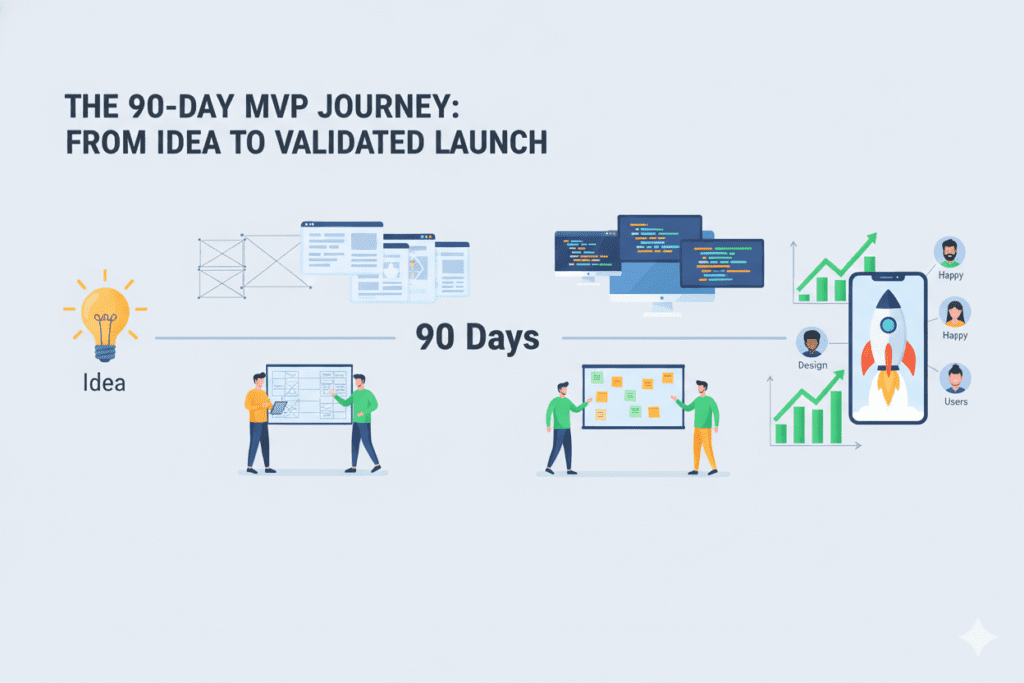
The $500,000 Mistake That Could Have Been Avoided
Sarah spent 18 months and half a million dollars building her “perfect” EdTech platform. She hired a full development team, designed every feature she could imagine, and polished the UI until it gleamed. When she finally launched, the response was devastating: crickets. Users wanted something completely different from what she’d built.
Meanwhile, her competitor launched a basic version in 8 weeks, gathered real user feedback, and iterated rapidly. Today, that competitor dominates the market Sarah thought was hers.
This story isn’t unique. It plays out hundreds of times every year across the startup ecosystem. The difference? One founder understood the power of MVP development services, and the other learned an expensive lesson about building in a vacuum.
If you’re sitting on a product idea right now—whether you’re a first-time founder, a corporate innovator, or a technical co-founder—understanding how to leverage MVP development services might be the difference between your product’s success and becoming another cautionary tale.
What Are MVP Development Services (And Why Everyone Gets Them Wrong)
MVP development services are specialized offerings that help you build a Minimum Viable Product—the simplest version of your product that solves the core problem for your target users. But here’s where most people stumble: they confuse “minimum” with “mediocre.”
An MVP isn’t a half-baked, buggy mess you’re embarrassed to show users. It’s a strategically stripped-down version that includes only the features essential to validate your core value proposition. Think of it as a precision instrument, not a rough sketch.
Professional MVP development services bridge the gap between your vision and market reality. They combine:
- Strategic product thinking to identify what truly matters
- Rapid development capabilities to build and ship quickly
- Technical expertise to avoid architectural debt
- User-centric design to create actual value, not just features
- Market validation frameworks to measure what matters
The best MVP development services don’t just code your specifications—they challenge your assumptions, refine your strategy, and help you avoid building the wrong thing efficiently.
The Real Problem: Why 90% of Product Ideas Fail Before They Should
Here’s an uncomfortable truth: most product failures aren’t execution failures. They’re validation failures.
Founders fall in love with solutions before understanding problems. They build entire platforms before confirming anyone actually wants them. They perfect features that users will never touch.
The statistics are brutal:
- 42% of startups fail because there’s no market need (CB Insights)
- The average startup spends $50,000-$150,000 before validating product-market fit
- 67% of features in typical software products are rarely or never used (Standish Group)
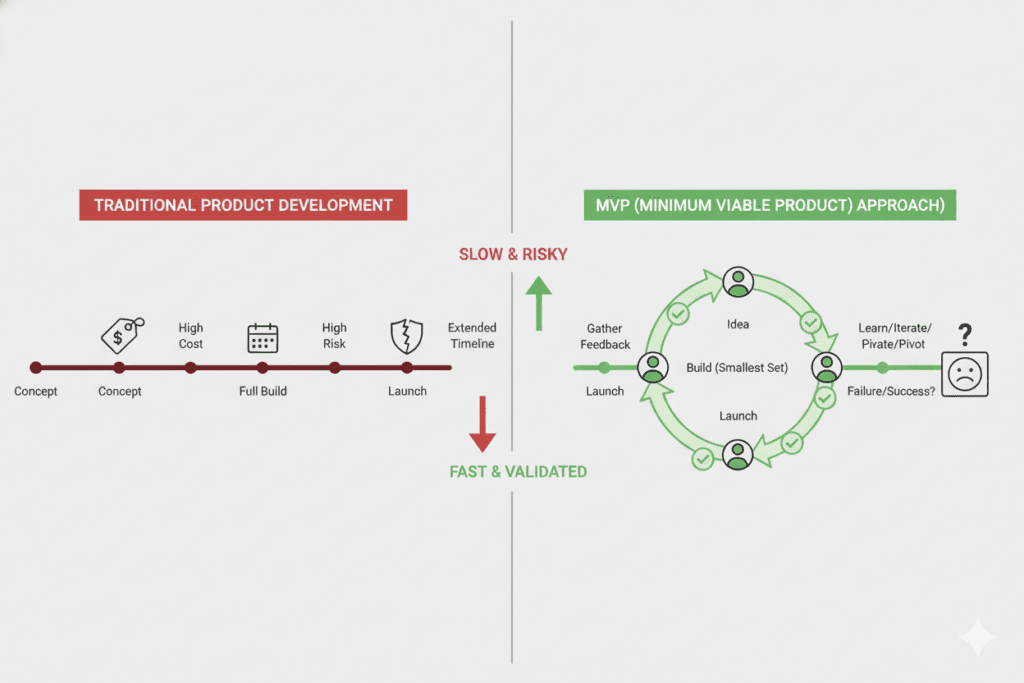
This happens because traditional development approaches encourage you to:
Build everything upfront → More time, more money, more risk Perfect before launching → Miss critical market windows Guess what users want → Build based on assumptions, not data Go all-in immediately → Massive financial and opportunity cost
MVP development services exist specifically to counter these natural but dangerous tendencies. They create a structured pathway from idea to validated product without betting your entire runway on untested assumptions.
How MVP Development Services Actually Work: The Four-Phase Framework
Let me walk you through how strategic MVP development services approach product building, using frameworks we’ve refined across dozens of successful launches.
Phase 1: Strategic Discovery and Validation (Week 1-2)
Before writing a single line of code, professional MVP development services dig deep into your core assumptions:
Problem Validation
- Who exactly has this problem?
- How are they solving it today?
- What’s the cost of the problem (time, money, frustration)?
- Is this problem urgent or just annoying?
Solution Hypothesis
- What’s the simplest solution that could work?
- What’s the core value proposition in one sentence?
- What features are essential versus nice-to-have?
- What can we defer to version 2.0?
Market Research
- Who are the competitors and alternatives?
- What gaps exist in current solutions?
- What’s the realistic market size?
- What’s the customer acquisition strategy?
A founder recently came to us wanting to build a comprehensive project management tool with 47 features. Through discovery, we identified that his real differentiator was one specific workflow automation. We built an MVP around that single capability, launched in 6 weeks, and secured 50 paying customers before building anything else.
Phase 2: MVP Scoping and Architecture (Week 2-3)
This is where strategy meets technical reality. Quality MVP development services create a technical roadmap that balances speed with scalability:
Feature Prioritization Using the MoSCoW Method
- Must Have: Core features without which the product has no value
- Should Have: Important but not critical for initial launch
- Could Have: Desirable features that can wait
- Won’t Have: Explicitly deferred to future releases
Technical Stack Decisions The right technology choices can 10x your development speed. Modern MVP development services leverage:
- No-code/low-code foundations where appropriate (Bubble, Webflow, Airtable)
- Proven frameworks that accelerate development (React, Next.js, Django, Ruby on Rails)
- Managed services to avoid infrastructure complexity (Vercel, Supabase, Firebase)
- API-first architectures for future flexibility
UX/UI Design Philosophy Your MVP should look professional and inspire confidence, but not require months of design iteration. The focus is on:
- Clean, intuitive user flows for core actions
- Minimal but purposeful visual design
- Mobile-responsive layouts
- Accessibility basics
Phase 3: Rapid Development and Testing (Week 4-10)
This is where experienced MVP development services demonstrate their value through speed without sloppiness:
Agile Sprint Structure
- 1-2 week sprints with clear deliverables
- Weekly demos and feedback sessions
- Continuous user testing with target audience
- Iterative refinement based on real feedback
Quality Assurance Balance MVPs need to work reliably without requiring enterprise-grade testing infrastructure:
- Focus on happy path functionality
- Manual testing for core user journeys
- Automated testing for critical business logic
- Real user beta testing before public launch
Technical Debt Management This is crucial: good MVP development services build fast but not recklessly. The code should be:
- Well-structured enough to iterate on
- Documented for future developers
- Scalable to 10x users without rewriting
- Free of critical security vulnerabilities

Phase 4: Launch, Measurement, and Iteration (Week 10-12+)
The MVP launch isn’t the finish line—it’s the starting line. Professional MVP development services include:
Soft Launch Strategy
- Beta release to limited user group
- Feedback collection mechanisms (in-app surveys, user interviews)
- Analytics implementation (Mixpanel, Amplitude, or Google Analytics)
- Performance monitoring (error tracking, load times)
Key Metrics Definition What actually matters for your MVP?
- Activation: Are users completing the core action?
- Engagement: Are they coming back?
- Retention: What’s the 7-day/30-day retention?
- Satisfaction: Would they recommend it?
- Revenue: Are they willing to pay (if monetized)?
Iteration Framework Based on real data, MVP development services help you:
- Identify what’s working and double down
- Remove or refine what’s confusing users
- Prioritize the next wave of features
- Decide whether to pivot, persevere, or expand
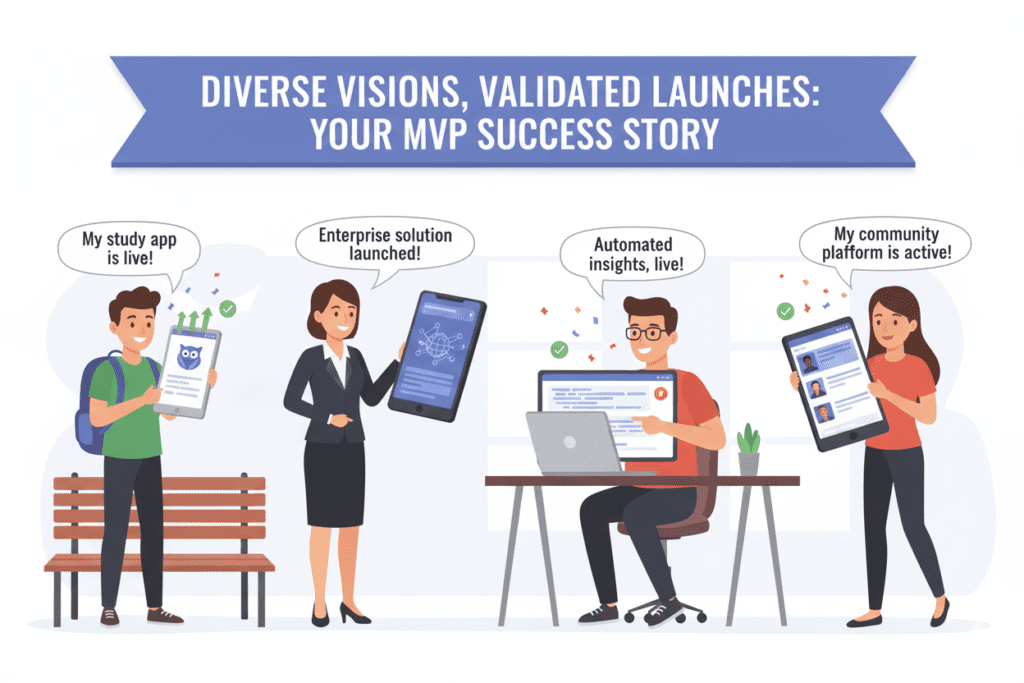
Real-World Use Cases: Who Benefits from MVP Development Services
For First-Time Founders
The Challenge: You have domain expertise but limited technical knowledge. You know there’s a problem worth solving but don’t know how to translate your vision into working software.
The MVP Solution: Professional MVP development services become your technical co-founder, translating business requirements into technical specifications, making technology choices, and building your product while keeping you informed and involved.
Real Example: A healthcare administrator identified massive inefficiencies in patient scheduling. With no coding background, she partnered with MVP development services to build a specialized scheduling tool. After an 8-week development cycle, she launched with three hospital pilots and secured $100K in contracts before raising any venture capital.
For Technical Founders and Developers
The Challenge: You can build anything, but time is your constraint. You’re also often too close to the technology to ruthlessly prioritize features.
The MVP Solution: Expert MVP development services provide product strategy, design expertise, and additional development velocity. They help you avoid over-engineering and focus on market validation over technical perfection.
Real Example: A senior developer wanted to build a developer tool but found himself adding “just one more feature” repeatedly. MVP development consultation helped him strip the product to three core features, launch in half the time, and gather feedback that completely changed his roadmap. The features he almost spent months building? Users didn’t want them.

For SaaS Builders and Serial Entrepreneurs
The Challenge: You need to test multiple ideas quickly or explore new market segments without committing your entire team to one unvalidated direction.
The MVP Solution: Dedicated MVP development services let you validate new products without disrupting your core business. Think of it as a “product validation lab” that operates parallel to your main operations.
Real Example: An established SaaS company wanted to test an adjacent product idea. Instead of allocating internal engineering resources, they engaged MVP development services for a 10-week project. The MVP validated the market, attracted 200 early users, and generated enough traction to justify creating an internal team to scale it.
For Corporate Innovators and Intrapreneurs
The Challenge: You’ve identified an opportunity within your organization but face bureaucratic development cycles that take 12-18 months. By the time IT delivers, the market has moved.
The MVP Solution: External MVP development services bypass internal bottlenecks, moving at startup speed while still integrating with corporate systems where necessary.
Real Example: A product manager at a Fortune 500 company saw an internal tool need that affected 5,000 employees. Internal IT quoted 18 months. She got budget approval for external MVP development services, which delivered a working solution in 8 weeks. After proving value, the company allocated resources to scale it enterprise-wide.
For Marketers Building Marketing Tools
The Challenge: You understand customer pain points from running campaigns but lack the technical skills to build solutions. You see gaps in existing martech tools.
The MVP Solution: MVP development services translate marketing insights into functional tools, creating competitive advantages or new revenue streams.
Real Example: A growth marketer repeatedly faced the same content distribution challenge across campaigns. She conceptualized a tool to solve it and worked with MVP development services to build it. After validating it worked for her clients, she productized it and now runs it as a profitable side business serving 150+ marketing agencies.
For Students and Recent Graduates
The Challenge: You have innovative ideas and entrepreneurial energy but limited capital and no technical team. Traditional development is too expensive, and learning to code well enough takes too long.
The MVP Solution: Affordable MVP development services designed for early-stage founders provide access to professional development without requiring massive upfront investment.
Real Example: Two business school students identified a campus problem affecting thousands of students. They worked with affordable MVP development services, launching a functional app for $8,000 that they funded through a small university grant. The MVP attracted 800 users in the first month and caught the attention of a local accelerator that provided funding to scale.
The True Cost of MVP Development Services (And Why Cheap Is Expensive)
Let’s talk numbers, because the pricing conversation around MVP development services is often murky and misleading.
The Price Spectrum
Low-End ($5,000-$15,000)
- Typically offshore teams or freelancer collectives
- Basic functionality, template-based designs
- Minimal strategic input or product guidance
- Best for: Very simple apps, proof-of-concept demonstrations
Mid-Range ($15,000-$50,000)
- Boutique agencies or experienced freelance teams
- Custom development with strategic consultation
- Professional design and user experience focus
- Best for: Most startup MVPs, B2B SaaS products, mobile apps
High-End ($50,000-$150,000+)
- Top-tier agencies or specialized consultancies
- Comprehensive strategy, research, and validation
- Advanced technical requirements or regulatory compliance
- Best for: Complex platforms, healthcare/fintech products, enterprise tools
What You’re Actually Paying For
The cheapest option isn’t always the most expensive. Consider the total cost of:
Development Time
- Fast delivery = faster validation = preserved runway
- Slow delivery = burned cash + missed opportunities + competitor advantage
Quality and Maintainability
- Good code = easier to iterate and scale
- Sloppy code = technical debt that slows everything later
Strategic Guidance
- Experienced teams prevent expensive mistakes
- Inexperienced teams build what you ask for (even if it’s wrong)
Opportunity Cost
- Launching 3 months earlier could mean 3 months of user feedback, 3 months of revenue, or 3 months ahead of competitors
A founder recently told me: “We hired the cheapest developers and saved $20,000 upfront. Then we spent $60,000 rebuilding it properly six months later. I wish we’d just paid for quality MVP development services from the start.”
How to Choose the Right MVP Development Services for Your Project
Not all MVP development services are created equal. Here’s how to evaluate potential partners:
Essential Questions to Ask
About Their Process
- How do you approach feature prioritization?
- What’s your typical timeline from kickoff to launch?
- How do you handle changing requirements mid-project?
- What happens after the MVP launches?
About Their Expertise
- Do you have experience in my industry or with similar products?
- Can you show me MVPs you’ve built that succeeded?
- What’s your technical stack recommendation for my use case?
- How do you balance speed with code quality?
About Communication and Collaboration
- How often will we communicate during development?
- Who will be my main point of contact?
- How do you handle feedback and revision requests?
- What project management tools do you use?
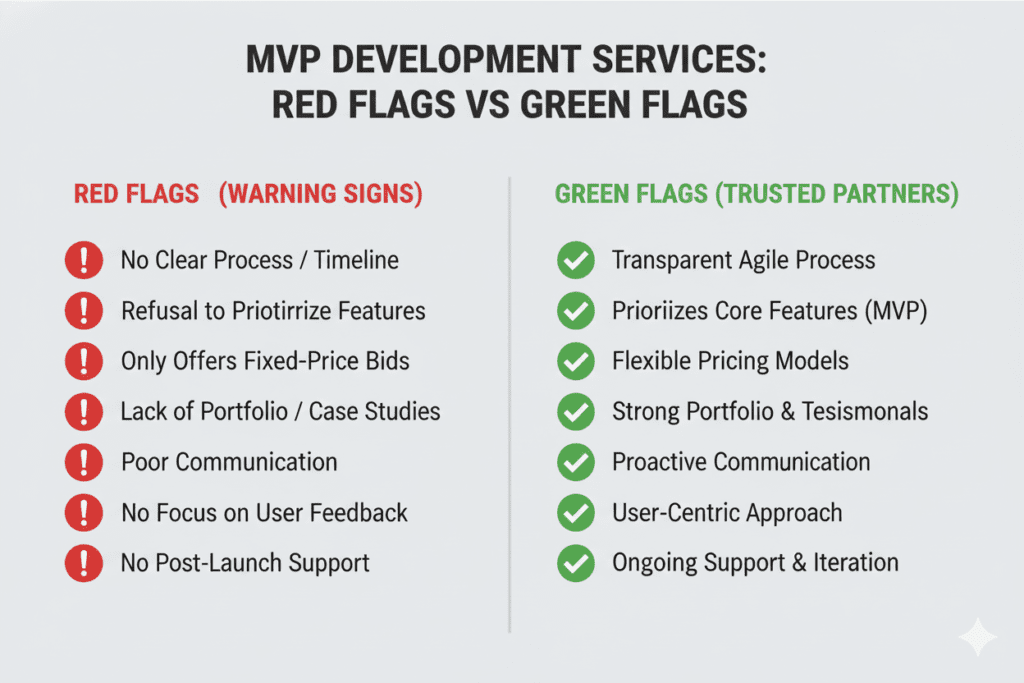
Red Flags to Watch For
- Promises without questions: Great MVP development services ask tons of questions before promising timelines or features
- Fixed scope without discovery: How can they price accurately without understanding your needs?
- Only technical focus: MVP success requires strategy, not just coding
- No post-launch support: The real work begins after launch
- Lack of transparency: You should understand what’s happening and why
Green Flags That Indicate Quality
- Strategic pushback: They challenge your assumptions and suggest simpler approaches
- Portfolio of successful launches: Not just pretty designs, but products that gained traction
- Clear process documentation: They’ve done this before and refined their approach
- Realistic timelines: They underpromise and overdeliver
- Product thinking: They care about your success, not just completing tasks
The BkAbhi Approach: Building MVPs That Matter
At BkAbhi, we’ve refined our MVP development services through real-world experience across dozens of successful product launches. Our philosophy is simple but uncommon: we succeed when your product succeeds, not just when we deliver code.
What Makes Our MVP Development Services Different
We Challenge First, Build Second Before agreeing to build anything, we spend time understanding whether your idea solves a real problem. Sometimes the best service we provide is convincing you to pivot before spending money.
We Think Like Founders, Execute Like Engineers Our team combines product strategy, user experience design, and technical excellence. We don’t just translate requirements—we refine them based on what actually works in the market.
We Build for Iteration, Not Perfection Every technical decision considers: “How easy will this be to change when we learn more?” Speed matters, but we never sacrifice your ability to evolve.
We Measure What Matters We help you define success metrics before launch and implement analytics from day one. Your MVP should generate learning, not just activity.
Our Track Record
We’ve helped founders, developers, and companies launch MVPs that:
- Acquired first paying customers within 30 days of launch
- Secured accelerator acceptance and seed funding
- Validated new product lines for established companies
- Attracted thousands of organic users through product-led growth
- Proved market demand before full-scale investment
But more importantly, we’ve helped clients avoid building products that wouldn’t have worked—saving them months of time and hundreds of thousands in development costs.
From MVP to Market Leader: Your Next Steps
The gap between idea and market isn’t as wide as it feels. With the right MVP development services, you can:
- Validate your idea in weeks, not years
- Start generating revenue before burning through your runway
- Gather real feedback from actual users, not focus groups
- Iterate based on data, not assumptions
- Build investor confidence with tangible traction
The founders who succeed aren’t always the ones with the best ideas—they’re the ones who validate fastest and iterate smartest.
Ready to Build Your MVP?
Whether you’re a first-time founder with a breakthrough idea, a developer with limited time, or an innovator inside a larger organization, professional MVP development services can accelerate your path from concept to market.
Here’s what happens when you start:
- Strategic Discovery Session: We understand your vision, validate your assumptions, and identify the core features
- Scoping and Planning: We create a detailed roadmap, timeline, and technical architecture
- Rapid Development: We build your MVP using modern tools and proven frameworks
- Launch and Validation: We help you get to market and measure what matters
- Iteration Support: We help you evolve based on real user feedback
The question isn’t whether you can afford MVP development services. It’s whether you can afford to build without them.
Explore more insights on building successful products at BkAbhi. Our blog features real-world case studies, technical guides, and startup strategies drawn from actual product launches, not just theory.
Start building smarter with BkAbhi. Learn from experience that comes from shipping real products, making real mistakes, and discovering what actually works in the market.
The next unicorn started as someone’s MVP. Maybe yours is next.
Suggested External Links
To enhance SEO value and credibility:
- CB Insights Startup Failure Report (https://www.cbinsights.com/research/why-startups-fail/)
- Authoritative source for startup failure statistics
- Y Combinator Startup School Resources (https://www.startupschool.org/)
- Credible startup education platform on MVP principles
- The Lean Startup by Eric Ries (official website or Amazon)
- Foundational reference for MVP methodology
- ProductHunt (https://www.producthunt.com/)
- Example platform where MVPs often launch successfully
- Standish Group CHAOS Report (official source)
- Authority on software project success/failure data
- Firebase Documentation (https://firebase.google.com/docs)
- Example of modern MVP development tools
- Next.js Documentation (https://nextjs.org/)
- Leading framework for rapid web development
- Mixpanel Analytics Guide (https://mixpanel.com/topics/product-analytics/)
- Authority on product analytics and measurement