
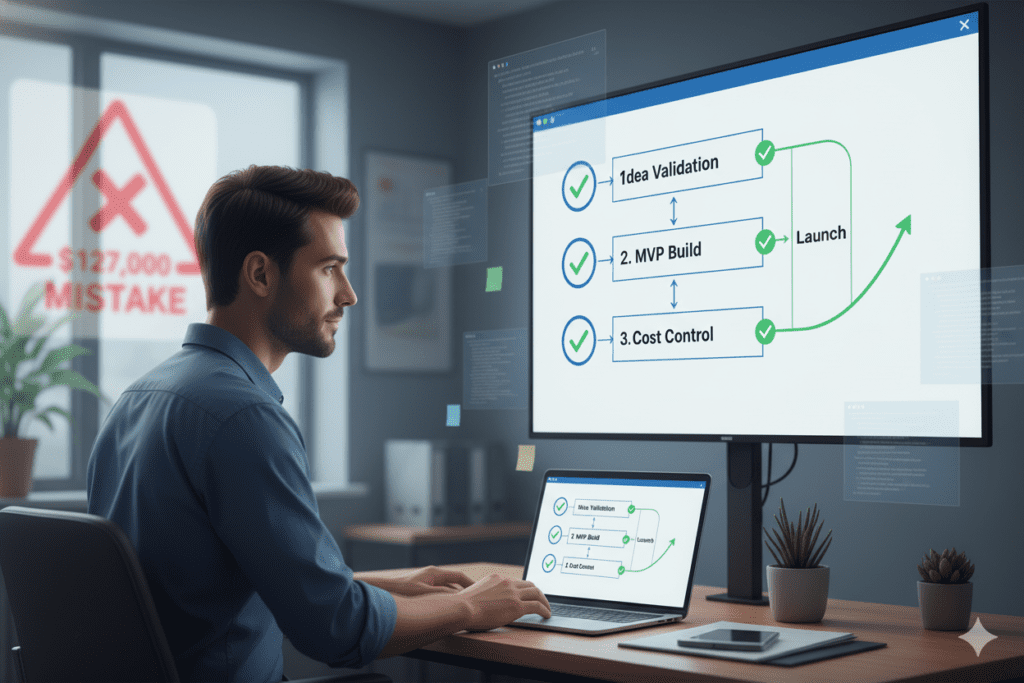
It was 2:47 AM when Alex finally closed his laptop, hands trembling.
For nine months, his fintech startup had been bleeding cash. What started as a “quick MVP” with a $35,000 budget had ballooned into a $127,000 nightmare. The app still wasn’t live. His co-founder had quit. And the investors who’d been interested three months ago? Radio silence.
The developer he hired kept saying “just one more feature” and “we need to rebuild this part.” Alex, a non-technical founder with a background in sales, had no way to push back. He didn’t understand the technical jargon, couldn’t tell if the delays were legitimate, and had no benchmark for what MVP development cost for startups should actually be.
Sound familiar?
If you’re a founder researching MVP costs right now, you’re probably terrified of ending up like Alex. You’ve seen the ranges online — anywhere from $15,000 to $150,000+ — and you’re wondering: What’s the real number? And why is there such a massive gap?
Here’s the truth: Most founders don’t fail because they run out of money. They fail because they spent money on the wrong things.
In this guide, we’re breaking down everything about MVP development cost for startups in 2026 — the real numbers, the hidden traps, the smart strategies, and how founders at every stage can build lean without building broken.

Why Understanding MVP Development Cost for Startups Can Make or Break Your Business
Before we dive into numbers, let’s talk about why this matters so much.
According to recent research, approximately 42% of startups fail because there’s no market need for their product. But here’s the kicker: another significant portion fails not because the idea was wrong, but because they burned through capital building the wrong version of their product.
The MVP development cost for startups isn’t just a budget line item. It’s a strategic decision that affects:
- How fast you can validate your idea — Every dollar spent on unnecessary features is time you could’ve spent learning from real users
- Your runway — Most early-stage startups have 12-18 months of capital. Spend it wrong, and you’re done
- Investor confidence — VCs don’t want to see a polished product. They want to see traction, validation, and smart capital allocation
- Your ability to pivot — Overbuilding locks you into a specific direction. MVPs should be flexible
The difference between successful founders and those who flame out? They understand that MVP development cost for startups isn’t about building cheap — it’s about building smart.
The Real MVP Development Cost for Startups in 2026: Breaking Down the Numbers
Let’s cut through the noise. Here’s what you actually need to budget for when planning your MVP development cost for startups:
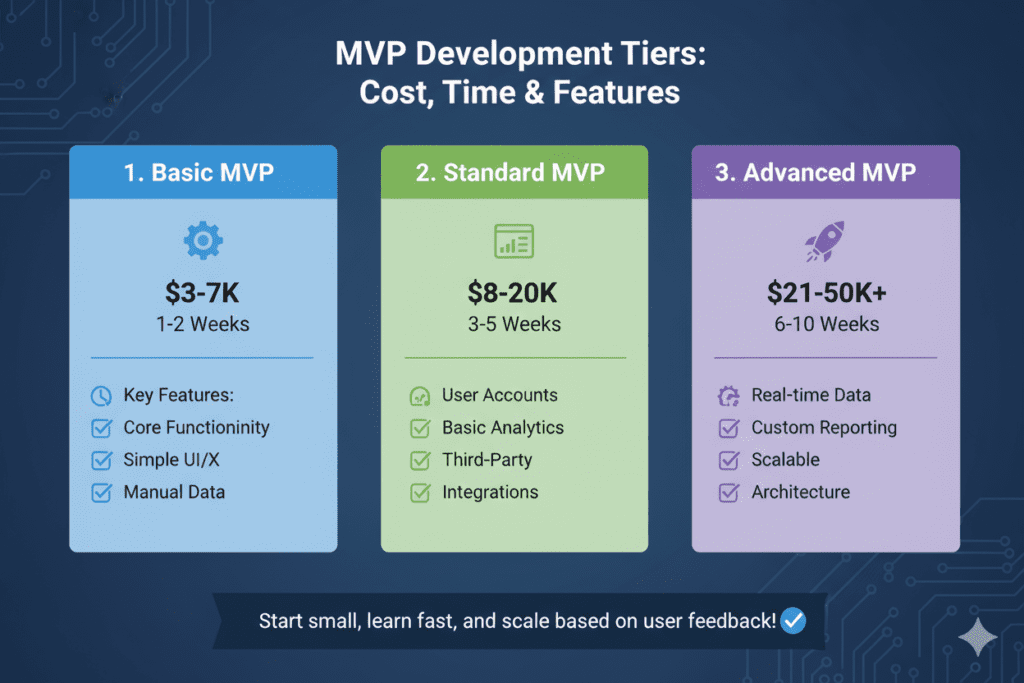
Simple MVP: $15,000 – $50,000
What you get:
- Basic functionality with 3-5 core features
- Single platform (web or mobile, not both)
- Standard UI/UX design
- Basic authentication and database
- 6-10 weeks development time
Best for:
- First-time founders testing a hypothesis
- Solo founders or very small teams
- Products with straightforward user flows
- Marketplaces with basic matching logic
Real example: A subscription-based newsletter platform with user signup, content recommendations, and payment integration.
Mid-Complexity MVP: $50,000 – $100,000
What you get:
- 5-10 core features with moderate complexity
- Cross-platform development (React Native or Flutter)
- Custom UI/UX design with brand identity
- Third-party API integrations
- Basic admin dashboard
- 10-16 weeks development time
Best for:
- SaaS products with moderate feature sets
- Founders with some initial traction or validation
- B2B tools with specific workflow requirements
- Products requiring multiple user roles
Real example: A project management tool for remote teams with task management, file sharing, basic reporting, and team collaboration features.
Complex MVP: $100,000 – $150,000+
What you get:
- 10+ features with advanced functionality
- Native iOS and Android apps plus web platform
- Advanced UI/UX with extensive user research
- Complex backend architecture
- Real-time features (chat, notifications, live updates)
- AI/ML integration
- Advanced security and compliance
- 16-24 weeks development time
Best for:
- Fintech, healthcare, or regulated industry products
- Enterprise SaaS with complex workflows
- Products with advanced technical requirements
- Teams with strong investor backing
Real example: A healthcare telemedicine platform with video consultations, electronic health records, prescription management, insurance integration, and HIPAA compliance.
What Really Drives MVP Development Cost for Startups? The 7 Hidden Factors
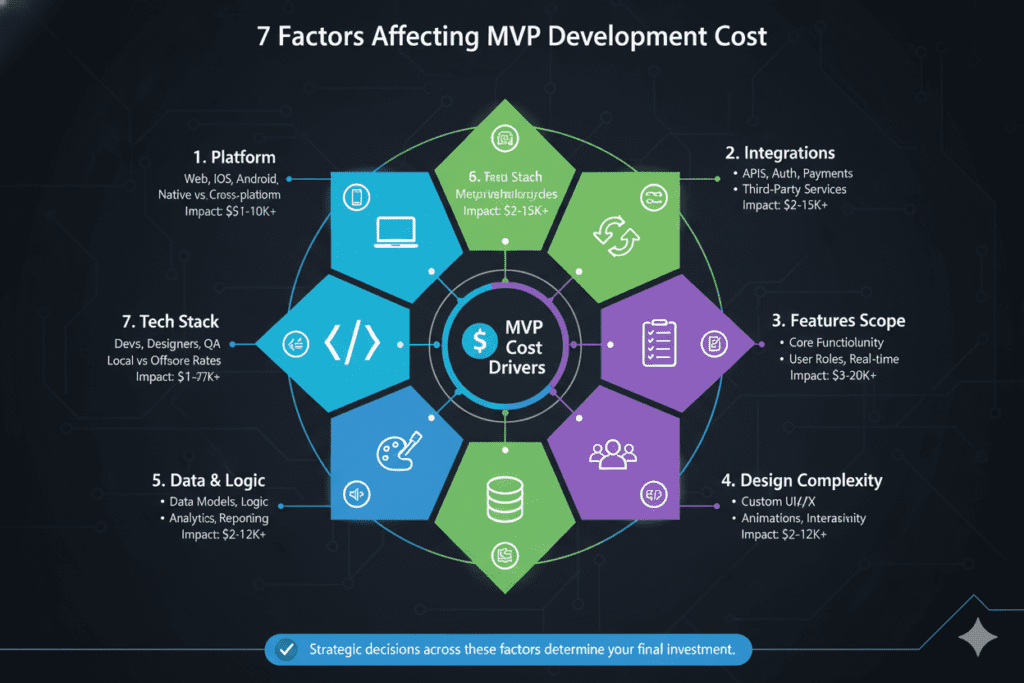
Understanding the ranges is helpful, but what actually determines where your MVP development cost for startups falls on that spectrum? Here are the seven factors that matter most:
1. Feature Complexity (Not Just Quantity)
It’s not about how many features you have — it’s about how complex each feature is.
Low complexity: User registration, basic search, static content display
Medium complexity: Payment integration, file uploads, email notifications
High complexity: Real-time chat, video streaming, AI recommendations, geolocation tracking
A simple booking app with 8 straightforward features might cost less than a chat app with 4 complex real-time features.
2. Platform Choice
Web-only: $15,000 – $60,000 (cheapest option, fastest to market)
Cross-platform (React Native/Flutter): $30,000 – $100,000 (one codebase, two platforms)
Native iOS + Android: $60,000 – $150,000+ (highest quality, highest cost)
For most startups, cross-platform is the sweet spot in 2026. The technology has matured significantly, and the performance gap with native apps is almost imperceptible for most use cases.
3. Design Requirements
Template-based design: Add $3,000 – $8,000
Custom design with brand identity: Add $8,000 – $20,000
Extensive UX research and testing: Add $15,000 – $35,000
Here’s a secret many founders miss: good design isn’t just about aesthetics. It directly impacts your MVP development cost for startups by reducing the need for extensive revisions later. Users forgive missing features, but they don’t forgive confusing interfaces.
4. Third-Party Integrations
Each integration adds cost and complexity:
- Payment processing (Stripe, PayPal): $2,000 – $5,000
- Email services (SendGrid, Mailchimp): $1,000 – $3,000
- Cloud storage (AWS S3, Google Cloud): $1,500 – $4,000
- Analytics (Mixpanel, Amplitude): $1,000 – $2,500
- Authentication (Auth0, Firebase): $1,500 – $4,000
5. Team Structure and Location
This is where MVP development cost for startups can vary by 300%.
US/UK-based agencies: $100 – $200/hour = $80,000 – $200,000 total
Eastern Europe: $50 – $80/hour = $40,000 – $100,000 total
Latin America: $40 – $70/hour = $30,000 – $80,000 total
Southeast Asia: $30 – $60/hour = $25,000 – $70,000 total
Quality matters more than location. A senior developer in Ukraine will outperform a junior developer in San Francisco, even at half the hourly rate.
6. Compliance and Security Requirements
Building for regulated industries adds significant cost:
- HIPAA compliance (healthcare): Add $20,000 – $50,000
- PCI-DSS (payment processing): Add $15,000 – $40,000
- GDPR compliance (EU users): Add $8,000 – $20,000
- SOC 2 (enterprise customers): Add $25,000 – $60,000
7. Backend Complexity
Simple backend: User authentication, basic CRUD operations = $8,000 – $20,000
Moderate backend: Multiple user roles, file storage, third-party APIs = $20,000 – $50,000
Complex backend: Real-time processing, advanced algorithms, scalable architecture = $50,000 – $100,000+
The Hidden Costs in MVP Development That Destroy Startup Budgets
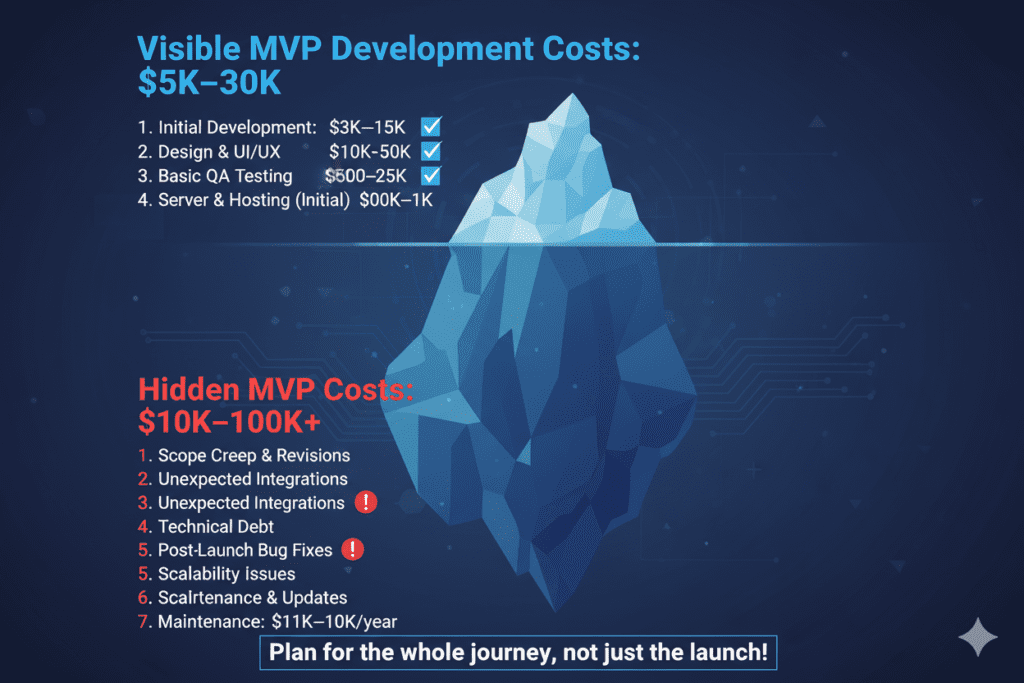
When founders ask about MVP development cost for startups, they’re usually only thinking about the development phase. But that’s like budgeting for a wedding by only counting the venue cost.
Here are the hidden expenses that catch founders off guard:
Pre-Development Phase: $3,000 – $27,500
Most founders skip this entirely, then pay for it later with expensive pivots.
- Market research: $1,000 – $5,000
- Competitive analysis: $500 – $2,500
- User interviews and validation: $1,500 – $8,000
- Technical feasibility assessment: $1,000 – $5,000
- Product roadmap and feature prioritization: $1,000 – $7,000
Why this matters: Data shows that startups spending at least 20% of their MVP budget on pre-development are 3x more likely to build a successful product.
Design and Prototyping: $6,000 – $45,000
- User flow mapping: $1,500 – $8,000
- Wireframing: $2,000 – $10,000
- High-fidelity mockups: $2,500 – $15,000
- Interactive prototypes: $2,000 – $12,000
Testing and Quality Assurance: $7,500 – $37,500
Many startups try to skip this. Don’t. MVPs with proper testing have 60% higher user retention rates.
- Functional testing: $3,000 – $15,000
- User acceptance testing: $2,000 – $10,000
- Performance testing: $1,500 – $7,500
- Security testing: $1,000 – $5,000
Post-Launch Costs: $2,650 – $14,500 per month
Your MVP development cost for startups doesn’t end at launch:
- Hosting and infrastructure: $200 – $2,000/month
- Third-party service subscriptions: $150 – $800/month
- Bug fixes and minor updates: $1,500 – $6,000/month
- Customer support tools: $100 – $500/month
- Analytics and monitoring: $200 – $800/month
- Marketing and user acquisition: $500 – $4,400/month
Plan to allocate about 20% of your initial development cost annually for maintenance and updates.
The 5 Biggest Mistakes That Inflate MVP Development Cost for Startups
After working with hundreds of startups, we’ve seen these mistakes destroy budgets again and again:
Mistake #1: Building for Imaginary Users Instead of Real Ones
The trap: Founders spend months building features they think users want, without validating with actual potential customers.
The cost: Adding unnecessary features can increase your MVP development cost for startups by 40-70%.
The fix: Before writing a single line of code, talk to 20-30 potential users. Ask about their current solutions, pain points, and what they’d actually pay for. Not what features they want — what problems they need solved.
Mistake #2: Treating Your MVP Like Your Final Product
The trap: Hiring senior architects to build “scalable infrastructure” that can handle a million users when you have zero.
The cost: Over-engineering can triple your initial MVP development cost for startups.
The fix: Your MVP doesn’t need to scale to a million users. It needs to work well for your first 100. You can always rebuild later if you achieve product-market fit. Instagram, Twitter, and Airbnb all completely rewrote their code after finding traction.
Mistake #3: Choosing the Wrong Development Model
The trap: Hiring freelancers to save money, then spending twice as much managing them and fixing quality issues.
The cost: Poor team structure adds 50-100% to your timeline and budget.
The fix: For most startups, partnering with an experienced agency offers the best balance of cost, speed, and quality. You get instant access to a full team (designer, frontend developer, backend developer, QA) without the overhead of hiring, managing, and coordinating freelancers.
Mistake #4: Not Planning for Iteration
The trap: Budgeting only for the initial build, with no capital reserved for improvements based on user feedback.
The cost: Your MVP development cost for startups should include at least 3-4 iteration cycles.
The fix: Reserve 30-40% of your MVP budget for post-launch iterations. Plan for at least three rapid improvement cycles in your first 6 months.
Mistake #5: Optimizing for the Wrong Platform
The trap: Building native iOS and Android apps when your users primarily use desktop, or vice versa.
The cost: Unnecessary platform development can add $30,000 – $80,000.
The fix: Go where your users are. Most B2B SaaS? Start web-only. Consumer social app? Mobile-first. Don’t build both until you’ve validated the core value proposition on one platform.
Smart Strategies to Reduce MVP Development Cost for Startups Without Sacrificing Quality
Let’s talk about how to build lean without building broken. Here are proven strategies to optimize your MVP development cost for startups:
Strategy #1: Start with the “Minimum” in MVP
Ask yourself: What’s the absolute smallest version that could test my core hypothesis?
Not “What features would make this product useful?” Ask “What’s the ONE thing this product must do to prove value?”
For a food delivery app, that might just be: Browse restaurants → Select items → Place order. That’s it. No user accounts, no payment processing, no order tracking. Just the core loop.
Add each additional feature only after users demand it.
Strategy #2: Use the “Cupcake Principle”
Don’t build a cake layer by layer. Build a cupcake — a complete, small, delightful experience.
Bad approach: Build authentication, then database, then API, then frontend, then features…
Good approach: Build ONE complete feature end-to-end that delivers value immediately.
Strategy #3: Leverage Existing Tools and Services
Don’t build what you can buy or integrate:
- Authentication: Auth0, Firebase ($0 – $200/month)
- Payments: Stripe, PayPal (2.9% + $0.30 per transaction)
- Email: SendGrid, Mailgun ($0 – $50/month for early users)
- Database: Supabase, Firebase (free tier covers early MVPs)
- Hosting: Vercel, Netlify (free for small apps)
Using existing services can reduce your MVP development cost for startups by $15,000 – $40,000.
Strategy #4: Choose Cross-Platform Over Native
In 2026, React Native and Flutter are mature enough to handle 95% of use cases. Unless you’re building an AR app, a game, or something requiring deep hardware integration, cross-platform is the smart choice.
Savings: $30,000 – $80,000 compared to building separate native apps.
Strategy #5: Work with a Specialized MVP Agency
Here’s something most founders don’t realize: generalist development agencies aren’t optimized for MVPs. They’re built for enterprise projects with 12-month timelines and feature-complete products.
Look for agencies that:
- Have built 30+ MVPs specifically
- Understand lean methodology
- Can validate your idea, not just code your specs
- Use modern, scalable tech stacks
- Offer post-launch iteration support
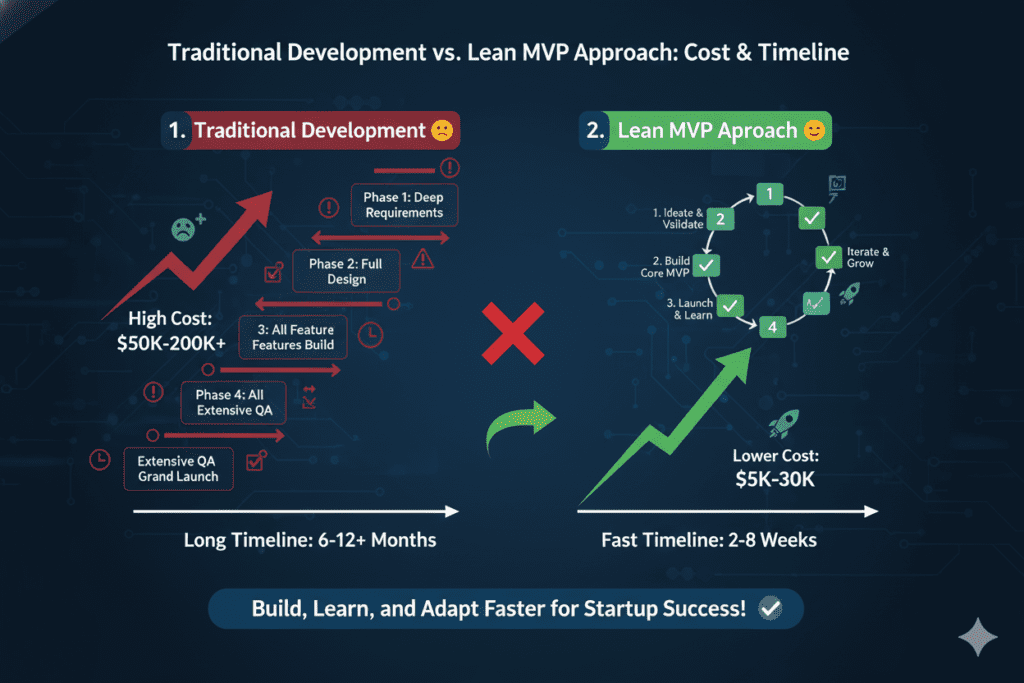
This is where BkAbhi comes in.
How BkAbhi Helps Startups Build Smart MVPs Without Burning Cash
At BkAbhi, we’ve seen it all. Founders who spent $200,000 building an app nobody wanted. Founders who launched with $8,000 and found product-market fit. The difference? Strategy.
Here’s how we approach MVP development cost for startups:
1. Discovery Before Development
Before we write a single line of code, we help you validate your core assumptions. We’ll:
- Review your market research (or help you conduct it)
- Analyze your competition
- Identify your riskiest assumptions
- Map out your MVP roadmap with clear prioritization
- Define success metrics
Investment: Usually 10-15% of total budget, but it saves 40-60% in wasted development.
2. Ruthless Feature Prioritization
We use the MoSCoW method:
- Must have: Features without which the product has no value
- Should have: Important features that can wait for v2
- Could have: Nice-to-haves that most MVPs don’t need
- Won’t have: Features that sound good but distract from core value
Most startups come to us with 20-30 features they think they need. We help them launch with 3-5.
3. Rapid Prototyping and Validation
We build interactive prototypes before development starts. This lets you:
- Test with real users before committing to development
- Validate assumptions cheaply
- Identify UX issues early
- Make changes when they’re cheap (design phase) not expensive (development phase)
4. Iterative Development Sprints
We work in 2-week sprints, delivering working features you can test immediately. This means:
- You see progress constantly
- We can adjust based on feedback
- You’re never investing months without seeing results
- Technical debt stays minimal
5. Modern, Scalable Tech Stack
We use proven technologies that balance speed, cost, and scalability:
- Frontend: React, Next.js for web; React Native for mobile
- Backend: Node.js, Express, or serverless options
- Database: PostgreSQL, MongoDB, or Supabase
- Infrastructure: Vercel, AWS, or Google Cloud
No proprietary frameworks. No vendor lock-in. Clean code you can hand to any developer later.
6. Transparent Pricing and Realistic Timelines
We give you fixed-price packages based on complexity:
- Starter MVP: $25,000 – $40,000 (6-8 weeks)
- Standard MVP: $40,000 – $70,000 (8-12 weeks)
- Advanced MVP: $70,000 – $120,000 (12-16 weeks)
What’s included:
- Discovery and planning
- UX/UI design
- Full-stack development
- Testing and QA
- Deployment
- 30 days post-launch support
- Code documentation and handoff
No hidden fees. No scope creep. Just honest, transparent pricing for your MVP development cost.
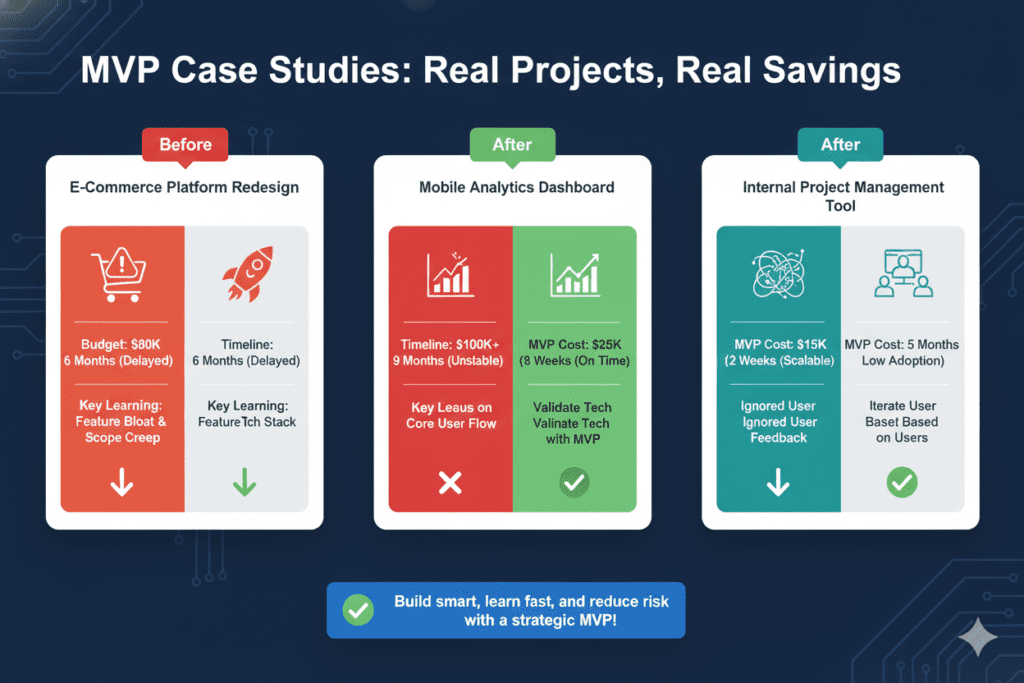
Real-World MVP Development Cost Examples: What Did Successful Startups Actually Spend?
Let’s look at some real examples to make this concrete:
Case Study #1: SaaS Project Management Tool
Problem: A founder wanted to build a project management tool specifically for creative agencies.
Initial plan: 18 features, native iOS and Android apps, custom design, 6 months timeline, $180,000 budget.
Our approach: We helped them focus on the core workflow — task assignment, time tracking, and client communication. Web-only first. Simple but clean design.
Actual build: 5 core features, web app, 10 weeks, $42,000
Result: Launched to 20 beta users. Got critical feedback that changed the product direction. Raised $500K seed round based on traction. Now rebuilding with proper budget and validation.
MVP development cost for startups lesson: Starting small let them learn fast and cheap. The original plan would’ve burned their entire runway before learning anything.
Case Study #2: Healthcare Appointment Booking
Problem: A doctor wanted a HIPAA-compliant telemedicine platform.
Challenge: Compliance requirements, video functionality, integration with existing systems.
Our approach: Phase 1 focused on appointment booking and patient management. Video consultations came later after validating demand.
Cost breakdown:
- Planning and compliance research: $8,000
- Custom secure design: $12,000
- Backend with HIPAA compliance: $35,000
- Frontend development: $28,000
- Security testing: $10,000
- Total: $93,000
Timeline: 14 weeks
Result: Live with 3 pilot clinics. Processed 200+ appointments in first month. Now expanding features based on real usage data.
Case Study #3: Marketplace for Freelance Designers
Problem: A non-technical founder wanted to connect designers with small businesses.
Our approach: Started with a simple two-sided marketplace — designers could create profiles, businesses could browse and contact them. No payment processing, no fancy matching algorithms.
Cost breakdown:
- Discovery and user research: $4,000
- UX/UI design: $8,000
- Frontend development (React): $18,000
- Backend development (Node.js + PostgreSQL): $15,000
- Testing and deployment: $5,000
- Total: $50,000
Timeline: 9 weeks
Result: Launched with 30 designers and 50 businesses in beta. Learned that businesses wanted curated matches, not open browsing. Pivoted accordingly. This insight saved them from building the wrong thing at scale.
MVP Development Cost for Startups: Your Action Plan
Here’s your step-by-step roadmap to budgeting and building your MVP:
Step 1: Validate Before You Build (Weeks 1-2)
- Conduct 20-30 customer interviews
- Analyze top 5 competitors
- Create simple landing page to gauge interest
- Budget: $2,000 – $5,000
Step 2: Define Your MVP Scope (Weeks 3-4)
- List all potential features
- Prioritize using MoSCoW method
- Identify technical requirements
- Choose your platform (web/mobile/both)
- Budget: $1,000 – $3,000
Step 3: Create Interactive Prototype (Weeks 5-6)
- Design user flows
- Build clickable prototype
- Test with 10-15 potential users
- Refine based on feedback
- Budget: $5,000 – $15,000
Step 4: Develop MVP (Weeks 7-16)
- Sprint-based development
- Weekly progress reviews
- Continuous testing
- Budget: $20,000 – $100,000 (based on complexity)
Step 5: Launch and Iterate (Weeks 17+)
- Soft launch to beta users
- Collect feedback systematically
- Plan iteration cycles
- Budget: $3,000 – $15,000/month
Total realistic budget for first-time founders: $35,000 – $75,000 including iterations.
Frequently Asked Questions About MVP Development Cost for Startups
How much should a startup spend on an MVP?
Most successful startups spend between $30,000 – $75,000 on their initial MVP, including design, development, and first iterations. The exact amount depends on your industry, technical complexity, mvp development cost for startups and whether you need mobile, web, or both.
Can I build an MVP for $10,000?
Yes, but with significant limitations. At this budget, you’re likely looking at:
- No-code/low-code solutions
- Very basic functionality (3 features max)
- Template-based design
- Web-only
- No custom integrations
This can work for pure validation, but you’ll likely need to rebuild when scaling.
Should I hire freelancers or an agency for my MVP?
Freelancers work well if you’re technical, can manage a team, and have time for oversight. Agencies are better if you want a complete team, faster delivery, and less management overhead. For non-technical founders, agencies typically provide better ROI despite higher upfront costs.
How long does it take to build an MVP?
- Simple MVP: 6-8 weeks
- Medium complexity: 10-14 weeks
- Complex MVP: 16-24 weeks
Beware of agencies promising 4-week MVPs for complex products — they’re either cutting corners or will miss the deadline.
What’s included in MVP development cost?
A complete MVP development cost for startups should include:
- Discovery and planning
- UX/UI design
- Frontend and backend development
- Quality assurance and testing
- Deployment and launch
- Basic documentation
- Post-launch support period
If these aren’t included in your quote, ask why.
Here you can also visit all in one ai tool- Aizolo
Ready to Build Your MVP the Smart Way?
Understanding MVP development cost for startups is just the beginning. The real question is: Are you going to build something that validates your idea, or something that drains your runway?
The founders who succeed aren’t always the ones with the best ideas. They’re the ones who validate fastest, learn cheapest, and iterate smartest.
At BkAbhi, we help startups ship MVPs that matter.
We’ve helped founders:
- Launch MVPs in 8-12 weeks instead of 6 months
- Cut development costs by 40-60% through smart prioritization
- Achieve product-market fit faster with continuous iteration
- Raise seed rounds based on validated traction, not just ideas
Whether you’re a first-time founder with a tight budget or an experienced entrepreneur looking to move fast, we can help you navigate the MVP development cost for startups maze.
Start building smarter with BkAbhi.
Explore more insights on BkAbhi
Read more expert guides on BkAbhi about building successful MVPs
Let’s turn your idea into a validated product that users love — without burning your entire budget.
Key Takeaways: MVP Development Cost for Startups
Before you start your MVP journey, remember:
- Budget realistically: $30,000 – $75,000 for most first MVPs, including iterations
- Validate before building: 20% of budget on pre-development saves 60% on pivots
- Build minimum, not mediocre: Focus on core value, not feature count
- Choose the right team: Specialized MVP agencies often deliver better ROI than freelancers
- Plan for iterations: Reserve 30-40% of budget for post-launch improvements
- Start with one platform: Web-only or mobile-only first, expand after validation
- Use existing tools: Don’t build what you can integrate
- Measure everything: Define success metrics before launch
The most successful startups aren’t the ones with the biggest budgets. They’re the ones who spend wisely, learn quickly, and iterate relentlessly.
Your MVP isn’t your final product. It’s your learning tool.
Make it count.
Ready to discuss your MVP? Follow BkAbhi for practical tech & startup insights and learn from founders who’ve been exactly where you are now.