
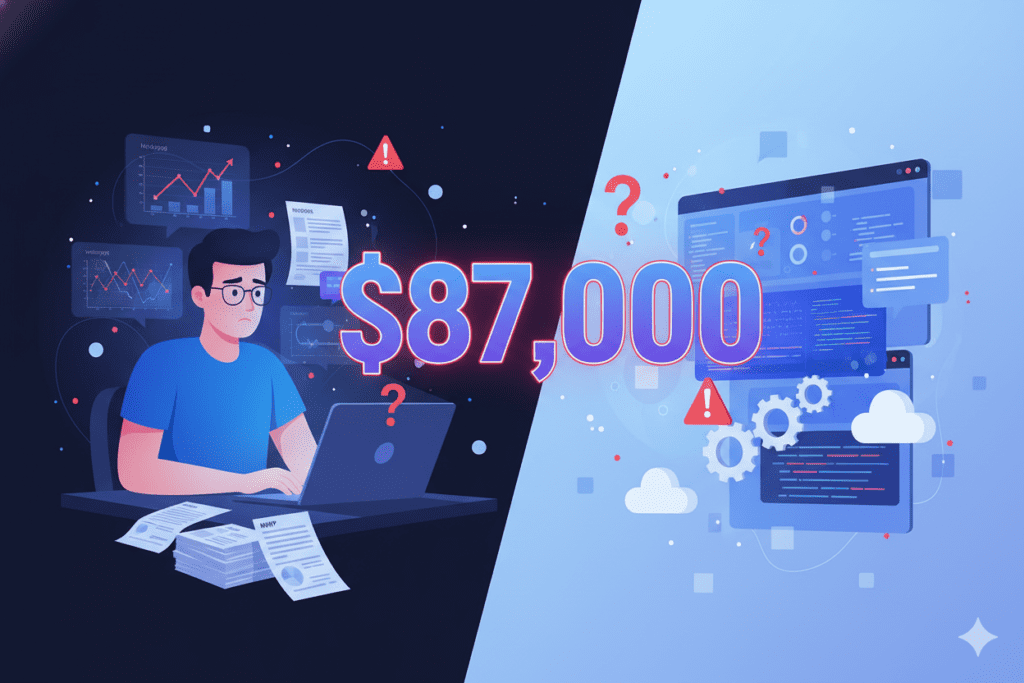
It was 11 PM when Marcus closed his laptop, his hands shaking slightly. He’d just received the final invoice from his development agency: $127,000. His original budget? $50,000.
“We had to add authentication,” they explained. “And the API integrations took longer than expected. Plus, you wanted it to look professional, right?”
Marcus had no idea what he’d actually signed up for. Three months later, his MVP still wasn’t launched, his runway was nearly gone, and he was scrambling to explain to investors why he’d spent their seed money on features he couldn’t even name.
Sound familiar?
If you’re wondering about the cost to build MVP in 2026, you’re asking the right question—but you’re probably not asking it at the right time. Most founders focus on the price tag when they should be asking: “What am I actually paying for, and how do I avoid bleeding money on things that don’t matter?”
The truth is, understanding the cost to build MVP in 2026 isn’t just about budgeting. It’s about survival.
Why the Cost to Build MVP in 2026 Isn’t What You Think

Let me be brutally honest: there’s no “one size fits all” answer to the cost to build MVP in 2026.
You’ll see agencies quoting $15,000 for a “basic MVP” and consultancies charging $200,000+ for what looks like the same thing. But here’s what nobody tells you upfront—the wide range isn’t because someone is ripping you off. It’s because most founders don’t actually know what they’re building until they’re halfway through.
According to recent industry data, the average cost to build MVP in 2026 falls between $25,000 and $90,000 for most startups. But that’s like saying the average house costs between $200,000 and $800,000—technically true, but practically useless without context.
The Real Breakdown: Understanding Cost to Build MVP in 2026
Here’s what actually determines your cost to build MVP in 2026:
Pre-Development Phase ($3,000 – $15,000) Before a single line of code gets written, you need clarity. Market research, competitor analysis, user story mapping, and technical architecture planning aren’t “optional extras”—they’re the foundation that prevents you from rebuilding everything three months in.
Design and Prototyping ($5,000 – $30,000) This is where founders either save themselves or doom their project. A well-designed prototype isn’t about making things “look pretty”—it’s about validating user flows before you pay developers to build them. Teams that invest 15-20% of their MVP budget here are three times less likely to require major rewrites.
Core Development ($20,000 – $100,000) This is where 60-70% of your budget goes. The cost to build MVP in 2026 at this stage depends on:
- Platform choice: Web apps are typically 30-40% cheaper than native mobile apps
- Feature complexity: Real-time features, AI integrations, or payment processing can double development time
- Technology stack: Modern frameworks like React and Node.js offer faster development than legacy systems
- Team location: Developers in India or Southeast Asia cost $30-60/hour; in the US or Western Europe, expect $100-200/hour
Testing and Quality Assurance ($5,000 – $25,000) Cutting corners here is the fastest way to kill your MVP before launch. Poor user experience due to bugs costs you far more than proper QA.
Post-Launch (15-20% of development cost yearly) Your cost to build MVP in 2026 doesn’t end at launch. Plan for hosting, monitoring, bug fixes, and iterative improvements based on user feedback.
The Hidden Costs That Inflate Your Cost to Build MVP in 2026
(Image prompt: Iceberg illustration showing visible MVP costs above water and much larger hidden costs below the surface)
Rachel thought she’d nailed her budget. $40,000 for development, $10,000 buffer. Done.
Except nobody mentioned:
- The $3,000/month AWS bill when her app went viral on Product Hunt
- The $8,000 emergency payment gateway integration because the first one didn’t support her use case
- The $12,000 redesign when early users said the interface was “confusing”
- The $15,000 in developer time just fixing bugs that could have been caught with proper QA
Her “buffer” evaporated in week three.
Here are the hidden costs that most estimates conveniently forget when calculating the cost to build MVP in 2026:
1. Third-Party Services and APIs
Authentication systems, payment processors, analytics tools, email services—these aren’t one-time costs. Budget $200-1,000/month minimum.
2. Infrastructure Scaling
That $50/month hosting plan? It becomes $500/month the moment you get real traffic. And if your developer chose the wrong architecture, scaling costs can spiral out of control.
3. Compliance and Security
Processing payments? Storing user data? You need SSL certificates, data encryption, privacy compliance, and security audits. Add $5,000-20,000 depending on your industry.
4. Communication Overhead
Working with freelancers across time zones? That “quick call” becomes a 3-day email thread. Misalignment costs money—expect 10-15% overhead just on communication.
5. Iteration and Pivot Costs
Your first version will be wrong. Budget 20-30% of your initial development cost for the first round of changes based on real user feedback.
The smartest founders don’t look for the lowest cost to build MVP in 2026—they look for transparent pricing that accounts for these realities upfront.
What Makes BkAbhi Different When It Comes to Cost to Build MVP in 2026
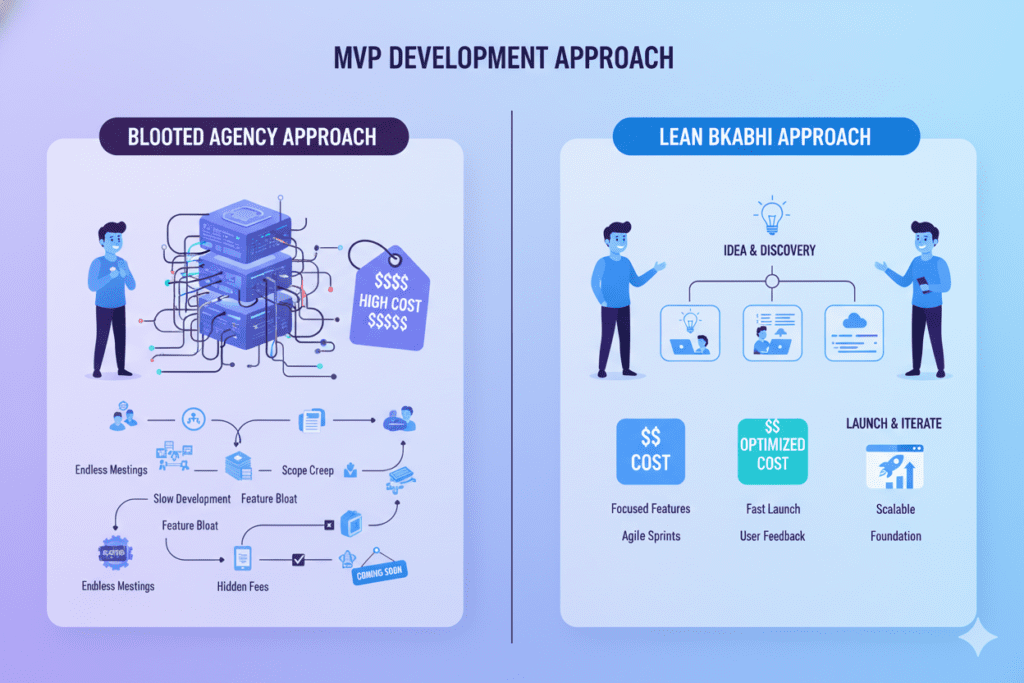
Here’s something most agencies won’t tell you: they have an incentive to make your MVP bigger, more complex, and more expensive. More features = more billable hours = bigger paychecks.
At BkAbhi, we’ve built our entire approach around a different philosophy: ship fast, learn fast, scale smart.
Founded by Abhijeet Kumar (bkabhi), a full-stack developer who’s been in the trenches building MVPs for founders just like you, BkAbhi understands something critical: the cost to build MVP in 2026 isn’t just about the money you spend—it’s about the runway you preserve for iteration.
The BkAbhi Approach to Managing Cost to Build MVP in 2026
1. Ruthless Feature Prioritization We don’t start with “what features do you want?” We start with “what problem are you solving, and what’s the absolute minimum needed to validate that solution?” This single mindset shift typically cuts development costs by 30-40%.
2. Battle-Tested Tech Stack We don’t experiment with trendy frameworks on your dime. We use proven, modern technologies that balance speed, scalability, and cost-effectiveness. React for frontend, Node.js or Python for backend, PostgreSQL or MongoDB for databases—choices that get you to market fast without boxing you in later.
3. Transparent Pricing, No Surprises When we quote the cost to build MVP in 2026, we break down exactly what you’re paying for at each stage. No hidden fees, no “oh by the way” surprises three weeks in.
4. Built-in Iteration Budget We factor in the reality that your first version will need adjustments. Our pricing includes post-launch support to fix issues and implement learnings from your first 100 users.
5. Focus on Validation, Not Perfection Your MVP isn’t meant to be your final product. It’s a learning tool. BkAbhi helps you build something good enough to test your hypothesis without wasting months pursuing pixel-perfect polish nobody asked for.
Real-World Examples: Cost to Build MVP in 2026 Across Different Use Cases
(Image prompt: Grid layout showing different types of MVPs with their associated cost ranges and timelines)
Let’s get specific. Here’s what the cost to build MVP in 2026 looks like for different types of products:
Simple Web App MVP: $18,000 – $35,000
Timeline: 6-8 weeks Example: Task management tool, basic CRM, simple booking system
What’s included:
- User authentication and profiles
- Core CRUD operations (Create, Read, Update, Delete)
- Basic admin dashboard
- Responsive web design
- Essential integrations (email, notifications)
Real scenario: Sarah wanted to build a freelancer management tool for small agencies. BkAbhi helped her ship an MVP in 7 weeks for $28,000 that included client onboarding, project tracking, and basic invoicing. Within two months, she had 50 paying customers validating her concept.
SaaS Platform MVP: $45,000 – $85,000
Timeline: 10-14 weeks Example: Multi-tenant SaaS, analytics dashboard, B2B platform
What’s included:
- Multi-user authentication with role-based access
- Data visualization and reporting
- Third-party API integrations
- Payment processing
- Basic automation workflows
Real scenario: A fintech startup came to BkAbhi to build a cash flow forecasting tool for small businesses. The cost to build MVP in 2026 came to $62,000 for a fully functional platform that integrated with accounting software, displayed real-time projections, and handled subscription billing. They secured seed funding three months after launch.
Mobile App MVP: $35,000 – $75,000
Timeline: 10-16 weeks Example: Social app, marketplace, on-demand service
What’s included:
- Cross-platform development (iOS + Android)
- Real-time features (chat, notifications)
- Location services
- Media handling (photos, videos)
- Backend API
Smart approach: Unless you absolutely need native performance, cross-platform frameworks like React Native can cut costs by 40% compared to building separate iOS and Android apps.
AI-Powered MVP: $70,000 – $150,000+
Timeline: 14-20 weeks Example: Recommendation engine, chatbot, content generation tool
What’s included:
- AI/ML model integration
- Training data preparation
- Complex backend architecture
- Real-time processing
- Advanced security measures
Reality check: AI features sound impressive but dramatically increase the cost to build MVP in 2026. Unless AI is your core differentiator, consider starting with simpler rule-based logic and adding AI in version 2 after you’ve validated demand.
How Founders Actually Reduce Cost to Build MVP in 2026 (Without Sacrificing Quality)

The smartest founders we work with at BkAbhi don’t look for “cheap” MVPs—they look for strategically lean MVPs. Here’s how they do it:
Strategy 1: Start With a Single User Journey
Instead of building for multiple user types, focus on one persona completing one critical task. You can always add complexity later.
Example: An education startup wanted to build a platform for teachers, students, and parents. BkAbhi convinced them to start with just the teacher experience—creating and sharing lesson plans. Cost savings: $35,000. Time savings: 8 weeks.
Strategy 2: Use Pre-Built Modules and APIs
Why rebuild authentication, payment processing, or email systems from scratch? Leverage services like Auth0, Stripe, and SendGrid.
Cost impact: Reduces development time by 20-30%, directly cutting your cost to build MVP in 2026.
Strategy 3: Choose the Right MVP Type for Your Stage
Not all MVPs need code:
- Concierge MVP: Manually deliver your service to first customers (cost: minimal)
- Wizard of Oz MVP: Fake the automation, deliver manually behind the scenes (cost: $5,000-15,000)
- Single-Feature MVP: Build only one feature exceptionally well (cost: $15,000-40,000)
- Full Functional MVP: Complete but minimal product (cost: $40,000-90,000)
BkAbhi’s recommendation: Start as low-tech as possible. Validate demand before investing in automation.
Strategy 4: Fix Scope Creep Before It Starts
Here’s a framework we use at BkAbhi called the “Must-Have, Should-Have, Could-Have, Won’t-Have” method:
- Must-Have: Core functionality. Without this, your product doesn’t work.
- Should-Have: Important features that can come in version 1.1
- Could-Have: Nice-to-haves for future iterations
- Won’t-Have: Features you’re explicitly cutting (for now)
Reality check: 70% of “must-have” features founders list are actually “should-haves” or “could-haves.” This discipline alone can reduce your cost to build MVP in 2026 by $20,000-50,000.
Strategy 5: Choose the Right Development Model
Your team structure dramatically affects cost:
Freelancer Platform ($10,000-30,000):
- Pros: Cheapest option
- Cons: High risk, coordination nightmare, often need to rebuild
Offshore Agency ($25,000-70,000):
- Pros: Balanced cost-to-quality ratio
- Cons: Time zone challenges, potential communication gaps
Boutique Studio like BkAbhi ($40,000-90,000):
- Pros: Direct founder involvement, accountability, strategic guidance
- Cons: Higher upfront cost than freelancers
US/European Agency ($80,000-200,000+):
- Pros: Premium quality, local communication
- Cons: Unnecessarily expensive for most MVPs
BkAbhi’s take: For most early-stage startups, a boutique studio offers the best balance—experienced enough to guide strategy, lean enough to move fast, and affordable enough to preserve runway.
The Biggest Mistake That Inflates Cost to Build MVP in 2026

Want to know the single biggest reason founders overspend on MVPs?
They confuse “minimum viable” with “minimum impressive.”
You’re not building to wow investors (yet). You’re not building to blow away users with polish. You’re building to answer one question: Will people pay for this solution?
At BkAbhi, we’ve seen founders spend $100,000 building elaborate onboarding flows, sophisticated admin dashboards, and gorgeous animations—only to discover users wanted something completely different.
Meanwhile, other founders ship “ugly” MVPs in 4 weeks for $20,000, get 100 paying customers in the first month, and use that revenue and feedback to build version 2 the right way.
The BkAbhi “Good Enough” Philosophy
When you work with BkAbhi, we’ll push back on feature creep. Hard. We’ll challenge every “wouldn’t it be cool if” and every “we should probably include.”
Not because we’re lazy—because we’ve seen too many brilliant founders run out of money before they reach product-market fit.
The cost to build MVP in 2026 isn’t just about the dollar amount. It’s about what percentage of your runway you’re burning before you have real market data.
Smart allocation:
- 40% on initial MVP build
- 30% on marketing and customer acquisition
- 30% on iteration based on feedback
Dumb allocation:
- 80% on initial MVP build
- 10% on launching
- 10% on panic when nothing’s left for iteration
When to Raise Your Cost to Build MVP in 2026 Budget (And When to Lower It)
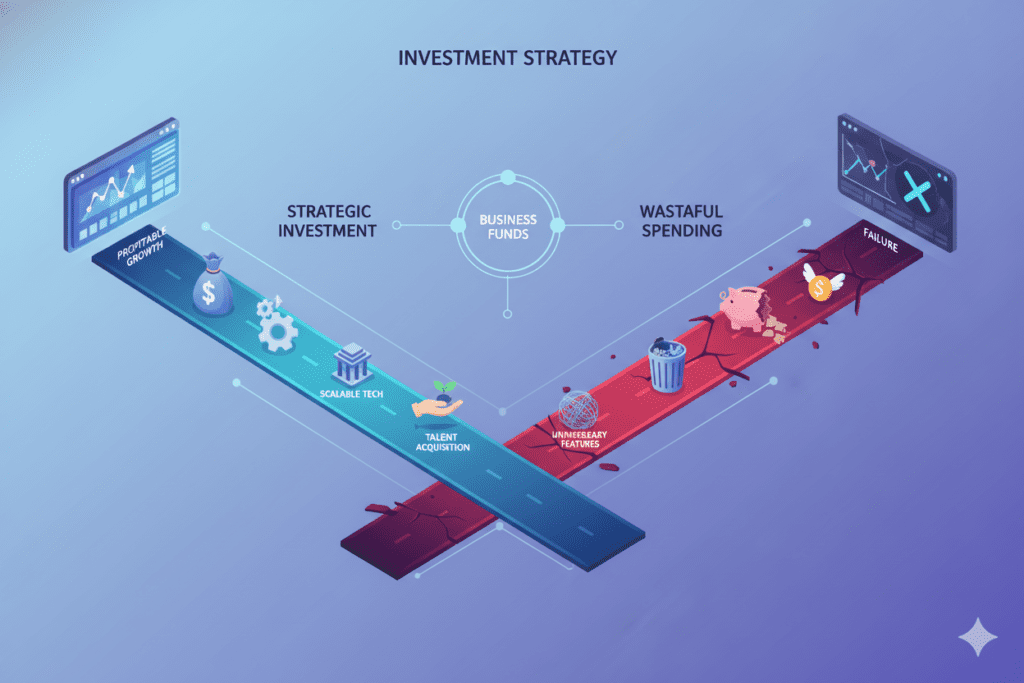
Invest More When:
1. Your Industry Has High Compliance Requirements Building a fintech, healthcare, or educational product? Security, privacy, and regulatory compliance aren’t optional. Budget 20-30% more for proper implementation.
2. You Need Technical Differentiation If your competitive advantage IS the technology (proprietary algorithm, unique architecture), cutting corners kills your value proposition. Allocate more for robust, scalable infrastructure.
3. You’re in a Competitive Market Launching into a crowded space? You need to nail user experience from day one. Polish matters more when users have 10 alternatives.
Spend Less When:
1. You’re Testing a Market Hypothesis If your primary question is “do people want this?” you don’t need beautiful code. You need fast answers.
2. Your Moat Isn’t Technical If you’re winning on relationships, process, or content—not technology—your MVP can be simpler and cheaper.
3. You’re Pre-Product-Market Fit Don’t optimize for scale when you don’t even know if anyone wants what you’re building. Start scrappy, scale strategically.
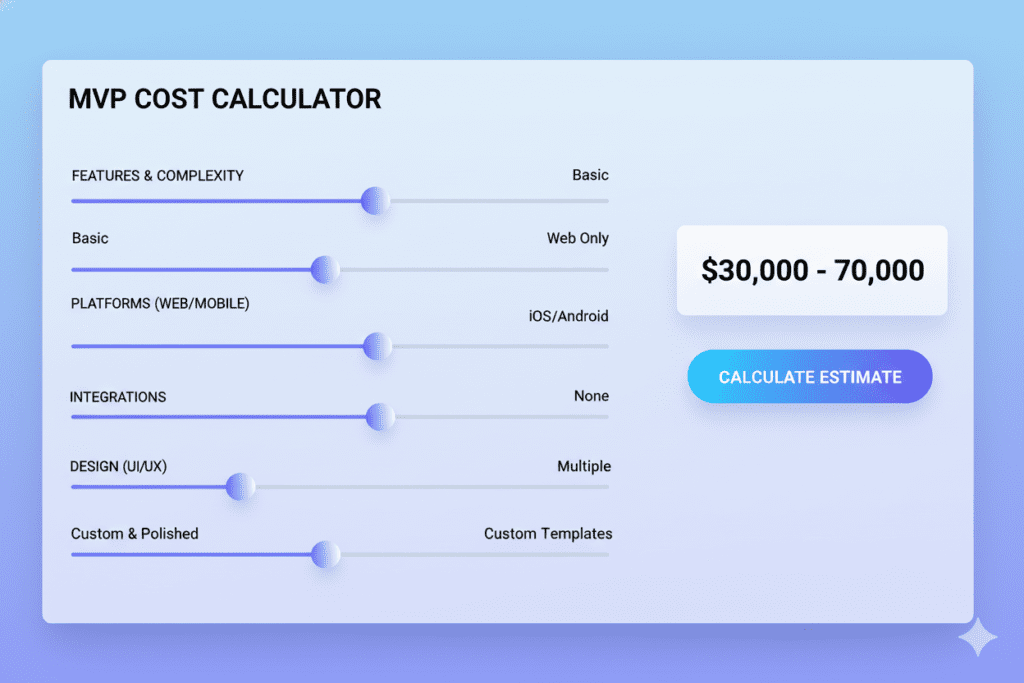
Your MVP Cost Calculator: Estimating Your Real Cost to Build MVP in 2026
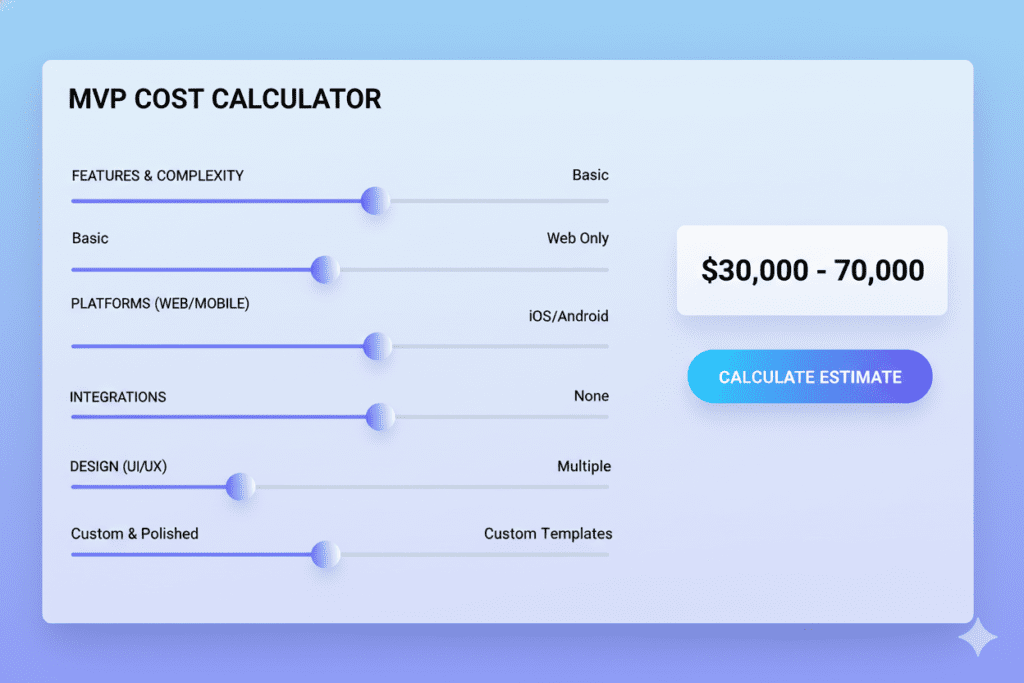
Use this framework to estimate your cost to build MVP in 2026:
Base Complexity:
- Simple (booking, CRUD operations): $20,000-40,000
- Medium (SaaS, marketplace): $40,000-80,000
- Complex (AI, real-time, multi-sided): $80,000-150,000+
Add for:
- Mobile app (vs web only): +40%
- Real-time features: +$15,000-30,000
- Payment processing: +$8,000-15,000
- AI/ML integration: +$30,000-70,000
- Complex data visualization: +$10,000-25,000
Multiply by location factor:
- India/Southeast Asia: 0.6x
- Eastern Europe: 0.8x
- Latin America: 0.85x
- Western Europe: 1.3x
- US/Canada: 1.5x
Add buffers:
- Pre-development (research, planning): +15%
- Post-launch support (3 months): +20%
- Contingency for surprises: +10-15%
The BkAbhi Promise: Transparent Cost to Build MVP in 2026
Here’s what you get when you partner with BkAbhi to understand and manage your cost to build MVP in 2026:
✅ Fixed-Price Proposals – No hourly billing surprises ✅ Phased Milestones – Pay as you validate progress ✅ Scope Protection – Clear documentation of what’s in/out ✅ Technical Guidance – Not just coding, but strategic product advice ✅ Post-Launch Support – Because launching isn’t the finish line ✅ Honest Timelines – We’d rather underpromise and overdeliver
Real Results from BkAbhi Founders:
“We came in with a budget of $80K and a dream. BkAbhi helped us ship an MVP for $52K that actually worked. Six months later, we’re at $15K MRR.” — Priya, SaaS Founder
“After burning $40K with a freelancer who disappeared, BkAbhi rebuilt our MVP in 8 weeks for $35K. The difference? They actually cared about our success.” — James, EdTech Founder
“I thought I needed a $100K+ MVP to compete. BkAbhi showed me how to validate for $30K first. Best decision I made.” — Maria, Marketplace Founder
Your Next Steps: Making Smart Decisions About Cost to Build MVP in 2026
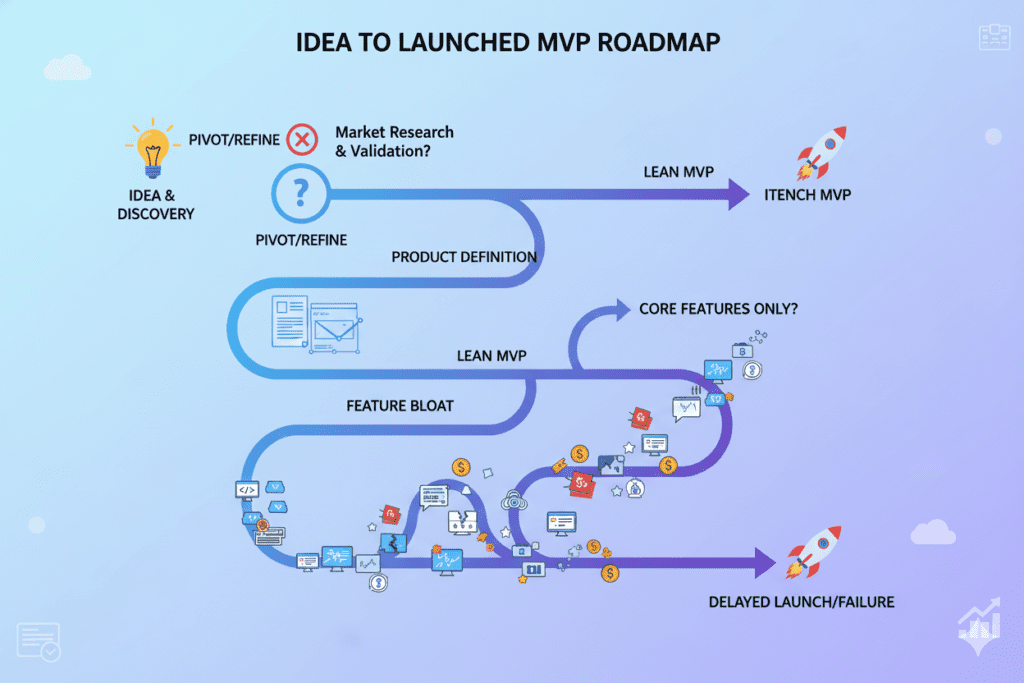
Understanding the cost to build MVP in 2026 is just the first step. Here’s what successful founders do next:
Step 1: Validate Before You Build
Talk to 20-30 potential users. Understand their pain points. Confirm they’d pay for a solution. Don’t skip this—it’s the cheapest form of validation.
BkAbhi offers: Free problem-solution fit consultation to help you validate your idea before spending a rupee on development.
Step 2: Define Your Learning Goals
What do you need to learn from your MVP? “Will people use it?” “Will they pay?” “How much will they pay?” “What features matter most?” Your learning goals determine your feature set.
Step 3: Get Multiple Estimates
Don’t just shop for price—shop for understanding. The best development partner asks hard questions about your business, not just about your features.
Red flags:
- ❌ Instant quotes without understanding your goals
- ❌ Promises of “industry-standard MVP” without customization
- ❌ Reluctance to discuss post-launch support
- ❌ Portfolio full of pretty mockups, light on launched products
Green flags:
- ✅ Questions about your target users and business model
- ✅ Suggestions to cut features, not add them
- ✅ Transparent breakdown of costs and timelines
- ✅ Examples of MVPs that actually reached customers
Step 4: Plan Your Full Journey
Your cost to build MVP in 2026 is just the beginning. Map out:
- Months 1-3: Build and launch
- Months 4-6: Gather feedback and iterate
- Months 7-12: Scale what’s working
- Year 2+: Build for growth
Budget accordingly. The smartest founders preserve 50%+ of their capital for post-MVP iteration.
Final Thoughts: The True Cost to Build MVP in 2026
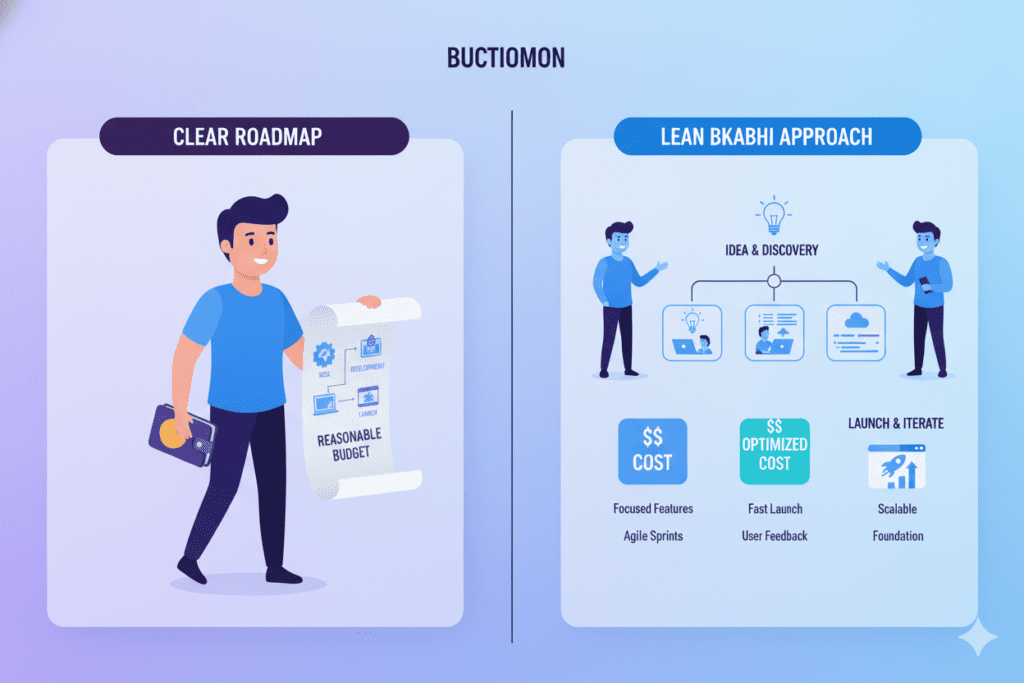
Here’s what I want you to take away from this guide:
The cost to build MVP in 2026 ranges from $15,000 to $150,000+ depending on complexity, team, and approach. But the number matters less than how you approach the build.
The founders who succeed aren’t the ones who spend the least or the most. They’re the ones who:
- Validate demand before building
- Ruthlessly prioritize features
- Choose partners who care about their success
- Preserve runway for iteration
- Ship before they’re “ready”
At BkAbhi, we’ve helped hundreds of founders navigate these decisions. We’ve seen MVPs built for $200,000 that failed and MVPs built for $25,000 that became million-dollar businesses.
The difference was never the budget. It was the clarity, focus, and strategic thinking behind it.
Ready to build your MVP the right way?
Explore more insights on BkAbhi and discover proven frameworks for turning your idea into a launched product without burning through your runway.
Book a free MVP strategy call where we’ll help you:
- Identify your true MVP scope
- Estimate your realistic cost to build MVP in 2026
- Map out a clear path from idea to launch
- Avoid the costly mistakes 90% of founders make
Learn from real-world experience at BkAbhi — because your MVP shouldn’t be where your startup story ends. It should be where it begins.
Frequently Asked Questions About Cost to Build MVP in 2026
Q: What’s the minimum cost to build MVP in 2026? A: The absolute minimum for a professionally built MVP is around $15,000-20,000 for very simple web applications. However, be cautious of anything significantly cheaper—it often means corners are being cut that you’ll pay to fix later.
Q: How long does it take to build an MVP in 2026? A: Most MVPs take 8-16 weeks from kickoff to launch, depending on complexity. Simple MVPs can ship in 4-6 weeks; complex ones may take 4-6 months. At BkAbhi, our average is 10 weeks.
Q: Should I hire freelancers or an agency for my MVP? A: It depends on your risk tolerance and budget. Freelancers are cheaper ($10K-30K) but riskier. Agencies offer more accountability but cost more ($40K-200K+). BkAbhi sits in the middle—boutique studio quality with founder-friendly pricing ($30K-90K).
Q: What percentage of my funding should go toward MVP development? A: A safe rule: allocate no more than 40% of your capital to the initial MVP build. Reserve 30% for customer acquisition and 30% for iteration. Running out of runway before you can iterate is a common death spiral.
Q: Can I build an MVP for under $10,000? A: Yes, but not through traditional development. Consider concierge MVPs (manual delivery), no-code tools (Bubble, Webflow), or wizard-of-oz MVPs (fake automation). These validate demand cheaply before investing in proper development.
Q: How do I know if I’m overpaying for my MVP? A: Warning signs include: vague scope definitions, hourly billing without caps, reluctance to show similar projects, pushing for unnecessary features, or quotes significantly higher than industry averages without clear justification.
Q: What’s included in BkAbhi’s MVP development cost? A: Our pricing includes discovery and planning, UI/UX design, full-stack development, quality assurance testing, deployment, 30 days of post-launch support, and documentation. No hidden fees, no surprise charges.
Q: Is the cost to build MVP in 2026 higher than in previous years? A: Developer rates have increased 10-15% since 2024 due to high demand for AI and specialized skills. However, modern frameworks and tools have also improved productivity, often offsetting these increases. The net effect is roughly flat to slightly higher.
Start building smarter with BkAbhi — where your MVP costs reflect your actual needs, not inflated agency overhead.
Suggested Internal Links:
- MVP Development Roadmap for Non-Technical Founders – For founders without technical backgrounds looking to understand the full development process
- How to Build a SaaS MVP in 4 Weeks – For readers interested in rapid MVP development timelines
- Micro SaaS Development Cost – For founders considering smaller-scope SaaS products
- Hire MVP Developer vs Agency – For readers weighing different team structures
- How to Validate Your Startup Idea with an MVP – For founders earlier in their journey
Suggested External Links:
- CB Insights – Why Startups Fail – Authoritative data on startup failure rates
- Y Combinator Startup Library – Building Your MVP – Trusted startup advice from top accelerator
- AWS Startup Credits Program – Resource for managing infrastructure costs
- Stripe Atlas – Trusted payment processing and incorporation resource
- Product Hunt – Platform for launching and validating MVPs
- GitHub – Open Source Projects – Resource for leveraging open-source code in MVPs